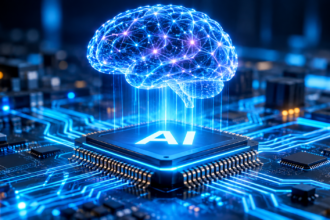
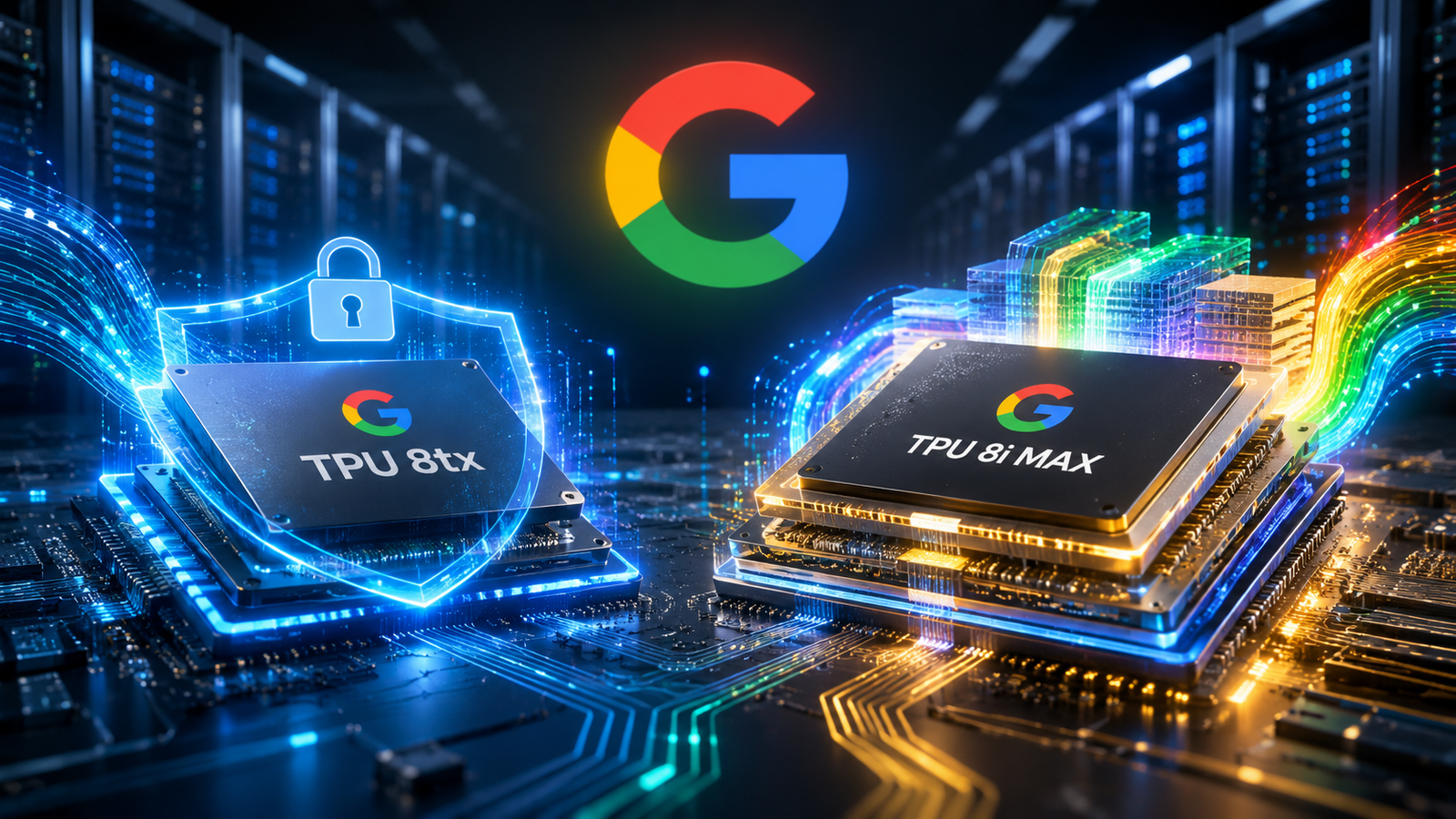
Alphabet’s Google on Monday introduced two specialized versions of its in-house Tensor Processing Units, intensifying competition with Nvidia in the rapidly growing market for artificial intelligence accelerators. The new systems, named TPU 8tx and TPU 8i Max, expand Google’s eighth-generation TPU portfolio and mark the first time the company has launched four distinct TPU systems in a single year.
Google’s TPUs have long powered internal services such as Search, YouTube, and the Gemini AI models. In recent years the company has increasingly offered the chips to external customers through Google Cloud, helping drive strong growth in that business. TPU-related sales contributed meaningfully to Google Cloud’s results in the September quarter, when the unit’s revenue more than doubled to $30.71 billion.
The new chips are tailored redesigns rather than entirely new silicon generations. The TPU 8tx targets government agencies and companies in heavily regulated industries that must protect sensitive data during processing. It pairs Google’s TPU technology with AMD processors and implements hardware-level encryption, keeping data protected even while it is being computed. Google says the system delivers up to twice the speed of the previous comparable version with virtually no performance trade-off. It is optimized for secure inference and can also handle smaller-scale training workloads.
The TPU 8i Max, by contrast, is engineered for AI applications that require processing very large amounts of information simultaneously. By combining two chips into a single package, it provides significantly more memory and computing power in the same physical footprint. This design addresses the so-called “memory wall” that can limit performance when multiple AI agents work across large codebases, long videos, or complex reasoning tasks. Google positions it as particularly well suited for coding assistants, mathematical reasoning, and drug-discovery applications.
Together with the earlier TPU 8t (focused on large-scale training) and TPU 8i (focused on low-latency inference), the new systems give customers purpose-built options across the full AI lifecycle from model training to secure deployment and high-context agentic workloads.
The move underscores Google’s determination to reduce reliance on Nvidia’s dominant GPUs and to capture a larger share of the booming enterprise AI infrastructure market. As demand for specialized AI compute continues to surge, custom silicon such as Google’s TPUs is becoming an increasingly important competitive battleground.