
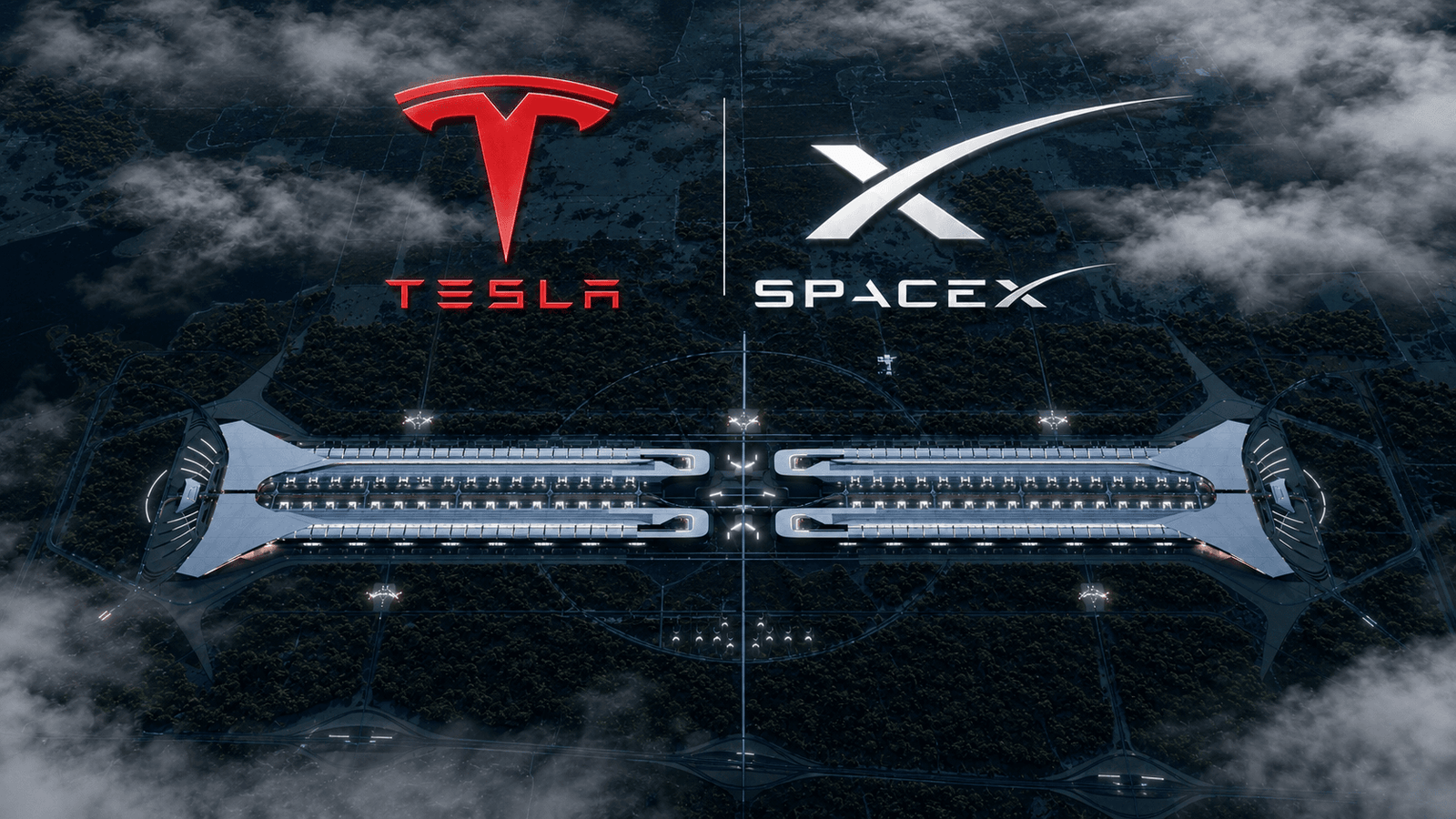
Project Terafab is a joint semiconductor manufacturing initiative led by Tesla and SpaceX (with xAI integrated under SpaceX and partnership support from Intel). Elon Musk announced it in March 2026 as a response to projected chip shortages that would constrain his companies’ AI, robotics, and space ambitions.
Terafab: Core Goal and Ambition
Terafab targets production of more than 1 terawatt (TW) of AI compute capacity per year—orders of magnitude beyond current global output (often cited by Musk as roughly 20 GW annually for AI-related chips).
It focuses on two main chip categories:
- Edge/inference processors optimized for Tesla hardware such as Optimus humanoid robots and self-driving Cybercabs/vehicles.
- High-power, space-hardened chips for SpaceX’s planned orbital data centers and AI satellites.
The project emphasizes full vertical integration—chip design, logic fabrication, memory production, advanced packaging, testing, and related processes under one roof. This setup aims to enable rapid iteration cycles without the delays of shipping wafers between specialized facilities.
As per recent statement of Elon Musk, Terafab will be 50 times the size of the Pentagon when complete
Terafab Texas will be the largest and most valuable building on Earth by far.
— Elon Musk (@elonmusk) August 6, 2026
And it will be stunningly beautiful. pic.twitter.com/4NweOqTL7y
Partners and Technology
Tesla leads the research/prototype efforts. SpaceX takes primary responsibility for the full-scale facility. Intel contributes manufacturing process expertise and technology, including plans to use its advanced 14A (approximately 1.4 nm) node once mature.
A smaller research fab broke ground in April 2026 on the North Campus of Giga Texas in Austin as a precursor for testing ideas and processes (initially targeted at a few thousand wafers per month).
Location and Physical Scale
The full-scale complex is confirmed for Grimes County, Texas (near the Gibbons Creek Reservoir, roughly an hour northwest of Houston / east of College Station). Announcement of the site and initial investment details came on August 6, 2026.
Planned manufacturing space exceeds 100 million square feet (up to about 110 million sq ft or 10 million m² in full build-out), described by Musk as potentially the largest and most valuable building on Earth. The site leverages the reservoir for industrial water needs rather than local groundwater. Local incentives include property tax abatements and a $30 million Texas Enterprise Fund grant.
Investment, Jobs, and Status
- Initial phase capital investment: approximately $16.8 billion from Tesla and SpaceX.
- Earlier projections ranged higher ($55 billion initial phase, up to $119 billion across all phases in some filings).
- Expected permanent jobs: at least 3,000 (many local to Grimes and Brazos counties).
As of early August 2026, site confirmation is complete, tax agreements are advancing, and civil/foundation work is expected to begin nearly immediately. Full operational timelines remain ambitious and subject to the usual challenges of semiconductor fab construction (tooling, cleanrooms, skilled labor, power, and supply-chain constraints).
Strategic Context
Musk has framed Terafab as essential because existing suppliers (even with expansion) cannot meet the volume required for millions of Optimus robots, large robotaxi fleets, and space-based solar-powered AI infrastructure. The project aims for domestic supply-chain resilience, faster recursive improvement in chip design and manufacturing, and support for the broader vision of large-scale AI deployment both on Earth and in orbit.
It represents one of the most ambitious single manufacturing undertakings in the semiconductor sector, combining extreme scale with an unusual degree of vertical integration. Realizing the full 1 TW annual target will require overcoming substantial technical, capital, and logistical hurdles.