
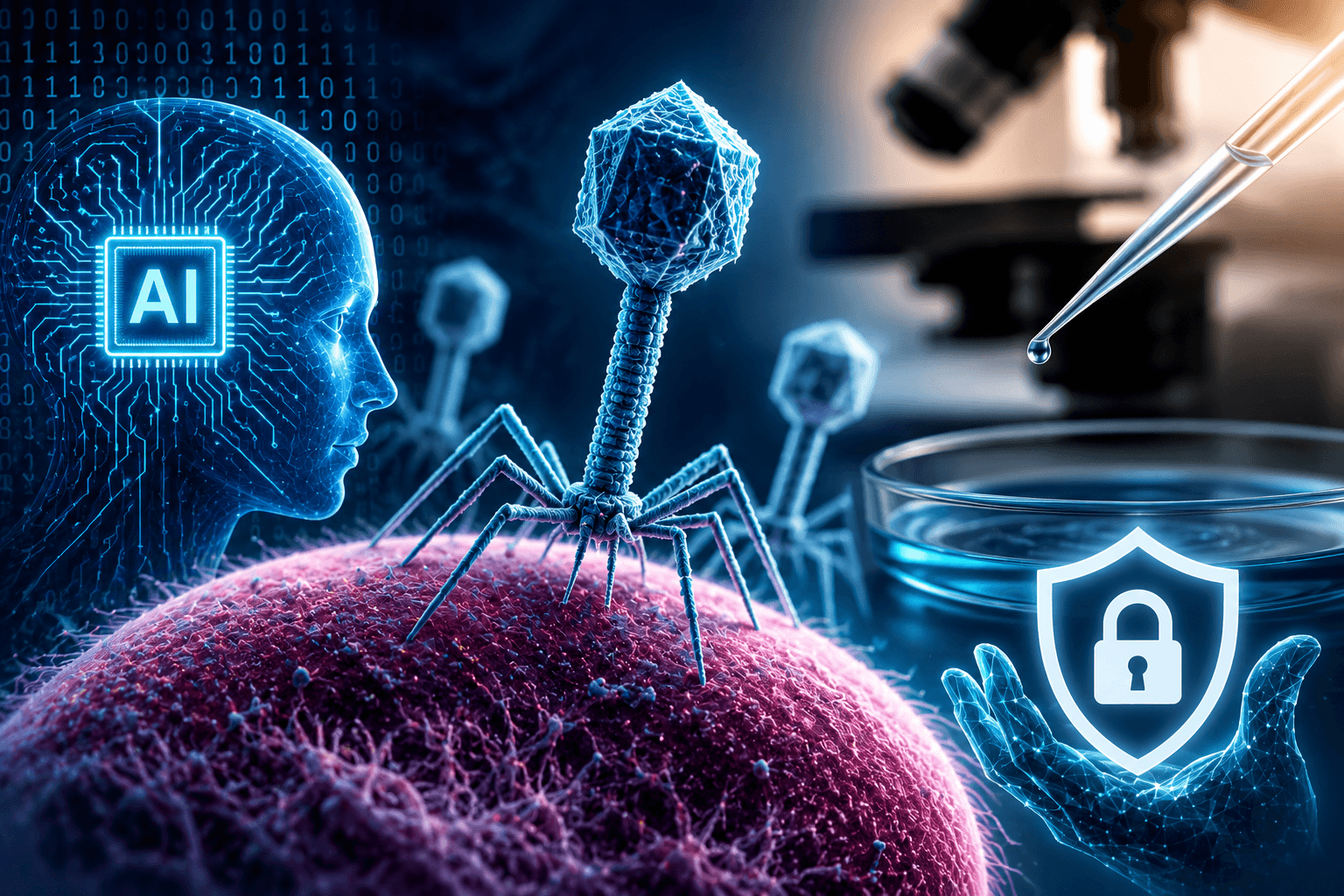
Artificial intelligence has now crossed another scientific milestone. Researchers have successfully used generative AI to design functioning viruses in the laboratory for the first time, marking a breakthrough that could transform medicine while simultaneously raising serious questions about biosafety and global governance.
The study, published in Science, demonstrates how AI can move beyond generating text or images to creating entirely new biological designs.
What Exactly Did Scientists Create?
The AI-designed viruses are bacteriophages, commonly called phages—viruses that infect only bacteria, not humans or animals.
Phages have been used for decades in phage therapy, an emerging treatment for patients suffering from bacterial infections that no longer respond to antibiotics.
Researchers led by Dr. Brian Hie of Stanford University employed advanced genome language models, called Evo 1 and Evo 2, to design completely new phage genomes. Unlike ChatGPT, which predicts words, genome language models predict sequences of DNA.
To reduce misuse risks, the AI models were trained on genetic information from nearly 2 million bacteriophages, while intentionally excluding viruses capable of infecting humans, animals or plants.
How the Experiment Worked
The AI generated thousands of possible viral genomes.
Scientists selected nearly 300 designs and synthesized them in the laboratory.
Only 16 produced viable bacteriophages—highlighting that AI-generated biology still requires extensive laboratory validation.
When combined into a therapeutic cocktail, these AI-designed phages successfully destroyed antibiotic-resistant Escherichia coli (E. coli) bacteria that had already developed resistance to naturally occurring bacteriophages.
This suggests AI could eventually help scientists design customized phages capable of overcoming bacterial resistance far more rapidly than traditional discovery methods.
Why This Matters
The breakthrough arrives at a critical time.
According to the World Health Organization, antimicrobial resistance (AMR) is one of the world’s biggest public-health threats. As bacteria become resistant to antibiotics, researchers are searching for entirely new treatment approaches.
AI-designed bacteriophages could allow doctors to:
- Develop personalized treatments for resistant infections
- Design phages against newly emerging bacterial strains
- Accelerate drug discovery
- Expand synthetic biology and biotechnology research
Instead of searching nature for suitable viruses, scientists may someday design them on demand.
The Biosecurity Challenge
While the medical promise is enormous, researchers emphasized that the same technology raises equally significant security concerns.
The study proves that generative AI can create functional viral genomes.
Although the current work involved only harmless bacteriophages, experts warn that similar techniques must never be applied to viruses capable of infecting humans, animals or crops without strict oversight.
Scientists from the Johns Hopkins Center for Health Security noted that AI can now compose viral genomes, but global governance has not yet caught up with this capability.
Rather than focusing only on AI models, experts recommend a layered safety framework including:
- Responsible AI development
- Independent biosecurity reviews
- DNA synthesis screening
- Strict laboratory biosafety standards
- International oversight for synthetic biology research
Many governments are already strengthening DNA screening systems to prevent the unauthorized synthesis of dangerous pathogens.
AI and Biology Enter a New Era
This development comes amid a broader wave of AI-driven scientific breakthroughs. Over the past year, AI has helped discover new materials, accelerate drug development, solve longstanding mathematical problems, and improve protein design. AI is increasingly becoming a research partner rather than simply a software tool.
The successful design of functional bacteriophages demonstrates that AI is beginning to contribute directly to biological engineering.
Looking Ahead
AI-designed viruses are not a new pandemic threat, nor are they evidence that dangerous pathogens are being created. The research focused exclusively on bacteriophages that attack bacteria and intentionally excluded human-infecting viruses from AI training.
Nevertheless, the achievement marks a turning point. AI can now assist in designing living biological systems, opening exciting opportunities for medicine while demanding stronger international safeguards.
The future of synthetic biology will likely depend not only on how powerful AI becomes, but also on how responsibly humanity governs its use.