
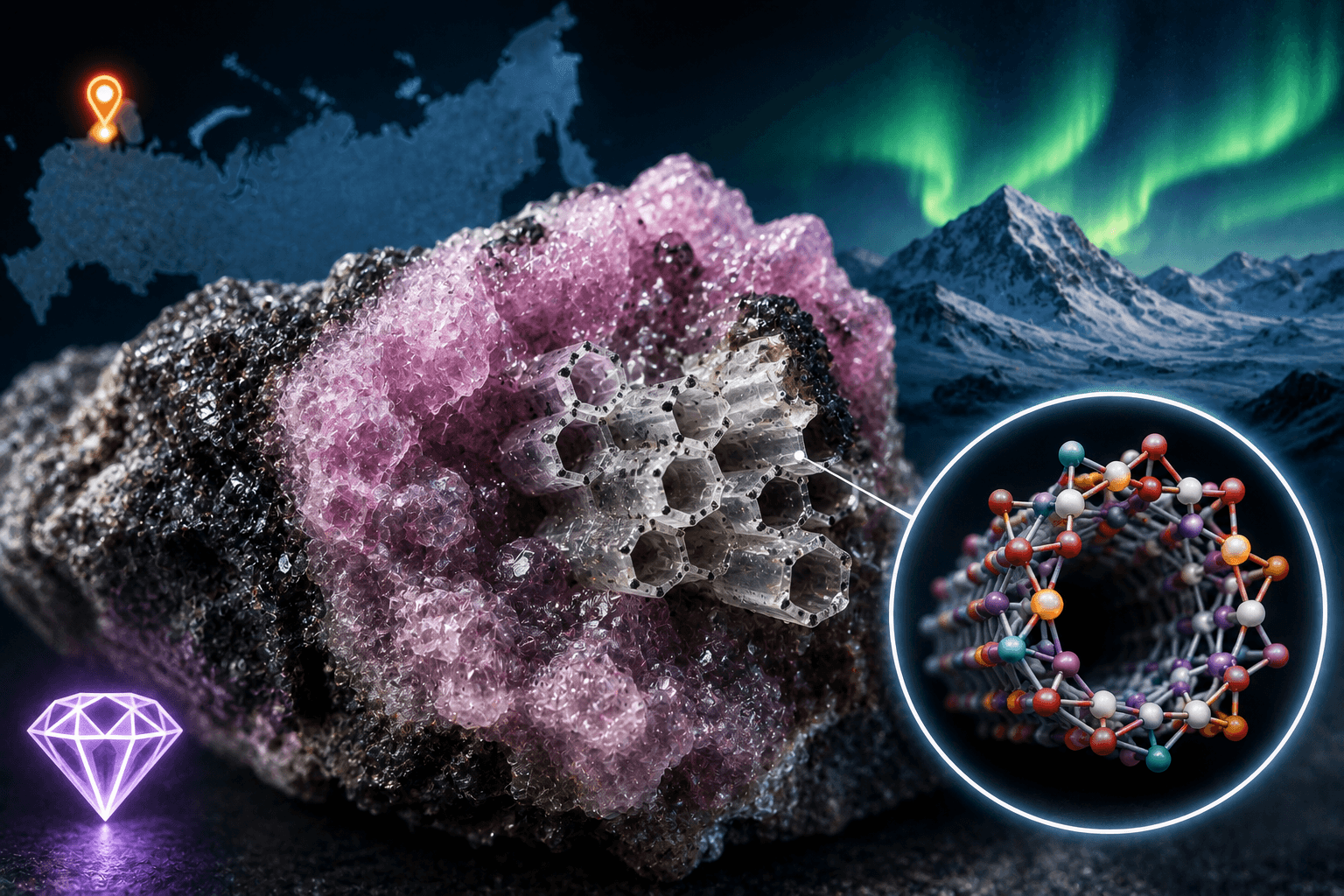
In August 2026, Russian scientists announced the discovery of an unusual mineral phase known as Kola Ashcroftine at the Kirovsky Mine in the Khibiny Massif on Russia’s Kola Peninsula. The discovery quickly gained attention after reports claimed the mineral’s collector value could reach around $145 per millimeter of mineral coating, making headlines that it was “more valuable than gold.” While that comparison is eye-catching, the real scientific significance lies in its extraordinary crystal structure rather than its commercial value.
Where Was Kola Ashcroftine Found?
Kola Ashcroftine was identified by researchers from:
- Kola Science Centre (Russian Academy of Sciences)
- St. Petersburg State University
- A.E. Fersman Mineralogical Museum
The Khibiny Massif is already one of the world’s richest mineral regions, containing hundreds of rare mineral species and significant deposits of rare-earth elements (REEs).
What Makes Kola Ashcroftine Special?
Kola Ashcroftine belongs to the rare ashcroftine mineral family, first identified nearly a century ago. The newly studied Kola variety displays an exceptionally complex internal crystal architecture.
Its most remarkable feature is a network of silicate nanotubes only about 2 nanometers wide. These microscopic tubular structures are built from interconnected silicon-oxygen tetrahedra and contain multiple chemical elements within the same lattice.
Researchers found it contains:
- Yttrium
- Silicon
- Potassium
- Sodium
- Calcium
- Manganese
- Fluorine
- Carbonate groups
- Water molecules
Because so many elements coexist in one stable structure, scientists describe the mineral as a “chemical archive” that records the geological evolution of Earth’s crust.
Why Is Everyone Talking About Its Price?
Many headlines highlighted that Kola Ashcroftine is supposedly worth more than gold.
This requires important context.
The reported $145 per millimeter does not represent the value of bulk mineral ore. Instead, it reflects the potential collector value of extremely rare mineral coatings sold to museums, researchers, and high-end mineral collectors.
The mineral occurs only as:
- Thin surface coatings
- Tiny crystals
- Extremely limited specimens
It is not economically viable for mining as a commercial source of rare-earth elements.
Scientific Importance
Although it has little industrial value today, Kola Ashcroftine could become highly valuable for research.
Scientists believe its nanotube-like structure may inspire future work in:
- Nanomaterials
- Catalysts
- Ion-exchange materials
- Porous silicate structures
- Advanced materials chemistry
Its intricate crystal lattice is also helping researchers better understand how rare-earth minerals form under extreme geological conditions.
Does It Contain Valuable Rare Earth Elements?
Yes.
The mineral contains yttrium, an important rare-earth element used in:
- Aerospace alloys
- Lasers
- LEDs and phosphors
- Optical systems
- High-performance ceramics
However, the concentration and rarity of Kola Ashcroftine make it unsuitable as an economic source of yttrium. Existing commercial REE deposits remain far more practical.
Will It Become an Official New Mineral?
Researchers are continuing detailed crystallographic and chemical analyses to determine whether Kola Ashcroftine qualifies as a completely new mineral species or should remain classified as a unique variety of ashcroftine-(Y).
Recognition ultimately depends on approval under the International Mineralogical Association (IMA) classification process.
Why This Discovery Matters
Kola Ashcroftine is less about commercial mining and more about expanding scientific knowledge. Its intricate nanotube structure, rare-earth chemistry, and exceptional rarity make it one of the most fascinating mineral discoveries of 2026. While headlines focused on its price, its lasting importance lies in advancing mineralogy, crystallography, and next-generation materials research that could eventually influence nanotechnology and advanced engineering.