
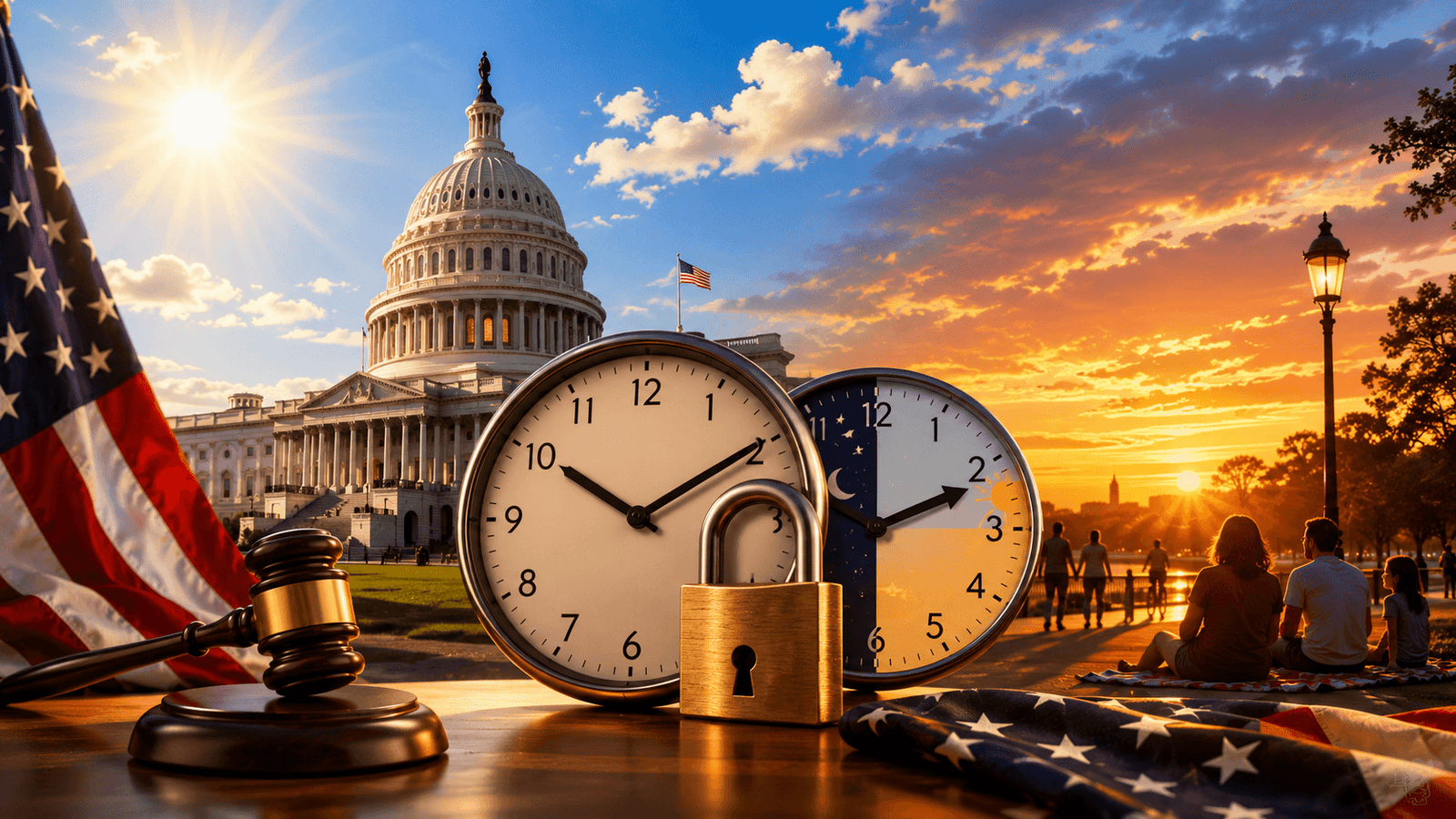
In a major bipartisan breakthrough, the U.S. House of Representatives has approved the Sunshine Protection Act, advancing legislation that would make daylight saving time permanent across most of the United States and eliminate the twice-yearly clock changes that have long frustrated Americans.
The bill passed on July 14 (or 15 IST) in a 308-117 vote, reflecting broad support for ending the seasonal time shifts. It now heads to the Senate, where approval is not yet assured.
What Is the Sunshine Protection Act?
The Sunshine Protection Act would amend federal law to establish daylight saving time (DST) as the new, permanent standard time nationwide. Under the proposal:
- Clocks would no longer “spring forward” in March or “fall back” in November.
- Most states would remain on DST year-round, providing later sunsets in the evenings.
- States could opt out and choose permanent standard time if they prefer (similar to current exemptions in Hawaii and most of Arizona).
Florida Republicans, including Representatives Vern Buchanan (the bill’s lead sponsor), Anna Paulina Luna, and Gus Bilirakis, have driven the latest effort. The legislation builds on years of debate, following earlier versions that passed the Senate in 2022 but stalled in the House. Congress last extended DST in 2005 via the Energy Policy Act, with foundational rules set by the 1966 Uniform Time Act and 1918 Standard Time Act.
President Donald Trump has strongly backed the measure, calling the current practice of changing clocks “ridiculous” and stating that Americans prefer “a longer, brighter day.” He has pledged to work toward signing the bill into law.
Key Arguments For and Against
Supporters highlight several benefits of permanent daylight saving time:
- More evening daylight for recreation, commerce, and outdoor activities.
- Reduced disruptions to sleep and schedules from biannual changes.
- Potential drops in workplace injuries and road accidents associated with clock shifts.
- Economic gains from extended evening hours.
Critics, including Senator Tom Cotton (R-AR), argue that permanent DST would lead to significantly darker winter mornings. In many regions, especially northern states, children could head to school in darkness, with sunrises delayed until nearly 9 a.m. in winter. This raises public safety concerns for commuters, outdoor workers, and families.
Some lawmakers, such as Representative Mary Gay Scanlon (D-PA), instead advocate for permanent standard time, emphasizing that morning light better supports the body’s internal clock, alertness, and natural sleep preparation in the evenings.
Public Opinion and Broader Context
Americans remain divided on the issue. While many appreciate later winter sunsets, the trade-off of darker mornings continues to spark debate among parents, educators, farmers, sleep experts, and health professionals. Studies link even minor clock changes to temporary increases in health and safety risks.
If the Senate passes the bill and it becomes law, the shift could take effect as soon as November 2026, fundamentally altering daily rhythms for millions.
The Sunshine Protection Act represents the most serious recent attempt to resolve a century-old policy debate. Whether it ultimately succeeds will depend on Senate action and ongoing negotiations. For now, the House vote keeps the prospect of permanent daylight saving time alive and moves the U.S. one step closer to stopping the clocks from changing.