
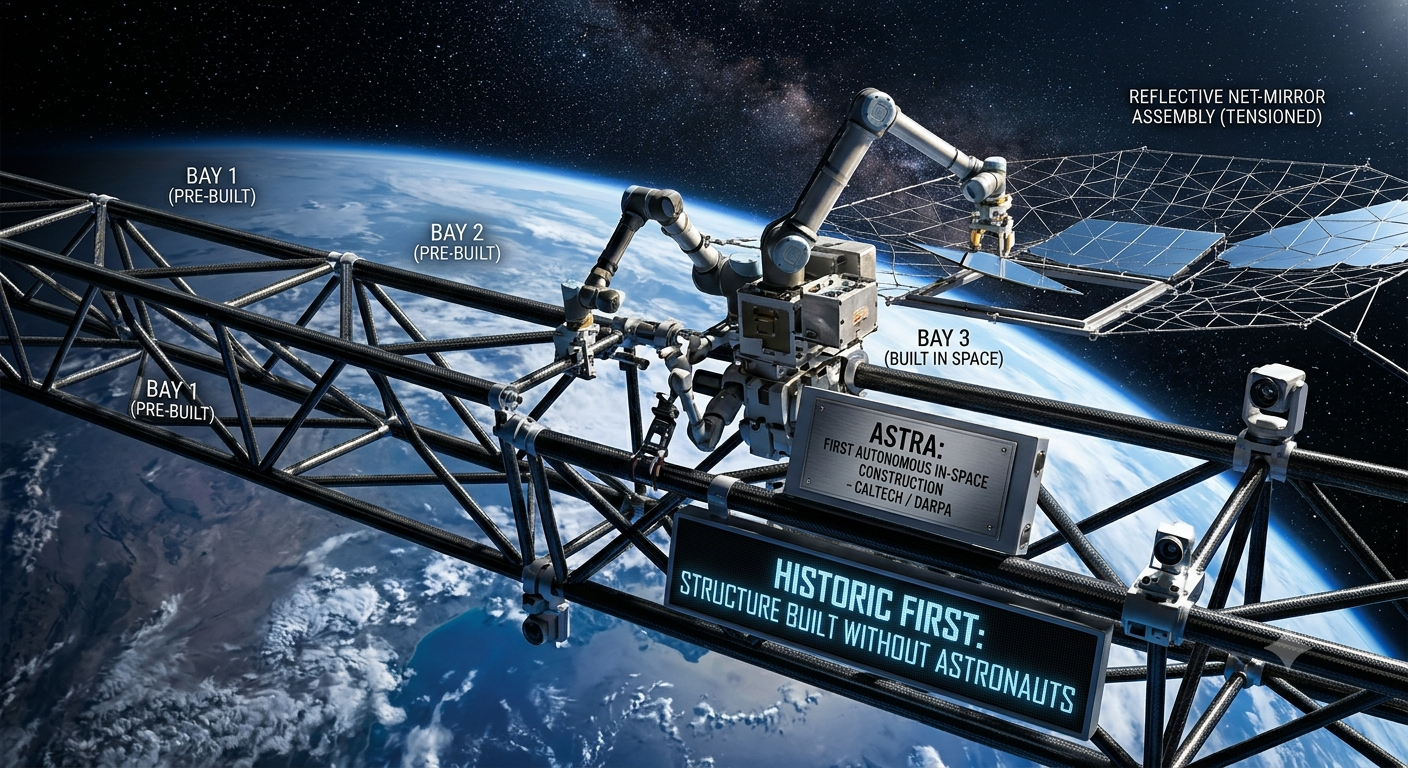
A robot has successfully assembled part of a structure in space without direct human intervention, marking a major step towards autonomous space manufacturing. Developed by researchers at the California Institute of Technology (Caltech) with funding from the US Defense Advanced Research Projects Agency (DARPA), the technology could eventually help build giant telescopes, communication antennas and solar power stations directly in orbit.
The experiment is part of DARPA’s Novel Orbital and Moon Manufacturing, Materials, and Mass-efficient Design (NOM4D) programme, which aims to make large-scale construction beyond Earth possible.
How Does the Caltech Space Construction Robot Work?
The robotic system, called ASTRA (Autonomous In-Space Tensioned Reflector Assembly), uses a robotic arm to collect structural tubes and connecting joints from onboard storage dispensers.
It then joins these components into repeating sections known as bays, forming a supporting framework called a truss. The planned demonstration involves assembling a reflector antenna approximately 1.4 metres across, using composite tubes, aluminium connectors and a lightweight reflective Kapton film.
ASTRA reached orbit on March 30, 2026, aboard SpaceX’s Transporter-16 mission. It travelled on Momentus’s Vigoride 7 orbital vehicle.
Researchers controlled the experiment from Earth, sending instructions to the onboard computer and monitoring construction through photographs transmitted from orbit. Communication opportunities were limited to around seven or eight sessions daily, each lasting approximately 15 minutes.
Why Is Building Structures in Space Important?
Today’s spacecraft are restricted by the dimensions of rocket payload compartments. Engineers generally overcome this limitation by folding structures for deployment in orbit or launching separate components for astronauts to assemble.
Autonomous robotic construction offers another option: transporting materials into orbit and building much larger structures directly in space.
Potential applications include:
- Giant space telescopes: Larger reflective surfaces could collect more light for astronomical observations.
- Advanced communication antennas: Large structures could support powerful communications systems.
- Space-based solar power: Enormous solar arrays could collect sunlight in orbit and potentially transmit energy wirelessly to Earth.
Can Robots Build Kilometre-Scale Structures in Space?
DARPA’s NOM4D programme ultimately targets structures hundreds of metres or even kilometres in size. However, ASTRA has demonstrated only an initial stage of autonomous orbital assembly.
Technical difficulties and scheduling constraints prevented the team from completing the entire 11-bay antenna. Researchers nevertheless consider the successful assembly a proof of concept that opens new possibilities for future missions.
The experiment demonstrates a potentially important shift in space engineering: instead of designing every spacecraft to fit inside a rocket, engineers may eventually send construction materials into orbit and let robots build the infrastructure.
The long-term vision is to turn space from a destination for launched spacecraft into a place where enormous structures can be manufactured and assembled.
Source: SD