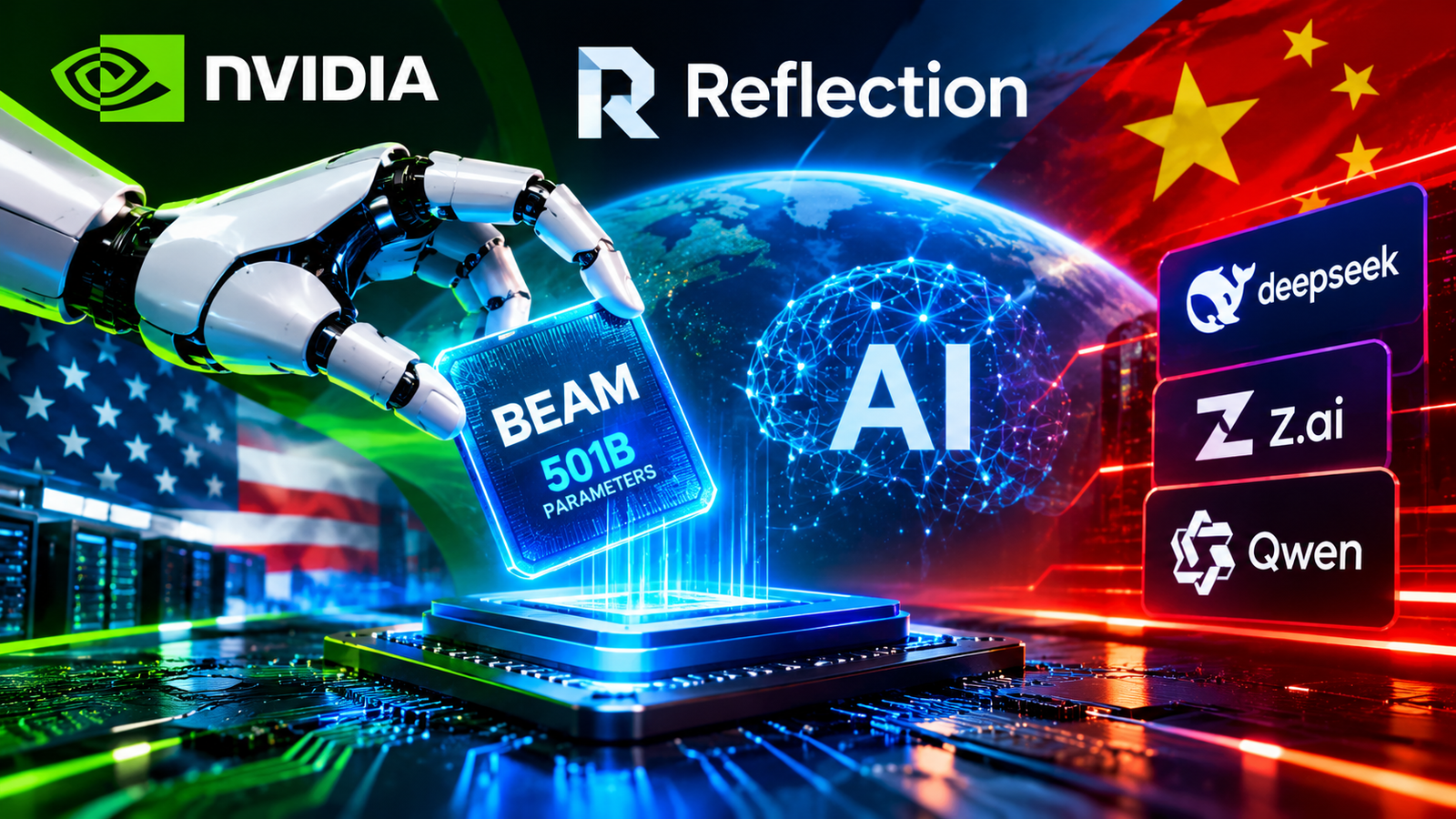
Reflection AI Beam has entered the global AI race with a 501-billion-parameter open-weight model designed to challenge powerful Chinese systems such as DeepSeek, Z.ai’s GLM-5.2 and Alibaba’s Qwen 3.8-Max.
The Nvidia-backed U.S. startup says Beam is particularly focused on coding, reasoning and agentic AI tasks—areas increasingly viewed as the next major battleground after chatbots.
What makes Reflection Beam different?
Beam uses a Mixture-of-Experts (MoE) architecture. Although the model contains 501 billion total parameters, only about 23 billion are activated for each task.
That design is important because running a giant AI model can be extremely expensive. Reflection says Beam can deliver competitive performance while requiring substantially less inference computing than some larger open models.
The company reports that Beam is competitive with GLM-5.2 and approaching Qwen 3.8-Max on coding and agentic workloads. However, these performance comparisons are based largely on Reflection’s own evaluations and should be treated accordingly until independent testing becomes available.
Why this matters in the U.S.-China AI race
Chinese companies have become major forces in open-weight AI, offering models that developers can customize and deploy with greater control than many proprietary systems.
Beam represents a U.S. attempt to close that gap. Reflection was founded in 2024 by former Google DeepMind researchers Misha Laskin and Ioannis Antonoglou, and has attracted major backing, including Nvidia.
The startup is also securing enormous amounts of computing capacity. It has signed agreements involving SpaceX and Nebius to access Nvidia’s advanced AI infrastructure, highlighting how access to compute has become as important as model architecture itself.
Beyond another AI model
Reflection’s bigger ambition is to make AI systems that companies, governments and other institutions can customize around their own data—what it describes as an “AI factory” approach.
The company plans to release Beam’s weights, technical report and developer materials later in October. Until then, its claims remain a closely watched test of whether a U.S. open-weight model can seriously challenge China’s rapidly advancing AI ecosystem.