
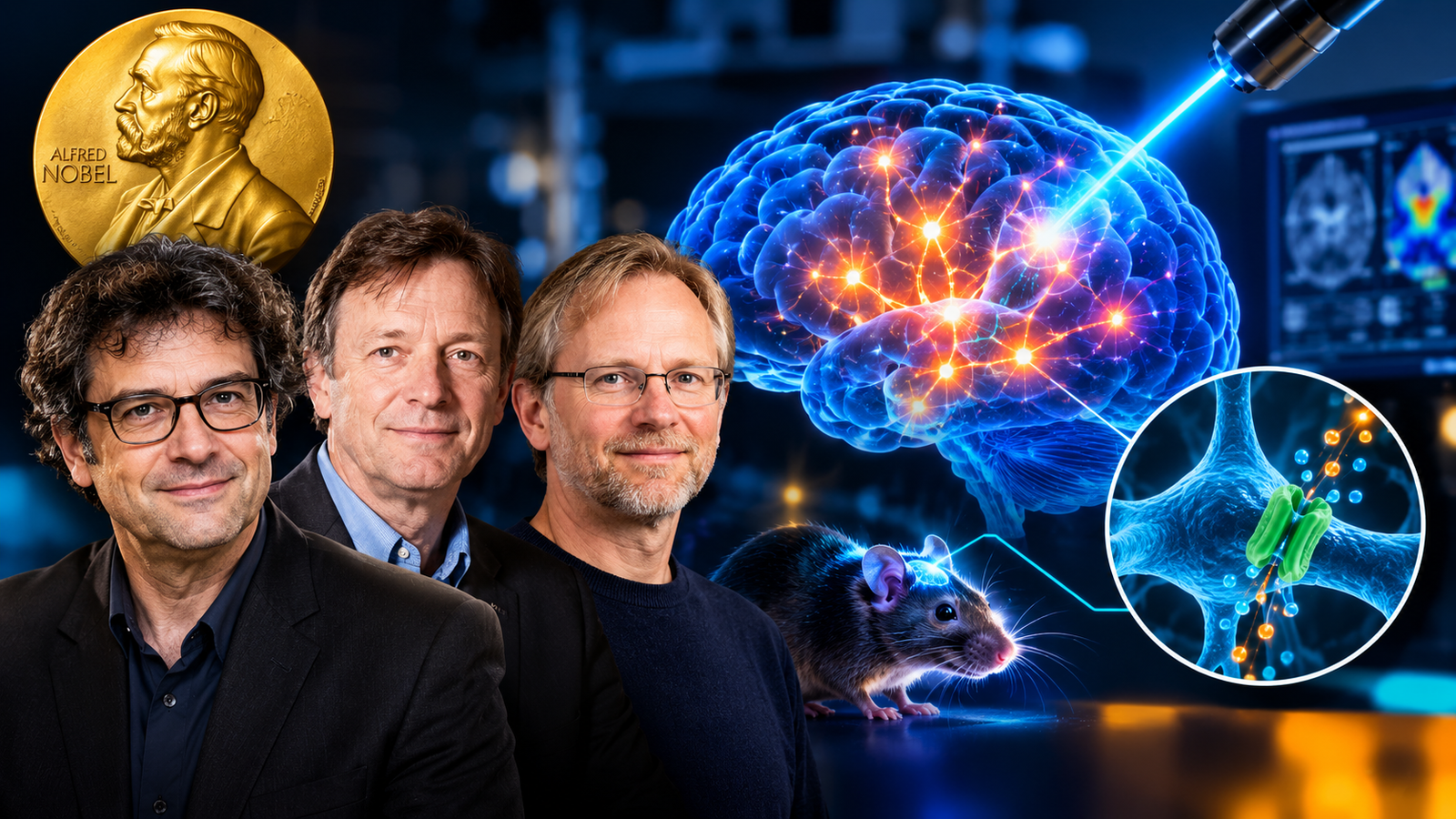
The 2026 Nobel Prize in Physiology or Medicine has been awarded to Karl Deisseroth, Peter Hegemann and Georg Nagel for discoveries concerning light-gated ion channels and optogenetics—a breakthrough that transformed how scientists study the brain.
Their work helped turn light into a precise biological control mechanism, allowing researchers to activate or silence selected nerve cells and investigate how neural circuits influence behaviour.
From algae to the human brain
The story began with an unexpected source: single-celled algae.
Peter Hegemann and Georg Nagel helped uncover channelrhodopsins, light-sensitive proteins found in microorganisms. These proteins function as light-gated ion channels, allowing ions to move across a cell membrane when exposed to light.
The discovery became far more powerful when Karl Deisseroth and collaborators demonstrated that these light-sensitive proteins could be introduced into neurons. Shining specific wavelengths of light could then trigger or suppress electrical activity in targeted nerve cells.
This became the foundation of optogenetics.
Unlike conventional drugs, which can affect many cells and operate relatively slowly, optogenetic methods can target particular neural populations with remarkable temporal precision. Researchers can therefore ask a much more direct question: What happens if this specific group of neurons is switched on—or switched off—right now?
Why it changed neuroscience
For decades, scientists could observe correlations between brain activity and behaviours such as movement, memory, fear and reward. Optogenetics made it possible to test causation more directly.
The technique has become an important research tool for studying conditions including Parkinson’s disease, depression, addiction and other neurological disorders.
It is also moving beyond laboratory research. Recent work has explored optogenetic approaches for restoring vision, although major challenges—including immune responses, light sensitivity and delivery of the technology—remain before widespread clinical use is possible.
Why the Nobel matters now
The award arrives as neuroscience increasingly combines biology, genetics, imaging, artificial intelligence and advanced engineering to decode the brain.
The significance of optogenetics is therefore bigger than simply controlling neurons with light. It provided researchers with a new experimental language for understanding how enormous networks of individual cells produce memory, emotion, movement and behaviour.
The 2026 Nobel recognition highlights a remarkable scientific journey: a light-sensitive protein from a microscopic organism ultimately became one of the most powerful tools for investigating the most complex organ in the human body.