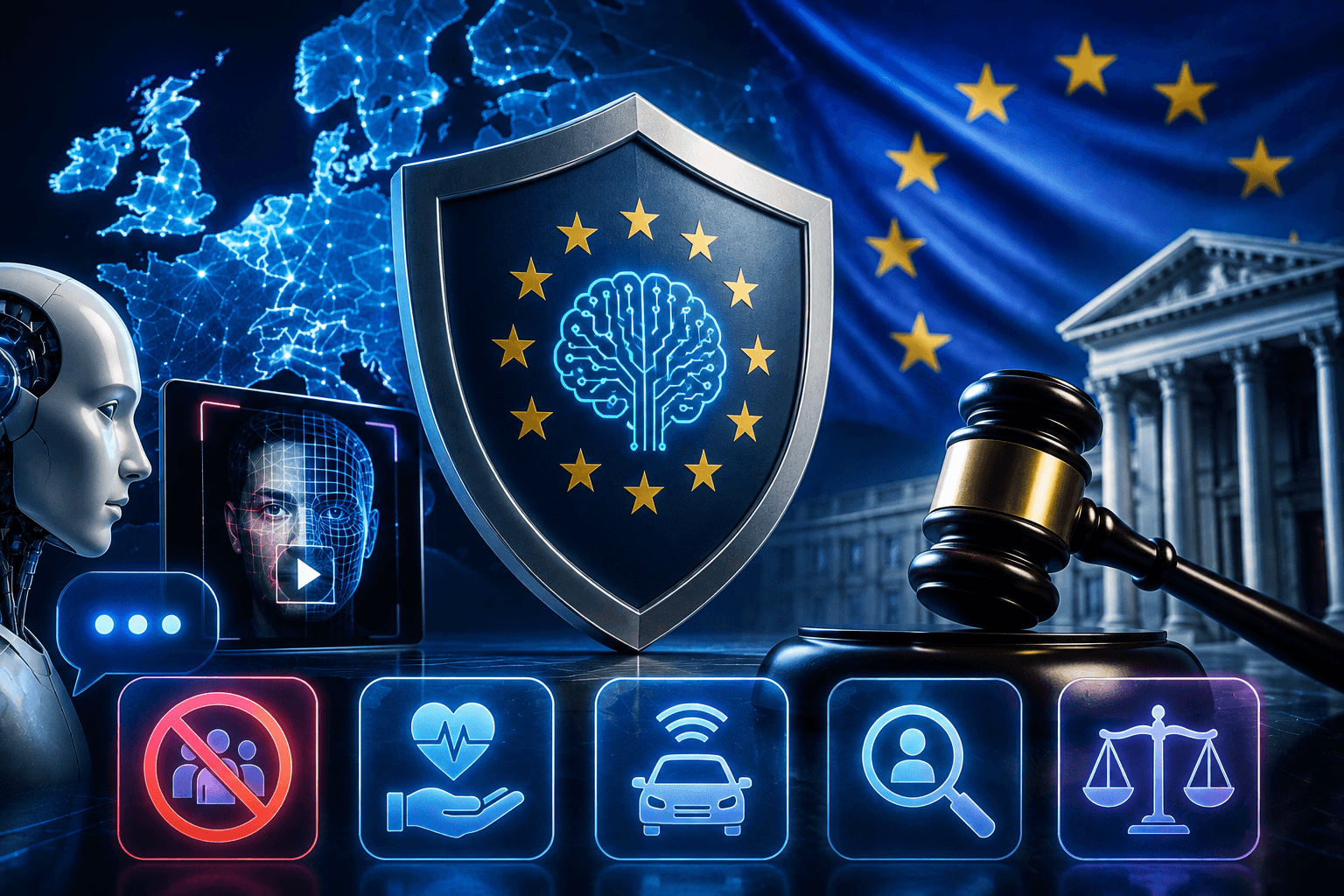
On August 2, 2026, the European Union officially began enforcing key provisions of the AI Act, marking a historic milestone in global AI regulation. Often described as the “GDPR moment for artificial intelligence,” the legislation is the world’s first comprehensive law governing AI systems.
First proposed in 2021, politically agreed in December 2023, and formally adopted in 2024, the AI Act introduces a risk-based framework aimed at making AI safer, more transparent, and accountable while still encouraging innovation.
AI Must Identify Itself
One of the biggest changes affects chatbots and conversational AI.
Companies deploying AI assistants must now clearly inform users that they are interacting with an AI system—not a human. The rule aims to improve transparency and reduce deception in online interactions.
Deepfakes Face New Transparency Rules
The Act also introduces strict requirements for AI-generated images, videos, and audio.
Developers must:
- Clearly label deepfake content.
- Embed machine-readable watermarks.
- Help platforms automatically detect synthetic media.
These measures are intended to combat misinformation, election manipulation, online fraud, and identity deception.
The Four Levels of AI Risk
The EU AI Act classifies AI into four categories:
1. Unacceptable Risk (Banned)
These systems are prohibited because they threaten fundamental rights.
Examples include:
- Social scoring
- Cognitive manipulation
- Predictive policing
- Emotion recognition in schools and workplaces
- Most real-time biometric surveillance
2. High Risk
AI used in sectors such as:
- Healthcare
- Autonomous vehicles
- Critical infrastructure
- Criminal justice
must undergo strict testing, maintain human oversight, and meet rigorous safety standards before deployment.
3. Limited Risk
Systems like:
- Chatbots
- AI assistants
- Image generators
remain legal but must clearly disclose AI involvement.
4. Minimal Risk
Applications such as:
- Spam filters
- AI-powered video games
face little or no regulatory burden.
Powerful AI Models Under Greater Scrutiny
The law also targets General-Purpose AI (GPAI) models capable of performing a wide range of tasks.
Developers must:
- Publish training data summaries.
- Follow copyright rules.
- Share technical documentation with regulators.
- Assess and mitigate systemic risks.
Advanced frontier models capable of enabling cyberattacks, biological threats, or large-scale societal harm will receive additional oversight.
Heavy Penalties for Violations
Companies failing to comply could face multi-million-euro fines linked to their global annual turnover, although smaller penalties apply to SMEs and startups.
Enforcement will be shared between:
- The European AI Office
- National regulators
- The European Data Protection Supervisor (EDPS)
The EU has also launched public complaint and whistleblower channels to report AI-related violations.
What Comes Next?
The AI Act will continue rolling out in phases:
- December 2026: Additional prohibitions targeting non-consensual explicit AI content and child sexual abuse material.
- December 2027: Rules for many high-risk AI systems become applicable.
- August 2028: AI embedded in regulated products (such as certain medical devices and machinery) enters full compliance.
Why It Matters
The EU AI Act is likely to become a global benchmark, much like GDPR reshaped privacy laws worldwide. Any company offering AI products in Europe—including major firms such as OpenAI, Google, Anthropic, Meta, Microsoft, and xAI—must now adapt to its requirements.
As generative AI rapidly transforms industries, Europe is betting that trustworthy AI will become a competitive advantage. Whether other countries adopt similar frameworks remains to be seen, but the AI Act has already positioned the EU as the world’s first major regulator of artificial intelligence.