
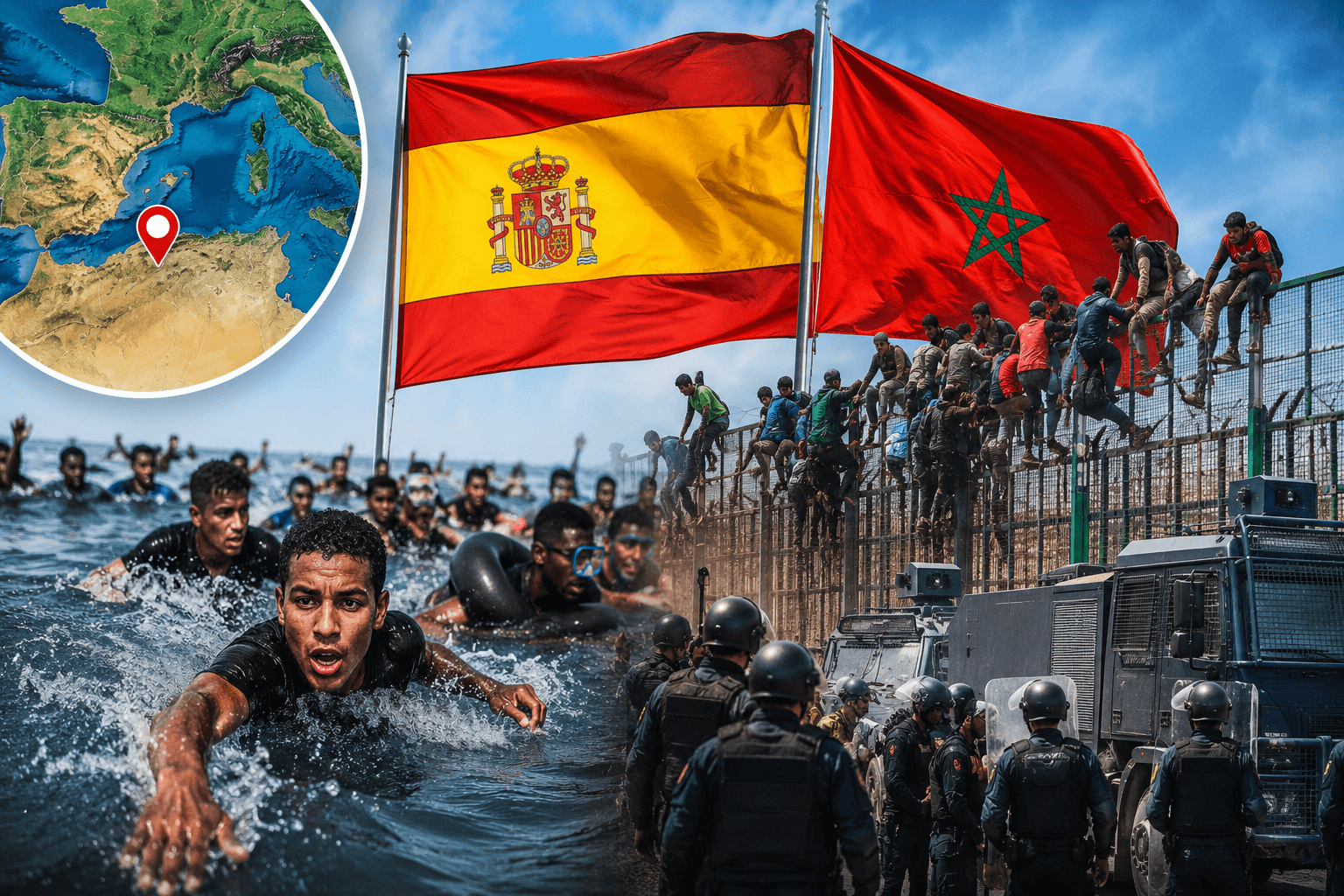
The Mediterranean migration crisis has returned to the global spotlight after one of the largest single-day mass border crossings in recent European history. On 30–31 July 2026, an estimated 49,000 migrants crossed from Morocco into Spain’s autonomous city of Ceuta within just 24 hours, overwhelming security forces and humanitarian facilities. The incident left at least 19 people dead, reigniting debates over illegal migration, EU border security, Schengen rules, and the future of Europe’s migration policy.
What Happened at Ceuta?
Ceuta is a small Spanish territory located on the northern coast of Africa. Together with Melilla, it forms the European Union’s only land border with Africa.
Thousands of migrants—mainly from Morocco and sub-Saharan African countries—attempted to enter Ceuta by:
- Swimming around breakwaters into Spanish territory.
- Climbing border fences.
- Rushing through border gates.
- Using inflatable tubes and makeshift flotation devices.
Videos from the scene showed crowds entering almost continuously, with arrivals reportedly reaching hundreds of people every minute. Temporary shelters quickly exceeded capacity, forcing many migrants to remain in streets and public spaces.
Humanitarian Tragedy
The crossing turned deadly.
Authorities recovered at least 19 bodies from the Mediterranean waters surrounding Ceuta. Most victims are believed to have drowned while attempting the dangerous sea crossing, while others reportedly died during crowd crushes near the border.
The tragedy once again highlights the enormous human cost of irregular migration across the Mediterranean.
Spain and Morocco Respond
Both governments reacted rapidly to prevent further crossings.
Morocco deployed:
- Water cannon vehicles
- Additional border police
- Reinforced security fences
- Coastal patrols
Spain responded by:
- Deploying additional Civil Guard units
- Sending military support
- Increasing naval patrols
- Accelerating identification and deportation procedures where legally possible
Spanish Prime Minister Pedro Sánchez visited Ceuta to assess the situation and coordinate emergency measures.
Why Did the Surge Happen?
No single reason explains the unprecedented influx, but several factors likely contributed.
1. Spanish Court Ruling
Earlier in July 2026, Spain’s Supreme Court restricted the use of immediate “hot returns” for certain migrants intercepted near Ceuta and Melilla. The decision strengthened due process protections for asylum seekers.
Some Spanish officials believe smugglers interpreted the ruling as a signal that entering Ceuta had become easier.
2. Economic Pressure
High unemployment, rising living costs, and limited opportunities continue to push many young people from North Africa and sub-Saharan Africa toward Europe.
Ceuta remains one of the shortest physical routes into the European Union.
3. Smuggling Networks
Organized human trafficking groups continue exploiting desperate migrants by advertising Ceuta as an accessible gateway into Europe.
Political Shock Across Europe
The crisis quickly expanded beyond Spain.
Several European governments expressed concern that migrants entering Ceuta could later move freely within the Schengen Area.
- France announced tighter border checks with Spain.
- Italy warned it could seek the temporary suspension of Schengen arrangements if migration pressures continued.
- Immigration once again became a central political issue across Europe, with several leaders calling for stronger external border protection.
The episode has renewed demands for greater support from Frontex, the EU’s border and coast guard agency.
Why Ceuta Is Strategically Important
Although covering only about 18 square kilometres, Ceuta occupies one of the world’s most sensitive geopolitical locations.
Its importance stems from:
- Direct access to Europe from Africa.
- Location near the Strait of Gibraltar, where the Atlantic Ocean meets the Mediterranean.
- Strategic military and maritime value.
- Role as an external frontier of the European Union.
Because of this unique geography, migration pressure at Ceuta often becomes a broader European security issue rather than simply a Spanish concern.
The Bigger Picture
The Ceuta crisis illustrates that migration today is driven by a combination of economic hardship, regional instability, organized smuggling networks, legal developments, and geopolitical tensions. While Spain and Morocco managed to slow the immediate influx through coordinated action, the structural causes remain unresolved.
As climate change, conflicts, demographic pressures, and inequality continue to reshape migration patterns, similar mass movements could become more frequent. For Europe, the challenge is no longer just protecting borders—it is finding a sustainable balance between security, humanitarian responsibility, and international cooperation.