
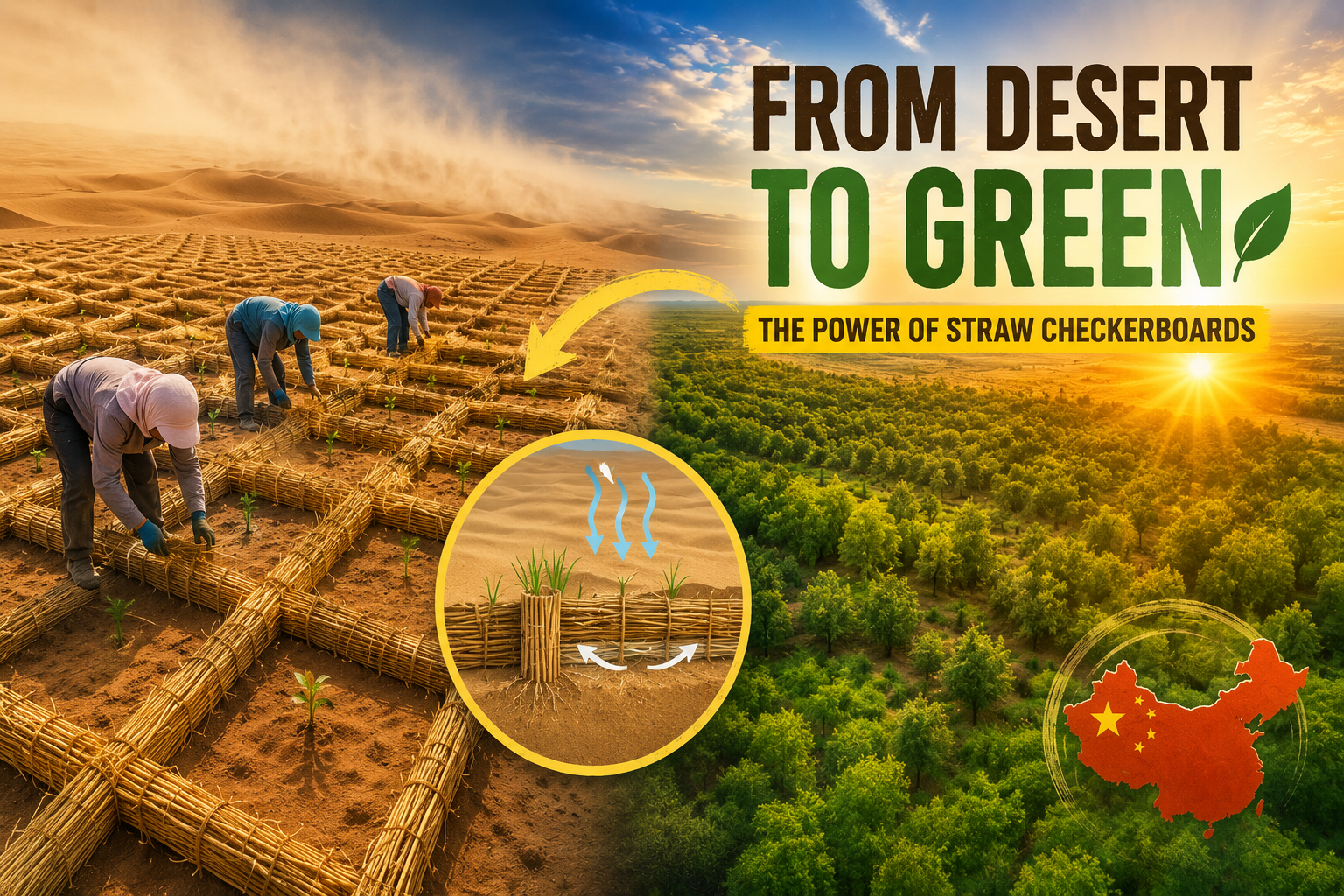
For decades, northern China has battled one of the world’s most relentless environmental threats: desertification. Expanding deserts, frequent sandstorms, declining farmland, and water scarcity once threatened millions of people across the country’s arid north. Surprisingly, one of China’s most effective weapons against moving sand isn’t a high-tech innovation—it is a simple grid made from bundles of straw.
Known as the straw checkerboards technique, this low-cost engineering solution has become the foundation of China’s Three-North Shelterbelt Program, popularly called the Great Green Wall. As climate change intensifies desertification worldwide, this humble technique is increasingly attracting global attention.
What Is the Straw Checkerboards Technique?
The straw checkerboards technique involves inserting wheat straw, rice straw, or reed stalks vertically into loose sand to create square grids, usually measuring about 1 meter × 1 meter.
The resulting checkerboard pattern performs several critical functions:
- Reduces near-surface wind speed
- Prevents shifting sand dunes
- Traps moisture inside the soil
- Minimizes evaporation
- Creates a stable environment where shrubs and grasses can establish roots
Once vegetation becomes established, the plants gradually replace the straw as the primary barrier against erosion.
Why Does It Work So Well?
Desert sand moves because strong winds continuously lift and transport loose particles. Straw checkerboards interrupt this process.
Each small square acts like a miniature windbreak, reducing the wind’s energy before it reaches the ground. Less wind means less sand movement. At the same time, the grids trap organic matter and conserve scarce rainfall, allowing drought-resistant plants to survive.
Scientists describe the technique as “engineering-assisted ecological restoration” because the straw provides immediate stability while vegetation delivers the long-term solution.
The Backbone of China’s Great Green Wall
Since the launch of the Three-North Protective Forest Program in 1978, millions of workers have laid straw checkerboards across deserts such as the Kubuqi, Tengger, and Badain Jaran.
The project aims to slow the advance of the Gobi Desert, protect farmland, and reduce devastating dust storms affecting northern China and neighboring countries.
According to Chinese government data:
- Around 500,000 square kilometres of forests have been established under the program.
- Since 2000, desertified land has reportedly shrunk by over 1,000 km² annually.
- Forest cover in the project region increased from roughly 5% in 1978 to about 14% by 2022.
- Researchers estimate China’s desertified land has declined by around 10%, while severely desertified areas have fallen by over 40% since 2000.
The United Nations Convention to Combat Desertification (UNCCD) has cited China’s long-term commitment as one of the world’s largest ecological restoration efforts.
A Nature-Based Solution
The straw checkerboards technique demonstrates that effective environmental restoration does not always require sophisticated technology.
It offers several advantages:
- Extremely inexpensive materials
- Uses locally available agricultural waste
- Easy for local communities to construct
- Produces immediate erosion control
- Supports long-term ecosystem recovery
The approach has also inspired restoration projects in Mongolia, Central Asia, and parts of the Middle East, where shifting sand threatens agriculture and infrastructure.
The Fight Isn’t Over
Despite impressive progress, scientists caution that desertification remains a long-term challenge.
Large parts of northern China continue to experience:
- Water scarcity
- Climate change-induced droughts
- Soil degradation
- Overgrazing pressures
- Extreme weather events
Experts also warn against relying solely on tree planting. In extremely arid regions, selecting native grasses and shrubs that match local water availability is often more sustainable than planting dense forests.
Why It Matters
The straw checkerboards technique is more than an engineering trick—it represents a practical lesson in ecological restoration. Instead of trying to overpower nature, it works with natural processes, slowing the wind just enough for vegetation to reclaim the land.
As countries from Africa’s Great Green Wall Initiative to the Middle East search for affordable ways to combat desertification, China’s straw checkerboards provide a compelling example of how a remarkably simple idea can help transform some of the world’s harshest landscapes.