
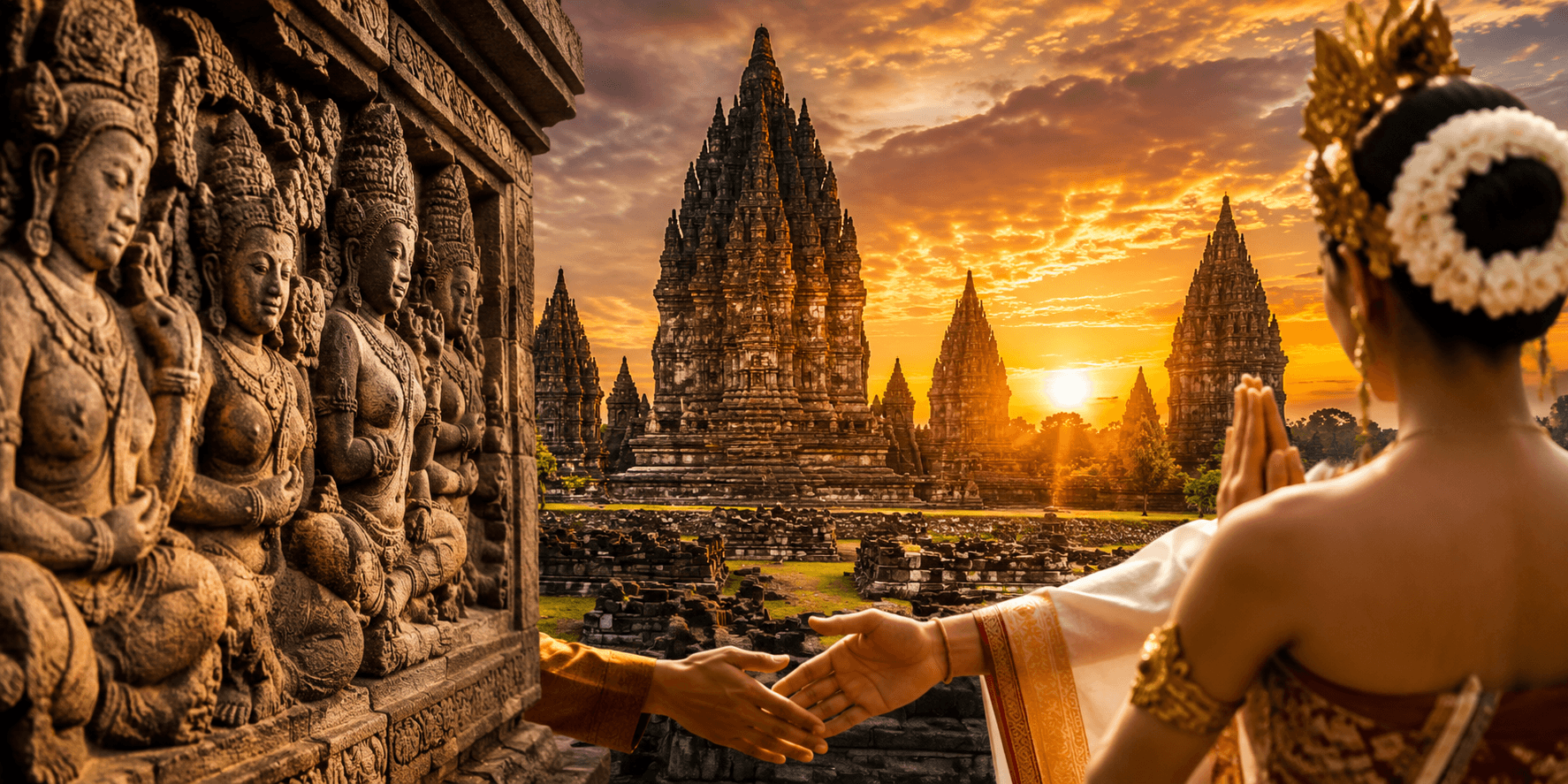
In an era where global influence is measured not only by military strength and economic power but also by culture, ideas and values, India’s soft power has emerged as one of its strongest diplomatic assets. Rooted in over 5,000 years of civilisation, India’s cultural legacy continues to shape its relations with countries across Asia, particularly Southeast Asia.
The recent visit of Prime Minister Narendra Modi to Indonesia’s UNESCO-listed Prambanan Temple is a reminder that India’s engagement with Southeast Asia is not a modern diplomatic project—it is the continuation of a millennium-old civilisational partnership.
Civilisational Links Beyond Borders
Long before the emergence of modern nation-states, Indian merchants, monks and scholars carried ideas across the Indian Ocean. Rather than conquest, India’s influence spread through trade, religion, language, literature, architecture and philosophy.
The result is visible across Southeast Asia:
- Angkor Wat (Cambodia) – the world’s largest religious monument, inspired by Hindu cosmology.
- Prambanan (Indonesia) – Southeast Asia’s largest Hindu temple complex, dedicated to Shiva, Vishnu and Brahma.
- Borobudur (Indonesia) – one of the world’s greatest Buddhist monuments, reflecting centuries of Indic Buddhist influence.
- Ramayana and Mahabharata traditions continue to flourish in Indonesia, Thailand, Cambodia and Laos through theatre, dance and literature.
Prambanan’s magnificent stone reliefs narrating the Ramayana demonstrate how Indian epics became part of Indonesia’s own cultural identity rather than remaining foreign imports.
Soft Power Through Cultural Diplomacy
India today actively preserves these historical connections through cultural diplomacy.
The Archaeological Survey of India (ASI), in partnership with the Ministry of External Affairs, has undertaken conservation and restoration projects at several heritage sites across Asia.
Notable examples include:
| Heritage Site | Country |
|---|---|
| My Son Temple & Nhan Tower | Vietnam |
| Vat Phou Temple | Laos |
| Earthquake-damaged temples and pagodas | Myanmar |
| Preet Vihar & Ta Prohm | Cambodia |
| Friday Mosque | Maldives |
India has also organised International Ramayana Conferences, Shared Buddhist Heritage Conferences, and exhibitions showcasing Southeast Asian versions of the Ramayana such as Reamker (Cambodia), Kakawin Ramayana (Indonesia) and Ramakien (Thailand). These initiatives strengthen people-to-people ties beyond conventional diplomacy.
Prambanan: A Symbol of Living Heritage
During PM Modi’s visit, India and Indonesia explored cooperation for the conservation of the Prambanan Temple, a UNESCO World Heritage Site built during the 9th century by the Sanjaya dynasty.
Although Indonesia is the world’s largest Muslim-majority nation, Prambanan stands as a powerful reminder of its Hindu heritage. The temple’s towering architecture, intricate Ramayana carvings and continuing Ramayana Ballet performances illustrate how Indian civilisation was adapted into local Javanese traditions rather than replacing them.
This shared heritage strengthens India-Indonesia relations under the broader framework of the Act East Policy and the Indo-Pacific vision.
Why India’s Soft Power Matters
Unlike hard power, soft power wins trust without coercion. India’s strengths include:
- Yoga and Ayurveda
- Buddhism and Hindu philosophy
- Sanskrit and classical literature
- Democracy and pluralism
- Indian diaspora
- Cinema, cuisine and digital innovation
- Shared cultural heritage across Asia
These resources enhance India’s diplomatic credibility, promote tourism, encourage educational exchanges and create goodwill that supports strategic partnerships.
As geopolitical competition intensifies in the Indo-Pacific, India’s civilisational heritage offers a unique advantage. Expanding heritage conservation projects, promoting Buddhist and Ramayana circuits, strengthening academic exchanges, digitising ancient manuscripts and leveraging organisations like the Indian Council for Cultural Relations (ICCR) can further reinforce India’s cultural leadership.
India’s greatest export has never been empire—it has been ideas. From Angkor Wat to Prambanan, from the Ramayana to Buddhist philosophy, India’s cultural influence continues to connect nations across Southeast Asia. By preserving these shared civilisational bonds, India transforms its ancient heritage into a modern instrument of diplomacy, demonstrating that soft power remains one of the most enduring pillars of its global engagement.