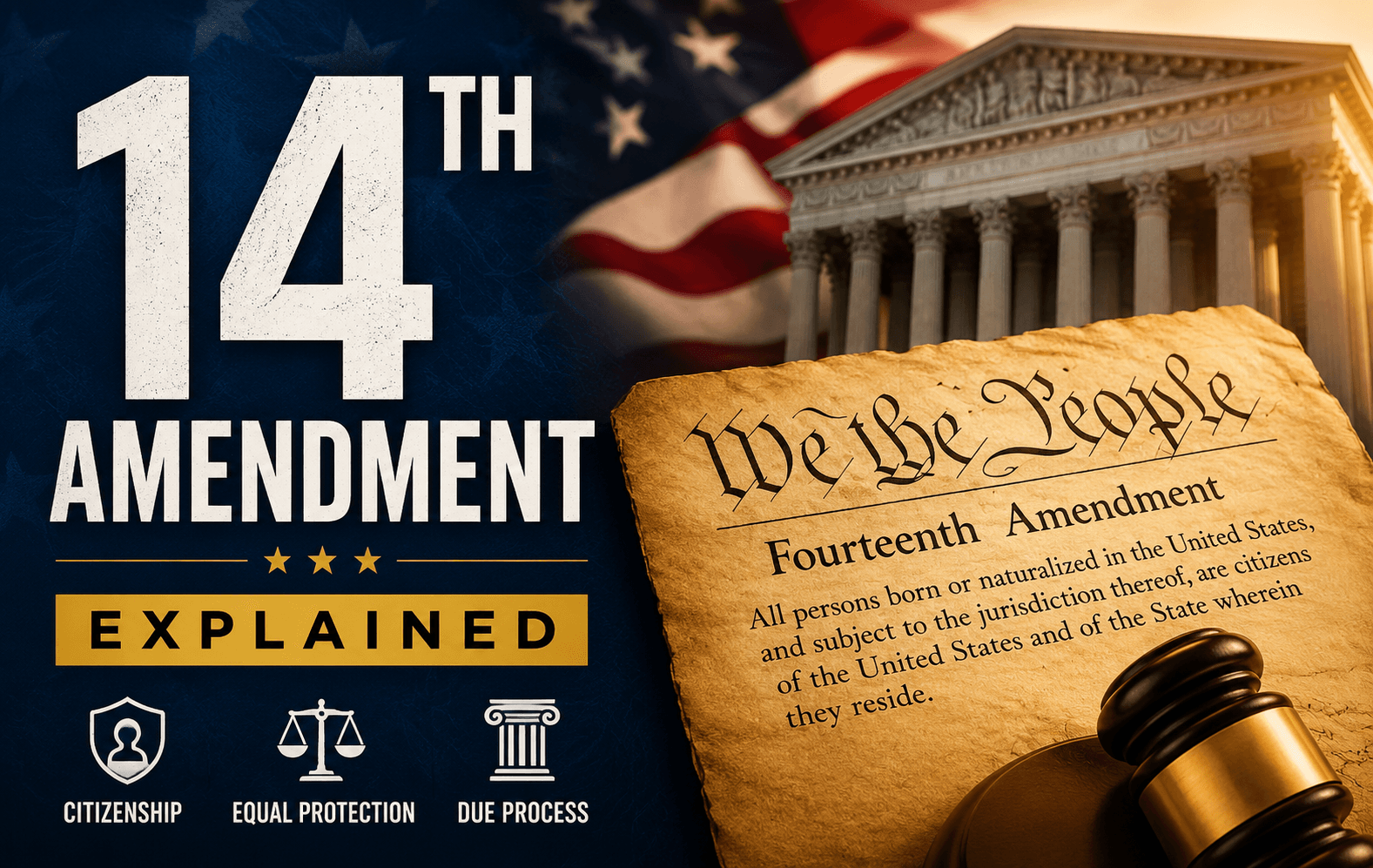
The 14th Amendment (Fourteenth Amendment), ratified July 9, 1868, grants birthright citizenship to all persons born or naturalised in the United States, guarantees equal protection of the laws, and ensures due process — making it the most cited amendment in Supreme Court history.
What Is the 14th Amendment? (Definition)
The 14th Amendment to the U.S. Constitution was ratified on July 9, 1868, as one of three post-Civil War Reconstruction Amendments. Its opening clause — the most litigated sentence in American constitutional law — reads:
“All persons born or naturalized in the United States, and subject to the jurisdiction thereof, are citizens of the United States and of the State wherein they reside.”
In plain language, it does four things:
- Grants citizenship to anyone born on U.S. soil (birthright citizenship / jus soli)
- Bars states from denying any person equal protection of the laws
- Prohibits deprivation of life, liberty, or property without due process
- Prevents states from abridging the privileges or immunities of U.S. citizens
It was written to directly overturn the Supreme Court’s 1857 Dred Scott v. Sandford ruling, which had denied Black Americans any constitutional protection or citizenship rights.
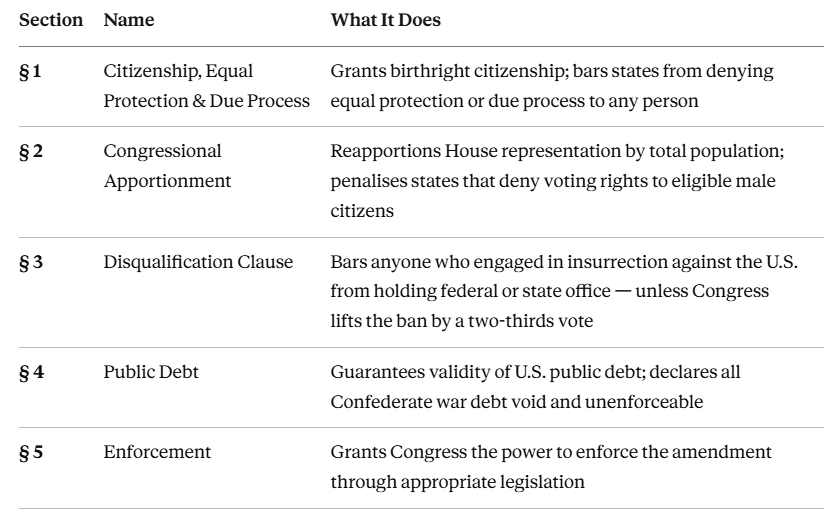
The 5 Sections of the 14th Amendment — Summarised
Fourteenth Amendment: Historical Significance
No constitutional amendment has been cited more in Supreme Court cases. Section 1 alone has driven every major civil rights battle in modern American history:
- Brown v. Board of Education (1954) — Equal Protection Clause used to strike down racial segregation in schools
- United States v. Wong Kim Ark (1898) — Established that children born in the U.S. to immigrant parents are citizens
- Obergefell v. Hodges (2015) — Guaranteed same-sex marriage under both Due Process and Equal Protection
- Section 3 revival (2024) — Cited in Trump v. Anderson (2024) challenging a candidate’s eligibility after January 6, 2021
The amendment was the constitutional foundation of the civil rights movement, abortion rights litigation, LGBTQ+ rights, voting rights, and immigration law — all running through its 400 words.
2026 Update: The Biggest 14th Amendment Case in 128 Years
Trump v. Barbara, 609 U.S. ___ (June 30, 2026)
On January 20, 2025, President Trump signed Executive Order 14160, declaring that children born in the U.S. to parents unlawfully or temporarily present were not “subject to the jurisdiction” of the United States — and therefore not entitled to birthright citizenship under the 14th Amendment.
Every lower court that reviewed the order found it unconstitutional. The Supreme Court agreed to hear the case and argued it on April 1, 2026 — with Trump becoming the first sitting president in U.S. history to attend oral arguments in person.
On June 30, 2026, the Supreme Court ruled 6–3 against the executive order:
“The Court reaffirmed the long-established view, in place for more than 150 years, that such children are ‘subject to the jurisdiction’ of the United States and are citizens at birth under the Fourteenth Amendment’s Citizenship Clause.” — States United Democracy Center, summarising the ruling (July 2026)
The majority (Roberts, Sotomayor, Kagan, Jackson, plus two others) held that the common law principle of birth-on-soil citizenship is embedded in the 14th Amendment’s text and cannot be undone by executive order.
The dissent (Thomas, Alito, Kavanaugh) argued the Citizenship Clause was intended narrowly — to grant citizenship to formerly enslaved people, not to children of non-citizen visitors or undocumented immigrants.
The ruling was decisive: amending birthright citizenship would require a constitutional amendment — a two-thirds vote in both chambers of Congress, plus ratification by three-fourths of states.
Key Dates: 14th Amendment Timeline
| Year | Event |
|---|---|
| 1857 | Dred Scott ruling denies citizenship to Black Americans |
| 1868 | 14th Amendment ratified — July 9 |
| 1898 | Wong Kim Ark — birthright citizenship confirmed for children of immigrants |
| 1954 | Brown v. Board — equal protection ends school segregation |
| 2015 | Obergefell — same-sex marriage guaranteed |
| 2025 | Trump signs EO 14160 attempting to end birthright citizenship |
| 2026 | Supreme Court strikes down EO 14160 in Trump v. Barbara (6–3) |
Frequently Asked Questions
What does the 14th Amendment say in simple terms? If you are born in the U.S., you are a citizen. No state can treat citizens unequally or deny anyone fair legal process.
What is the date of the Fourteenth Amendment? Ratified July 9, 1868 — three years after the Civil War ended.
What is the significance of the Fourteenth Amendment? It is the constitutional backbone of American civil rights. Every major equal rights case — from racial segregation to same-sex marriage to birthright citizenship — has been decided on its text.
Can the 14th Amendment be changed? Yes, but only through a formal constitutional amendment — requiring a two-thirds majority in Congress and ratification by 34 of 50 states. The 2026 Supreme Court ruling confirmed no president can change it by executive order.
What is birthright citizenship? The principle from Section 1 that anyone born on U.S. soil is automatically a U.S. citizen, regardless of the parents’ immigration status — reaffirmed by the Supreme Court in June 2026.
What is the difference between the 13th and 14th Amendments? The 13th (1865) abolished slavery. The 14th (1868) granted citizenship and equal rights to the people the 13th had freed — and to all Americans born on U.S. soil.
The Bottom Line
The Fourteenth Amendment is not history — it is today’s headlines. Ratified in 1868 to give freed enslaved people full citizenship, it has since anchored every major civil rights advance in America. The Supreme Court’s landmark 6–3 ruling in Trump v. Barbara (June 30, 2026) confirmed what courts have held for 128 years: birth on American soil means citizenship, and no executive order can change that. Any future attempt to limit birthright citizenship must clear the near-impossible bar of a constitutional amendment.
Sources: U.S. Supreme Court (official opinion, 25-365); SCOTUSblog; Britannica; States United Democracy Center; Center for American Progress; Constitution Center. Last updated July 10, 2026.