One mountain region. Five clues. Nearly two billion people depend on it. Scientists warn its glaciers are disappearing faster than expected. All real. All 2025–2026.
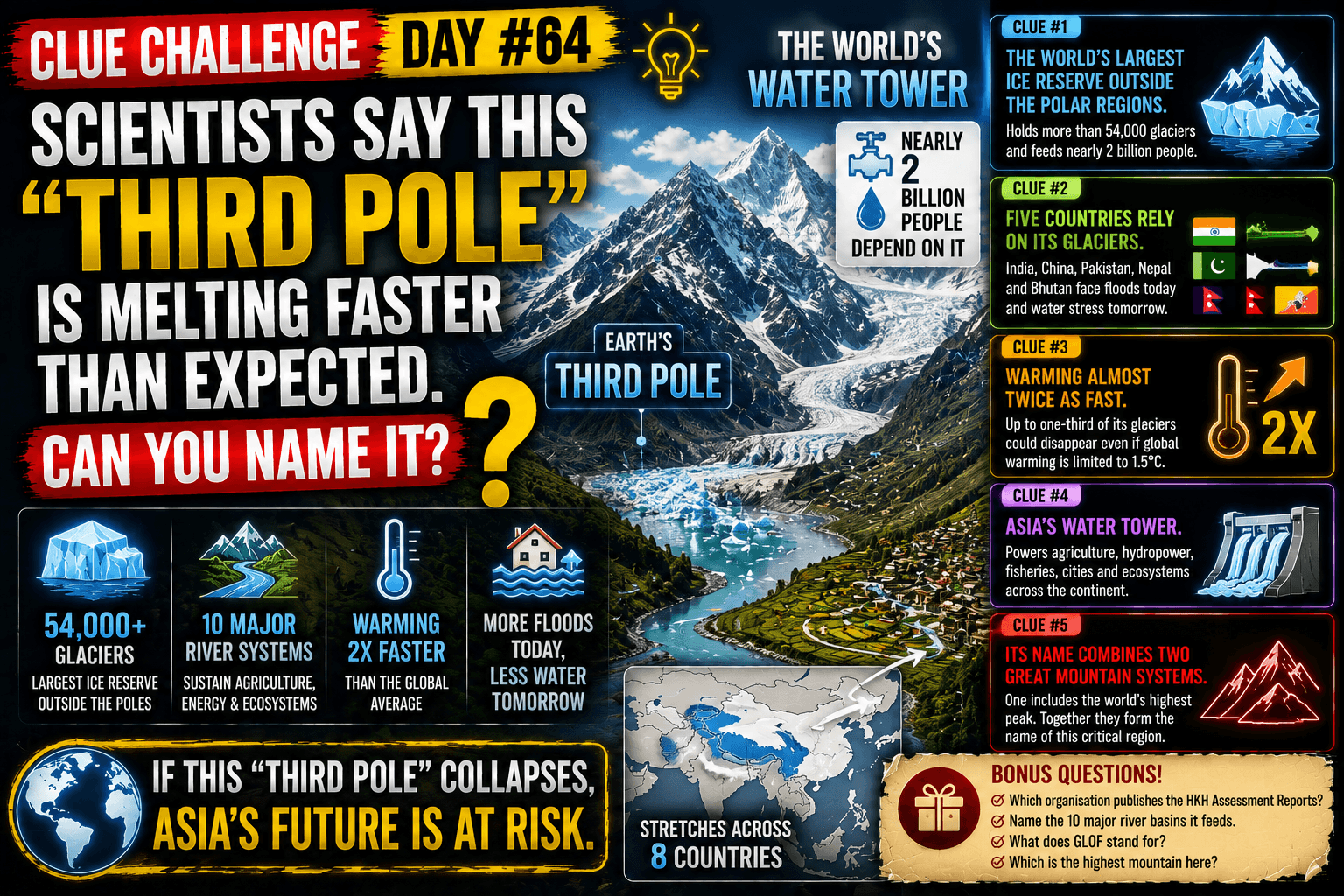
It holds more ice than anywhere outside the Arctic and Antarctica. It feeds ten of Asia’s greatest rivers, supports food and water security for almost one-quarter of humanity, and is now warming nearly twice as fast as the global average. Scientists say the consequences will reach far beyond the mountains themselves. Can you name this region before the final clue?
Clue #1 — It is called Earth’s “Third Pole” because it stores the planet’s largest reserve of ice outside the polar regions
This vast mountain system contains more than 54,000 glaciers, making it the largest store of frozen freshwater beyond the Arctic and Antarctica.
Scientists estimate that these glaciers feed ten major Asian river systems, including rivers that sustain agriculture, hydropower, ecosystems, and drinking water for nearly two billion people.
Recent assessments warn that glacier loss is accelerating despite global efforts to limit warming.
A frozen reservoir for nearly one in every four people on Earth.
Clue #2 — Five countries at its heart are already experiencing floods, glacial lake bursts and long-term water stress
The glaciers of this region directly influence the future of:
- India
- China
- Pakistan
- Nepal
- Bhutan
Rapid melting is increasing the risk of Glacial Lake Outburst Floods (GLOFs), while shrinking glaciers threaten long-term river flows that millions of farmers depend upon.
Scientists warn that communities may first experience more floods, followed by less water as glaciers continue to shrink.
Too much water today.
Too little tomorrow.
Clue #3 — Scientists say it is warming almost twice as fast as the global average
According to recent assessments by the International Centre for Integrated Mountain Development (ICIMOD) and other climate studies, temperatures across this region are rising significantly faster than the global mean.
Even if global warming is limited to 1.5°C, researchers project that up to one-third of its glaciers could disappear this century.
Under higher-emission scenarios, the losses could exceed half to two-thirds of today’s glacier volume.
The world’s highest mountains are becoming one of its fastest-changing landscapes.
Clue #4 — It influences monsoons, agriculture, hydropower and food security across Asia
This region is often called Asia’s Water Tower.
Its glaciers sustain rivers that irrigate hundreds of millions of hectares of farmland, generate electricity through hydropower, support fisheries, industries and major cities, and help regulate regional climate.
Recent climate reports warn that glacier retreat, changing snowfall patterns and extreme rainfall are increasing uncertainty across South Asia and beyond.
What happens here does not stay here.
Its impact travels thousands of kilometres downstream.
Clue #5 — Its name combines one ancient mountain range with another stretching across eight countries
This region extends across Afghanistan, Pakistan, India, Nepal, Bhutan, China and Myanmar.
Its official name combines two of Asia’s greatest mountain systems.
One is famous for hosting the world’s highest peak.
The other stretches westward through Central and South Asia.
Together they form the name of one of Earth’s most climate-critical regions.
So — what is this region?
It is known as Earth’s Third Pole.
Home to more than 54,000 glaciers.
Source of water for nearly two billion people.
Warming almost twice as fast as the global average.
Increasingly threatened by glacier retreat, extreme weather, and glacial lake outburst floods.
Scientists say protecting this region may become one of the defining climate challenges of the 21st century.
Bonus — can you name:
- The organization that publishes the landmark [Third Pole] Assessment Reports
- The ten major river basins fed by glaciers from this region
- The climate hazard abbreviated as GLOF
- The highest mountain located within this region
Drop your answer below. Unlike Wordle, this one supplies water to nearly one-quarter of humanity.
Missed yesterday’s challenge?
Answer to Yesterday’s Challenge: DAY #63
(Click above to reveal)