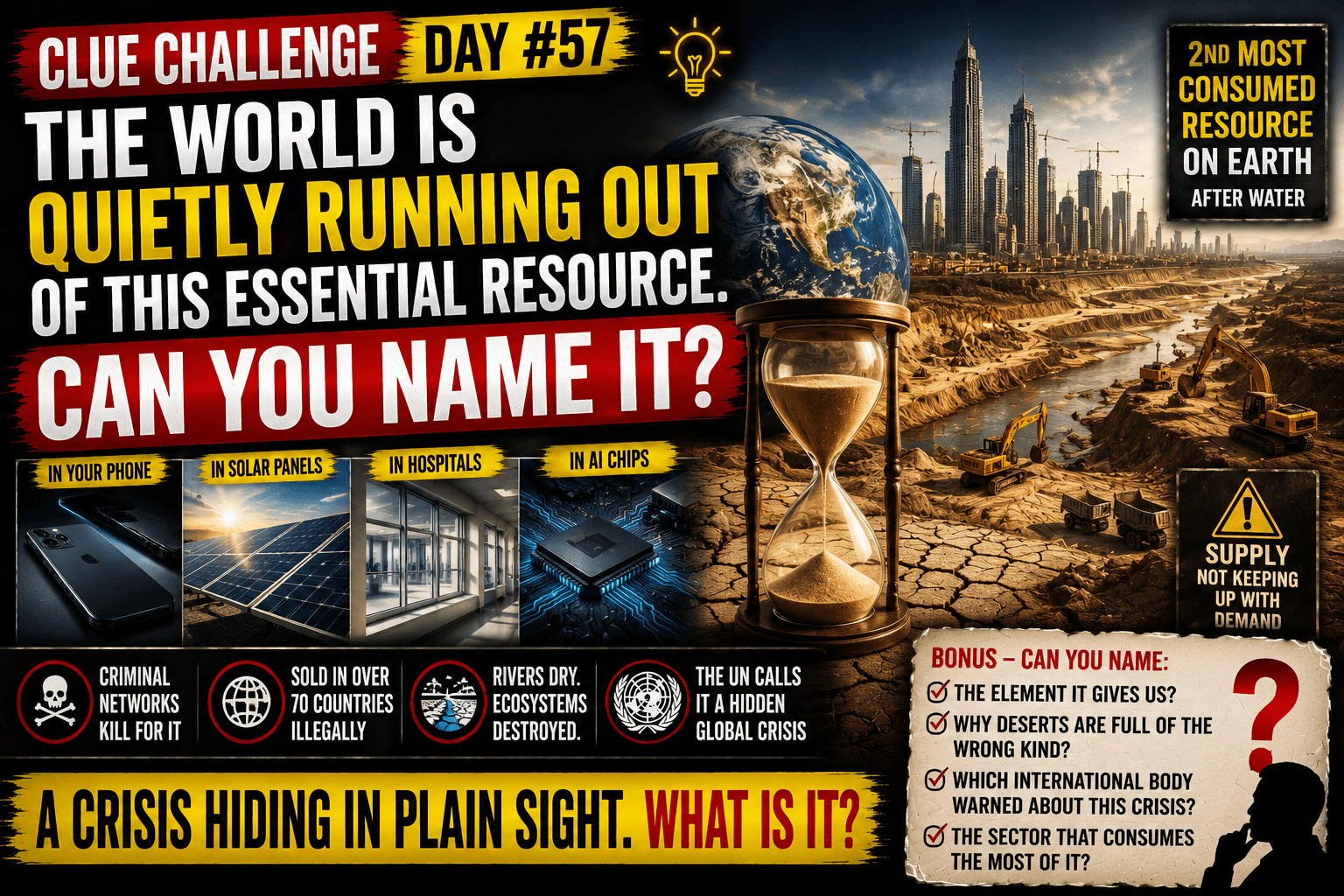
One resource. Five clues. The second most consumed substance on Earth. Criminals are killing for it. You walk on it every day. All real. All 2025–2026.
It is in your phone, your home, your roads, and your hospital windows. Deserts are full of it — yet the world is running out of the type it actually needs. Criminal networks are murdering activists to keep it flowing. Can you name this crisis before the final clue?
Clue #1 — It is the second most consumed resource on Earth after water — and we are extracting it faster than nature can replace it
The world currently consumes an estimated 50 billion tonnes of this material every year — enough to build a wall 27 metres high and 27 metres wide around the entire planet.
The current pace of global construction using it equals the city of Paris being built every fifth day.
A 2022 study by the University of Amsterdam confirmed that we are taking it faster than nature replaces it — and that we may entirely run out of the specific construction-grade type by 2050.
It is the most extracted solid material on Earth. More than coal. More than iron ore. More than any fossil fuel.
Clue #2 — The type found in deserts is completely useless — only riverbeds and seabeds hold what the world actually needs
This is the clue that surprises almost everyone.
The material exists in vast quantities across the world’s driest places — but that variety is too smooth and round, shaped by wind over millennia, and cannot bind properly in concrete or glass production.
The specific type needed for construction, electronics, and manufacturing must be coarse and angular — found only in riverbeds, lake beds, and seabeds. As extraction intensifies, riverbeds deepen, water tables drop, and entire agricultural zones lose their irrigation access entirely.
Vast deserts. Full of the wrong type. The right type: disappearing.
Clue #3 — It is inside your smartphone, your solar panels, your hospital windows — and every AI chip made in 2026
This resource is not just a construction material. It is the foundation of modern civilisation itself.
Purified silicon — derived from it — is the substrate of every semiconductor ever manufactured. Every AI chip running large language models in 2026. Every 5G antenna. Every solar cell powering the green energy transition. Every pane of glass in every hospital and office tower on Earth.
The green revolution and the AI revolution are both, at their most fundamental level, built on the same increasingly scarce material — extracted from riverbeds by hand in some of the world’s poorest countries and processed into the world’s most advanced technologies.
Clue #4 — Criminal networks controlling this resource are now active in over 70 countries — and they kill
In some regions, organised criminal networks controlling this resource have brought intimidation, murder, and political corruption — described by researchers as among the fastest-growing categories of transnational organised crime.
At least 418 people lost their lives and 434 sustained injuries in extraction-related violence and accidents in India alone between December 2020 and March 2022. Maharashtra introduced new laws in July 2025 making illegal extraction a criminal offence — following a surge in unauthorised dredging that polluted rivers, weakened bridges, and fuelled violence.
In Mexico, environmental activist José Luis Álvarez was found dead with five bullet wounds in 2019 — killed for opposing illegal operations. The same pattern repeats across Indonesia, Kenya, Tanzania, Colombia, and Sierra Leone.
Murdered. For a resource most people have never thought about.
Clue #5 — The UN has been warning about this crisis for years — and the world is still not listening
A landmark 2022 UNEP report titled [Mineral Name] and Sustainability: 10 Strategic Recommendations to Avert a Crisis found that global extraction of this material is rising approximately 6% annually — a rate the UN called explicitly unsustainable.
The report called for this material to be formally recognised as a strategic global resource — on par with oil, water, and rare earth minerals — and for its extraction and trade to be rethought from the ground up.
Almost half of all global dredging operators extracted from Marine Protected Areas in recent years — highlighting the near-total absence of international governance over what is arguably the world’s most under-regulated strategic resource.
The UN warned. Activists died. Extraction kept accelerating.
So — what is this two-word crisis?
It is the second most consumed resource on Earth after water. Found everywhere — yet the specific type the world needs is rapidly vanishing. Inside every smartphone, solar panel, hospital window, and AI chip made in 2026. Controlled in over 70 countries by violent criminal networks. Extracted at 6% annual growth — unsustainably. A 2022 UN report gave it a specific two-word crisis name that is now appearing in environmental policy discussions worldwide.
Bonus — can you name:
- The year scientists estimate construction-grade supplies could run out entirely
- The Indian state that criminalised illegal extraction in July 2025
- The exact title of the 2022 UNEP report warning of the crisis
- The specific element — derived from this resource — that forms the substrate of every semiconductor on Earth
Drop your answer below. Unlike Wordle, this one is hiding in plain sight — literally beneath your feet. Day #58 arrives tomorrow.
Missed yesterday’s challenge?
Answer to Yesterday’s Challenge: DAY #56
(Click above to reveal)