One species. Five clues. Less than 800 left. Found on a single island. Fighting for survival in 2026. All real.
Latest Update: Climate change intensified rainfall from Cyclone Senyar may have killed 58, the world’s rarest great ape, a new study says.
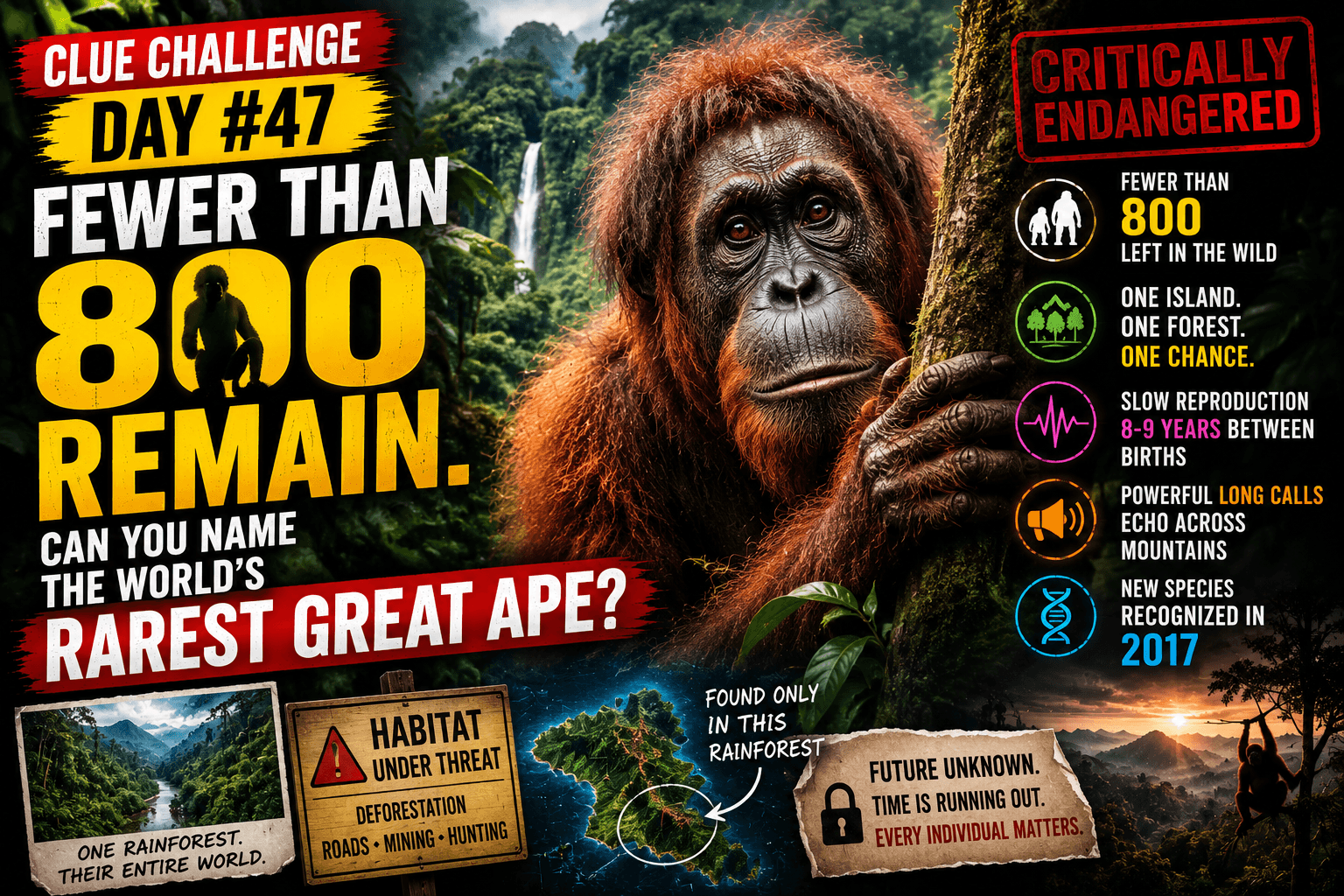
Scientists call it the rarest great ape on Earth. It was only officially recognized as a separate species in 2017. Today, fewer individuals remain than many small-town high schools. New conservation warnings in 2025–2026 suggest that even the loss of a handful of adults could push it closer to extinction. Can you name it before the final clue?
Clue #1 — It became the newest great ape species in the world
For decades, scientists believed these apes belonged to a larger, better-known orangutan population.
Then genetic, anatomical, and behavioral studies revealed something remarkable.
This isolated population had been evolving separately for hundreds of thousands of years.
In 2017, researchers officially recognized it as a distinct species — making it the newest great ape species identified by modern science.
The problem? By the time it received its name, it had already become the rarest great ape on Earth.
Clue #2 — Every single one lives inside one shrinking forest ecosystem
Unlike gorillas, chimpanzees, or other orangutans spread across large regions, this species survives in just one mountainous rainforest landscape.
Its entire global population is concentrated in a forest ecosystem covering roughly 1,000 square kilometers.
Scientists estimate fewer than 800 individuals remain in the wild.
That makes it one of the most geographically restricted great apes ever documented.
One disease outbreak. One major habitat disruption. One ecological mistake.
The margin for error is terrifyingly small.
Clue #3 — It lives near a national park famous for biodiversity
This ape inhabits forests surrounding one of Southeast Asia’s most important biodiversity hotspots.
The region contains cloud forests, river valleys, and rugged mountains that support rare birds, reptiles, and mammals found nowhere else.
Researchers often describe the area as one of the last strongholds of intact tropical rainforest on its island.
Conservation groups have spent years fighting to protect wildlife corridors connecting fragmented ape populations across this landscape.
Clue #4 — Its family life moves in slow motion
Most animals recover from population losses through rapid reproduction.
Not this one.
Females may wait eight to nine years between births — the longest birth interval recorded among great apes.
A mother invests nearly a decade raising a single offspring.
That means the death of even a handful of breeding females can echo through the population for generations.
It is one reason scientists consider this species exceptionally vulnerable to extinction.
Clue #5 — It has a distinctive voice and a surprising appearance
Adult males produce powerful long calls that can travel for kilometers through mountain forests.
Researchers use these calls to estimate population numbers and territory boundaries.
Compared with its close relatives, this species tends to have frizzier hair, smaller faces, and distinctive jaw and skull features.
Those physical differences became part of the evidence that convinced scientists they were looking at a completely separate species.
Clue #6 — The IUCN considers it one step away from disappearing forever
Its conservation status is currently listed as Critically Endangered on the IUCN Red List.
That is the highest threat category before extinction in the wild.
Recent conservation reports continue to warn about habitat fragmentation, infrastructure development, illegal hunting, and the loss of ecological connectivity between groups.
In conservation circles, it has become a symbol of how quickly a newly discovered species can become one of the most threatened animals on Earth.
So — what species is this?
Officially recognized in 2017.
The world’s rarest great ape.
Fewer than 800 individuals remain.
Found only in a single mountainous rainforest ecosystem on one Southeast Asian island.
Known for its long calls, slow reproduction, and critically endangered status.
Scientists say its future may depend on decisions being made right now.
Bonus — can you name:
- The island where it lives?
- The mountain ecosystem from which it gets its name?
- Its current IUCN Red List status?
- The year scientists officially recognized it as a separate species?
- The two other living orangutan species it is related to?
Drop your answer below. Unlike Wordle, this puzzle’s answer is fighting for survival in the real world. Day #48 arrives tomorrow.
Missed yesterday’s challenge?
Clue Challenge Day #46: The World’s Most Dangerous Volcano Is Waking Up. Can You Name It?
Answer to Yesterday’s Challenge: DAY #46
(Click above to reveal)