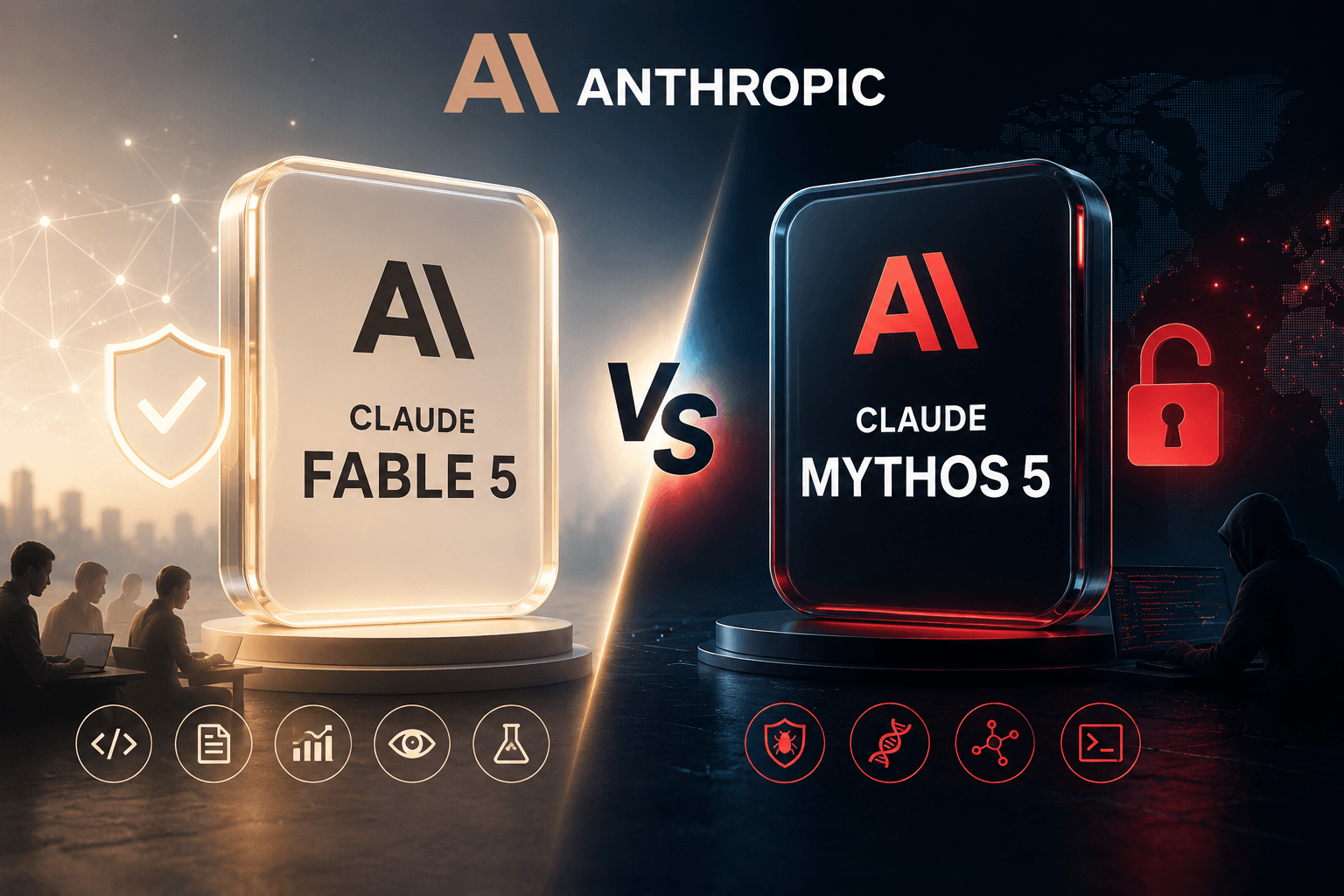
Anthropic has unveiled two of the most advanced AI systems ever created: Claude Fable 5 and Claude Mythos 5.
At first glance, the two models appear nearly identical. In fact, Anthropic confirms that they are built on the same underlying AI model. Yet only one is available to the general public, while the other remains restricted to cybersecurity experts, critical infrastructure providers, and selected researchers.
So what exactly separates Claude Fable 5 from Claude Mythos 5?
The answer lies not in capability, but in access, safeguards, and risk management.
What Are Claude Fable 5 and Claude Mythos 5?
Anthropic launched Claude Fable 5 as its most powerful publicly available AI model.
The company describes Fable 5 as a Mythos-class AI model made safe for general use. It delivers state-of-the-art performance in:
- Software engineering
- Scientific research
- Vision tasks
- Knowledge work
- Long-horizon reasoning
- Agentic workflows
Alongside it, Anthropic introduced Claude Mythos 5, which uses the same underlying model but removes certain restrictions for approved users.
In simple terms:
Claude Fable 5 = Public Version
Claude Mythos 5 = Restricted Version
Quick Comparison: Fable 5 vs Mythos 5
| Feature | Claude Fable 5 | Claude Mythos 5 |
|---|---|---|
| Public Availability | Yes | No |
| Underlying Model | Same as Mythos 5 | Same as Fable 5 |
| Cybersecurity Safeguards | Enabled | Removed |
| Biology & Chemistry Restrictions | Enabled | Can be removed for approved researchers |
| General Users | Yes | No |
| Project Glasswing Access | No | Yes |
| Trusted Access Program | No | Yes |
| Cyber Defense Applications | Limited | Full Capability |
| Drug Discovery Research | Limited | Advanced Access |
| Pricing | $10 Input / $50 Output per million tokens | Same |
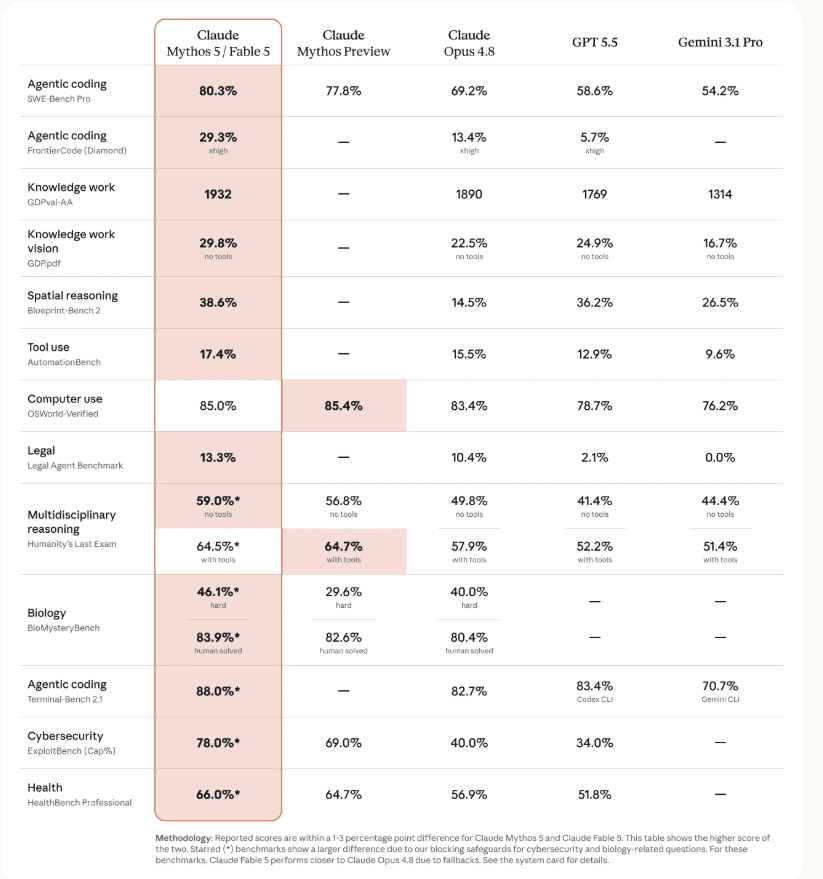
The table below compares the capabilities of Fable 5 and Mythos 5 to other leading models.
The Biggest Difference: Safeguards
Anthropic repeatedly emphasizes that Fable 5 and Mythos 5 share the same foundation.
The major distinction is that Fable 5 contains protective guardrails designed to prevent misuse.
Whenever Fable 5 detects requests involving:
- Cyberattacks
- Vulnerability exploitation
- Offensive security operations
- Advanced biology
- Chemistry-related research
- AI model distillation
the system automatically redirects those requests to Claude Opus 4.8 instead.
This means users still receive an answer, but they do not gain access to Mythos-level capabilities in sensitive areas.
Anthropic says these safeguards affect fewer than 5% of sessions on average.
Why Is Mythos 5 Restricted?
According to Anthropic, Mythos-class models have crossed a new capability threshold.
These models can:
- Discover software vulnerabilities
- Assist with advanced cybersecurity workflows
- Conduct complex biological reasoning
- Accelerate drug discovery
- Generate novel scientific hypotheses
While these capabilities can create enormous benefits, they could also be misused.
For example:
A cybersecurity professional could use Mythos 5 to secure critical infrastructure.
A malicious actor could potentially use similar capabilities to find vulnerabilities faster.
Because of these concerns, Anthropic initially restricted Mythos access through Project Glasswing, a program created in collaboration with the U.S. government.
Cybersecurity: Where Mythos 5 Pulls Ahead
The largest practical difference between the two models appears in cybersecurity.
Anthropic states that Mythos 5 possesses:
“the strongest cybersecurity capabilities of any model in the world.”
The model excels in:
- Vulnerability discovery
- Exploit analysis
- Security research
- Agentic hacking simulations
- Multi-stage cyber operations
Fable 5 users cannot access these capabilities directly because cybersecurity classifiers intercept such requests.
Mythos 5 users can.
This makes Mythos 5 especially valuable for:
- National security agencies
- Critical infrastructure providers
- Security researchers
- Enterprise cyber defense teams
Biology and Drug Discovery
Another major distinction emerges in life sciences.
Anthropic reports that Mythos 5 accelerated parts of its internal drug-design workflow by approximately 10 times.
In testing, Mythos 5 could independently:
- Select protein targets
- Run bioinformatics tools
- Design proteins
- Recover from failed experiments
- Generate therapeutic candidates
Researchers found that Mythos 5 often matched or exceeded skilled human operators in specific protein-design tasks.
Because of the dual-use risks involved, these capabilities are heavily restricted.
General users interacting with Fable 5 cannot access the full biological capabilities of the underlying model.
Scientific Discovery and Novel Research
One of the most fascinating differences is what Mythos 5 achieved during internal research projects.
Anthropic says Mythos 5:
- Generated novel molecular biology hypotheses
- Conducted autonomous genomics research
- Designed machine-learning systems
- Produced scientific insights that researchers considered worthy of experimental validation
In blind comparisons, Anthropic scientists preferred Mythos-generated biology hypotheses approximately 80% of the time over those produced by earlier Claude models.
This suggests Mythos 5 is moving beyond answering questions and toward helping create new scientific knowledge.
What Can Fable 5 Do That Most Users Care About?
For everyday users, developers, businesses, and researchers, Fable 5 remains extraordinarily powerful.
The model achieved leading performance in:
Software Engineering
Companies reported:
- Large-scale code migrations
- Long-running coding projects
- Production-grade software development
- Multi-agent workflows
Knowledge Work
Fable 5 excels at:
- Financial analysis
- Research synthesis
- Document review
- Spreadsheet reasoning
- Business intelligence
Vision
Fable 5 can:
- Analyze scientific charts
- Read complex figures
- Reconstruct applications from screenshots
- Interpret visual data
Long-Term Reasoning
Anthropic says Fable 5 performs better than previous Claude models on:
- Long-duration projects
- Memory-intensive tasks
- Autonomous workflows
- Multi-day assignments
For most users, these capabilities are already far beyond what previous-generation AI systems offered.
Why Didn’t Anthropic Release Mythos 5 Publicly?
The answer is safety.
Anthropic believes AI models have reached a stage where advanced capabilities can create real-world risks if released without restrictions.
Instead of withholding the technology entirely, the company chose a middle path:
- Release the core model publicly as Fable 5.
- Add safeguards around high-risk domains.
- Provide unrestricted access only to trusted organizations.
This approach allows broader access to frontier AI while limiting opportunities for misuse.
Which Model Is Better?
Technically, neither.
Because both systems share the same underlying architecture, their raw intelligence is essentially identical.
The real question is:
Which version can access more of its capabilities?
For everyday users:
✅ Claude Fable 5 is the better choice because it is available today and provides nearly all of the model’s power.
For cybersecurity professionals and advanced researchers:
✅ Claude Mythos 5 offers additional capabilities that Fable 5 intentionally restricts.
Final Verdict
The difference between Claude Fable 5 and Claude Mythos 5 is not about intelligence—it is about access.
Both models are built on the same frontier AI system. However, Fable 5 includes safety mechanisms that redirect potentially risky requests, while Mythos 5 removes many of those restrictions for trusted users.
Think of it this way:
- Fable 5 is the public-facing sports car with speed limits enabled.
- Mythos 5 is the same machine operating on a closed professional track.
As AI systems become increasingly powerful, Anthropic’s two-model strategy may become the blueprint for how future frontier AI technologies are deployed worldwide.
Source: Claude Fable 5 and Claude Mythos 5 Anthropic