
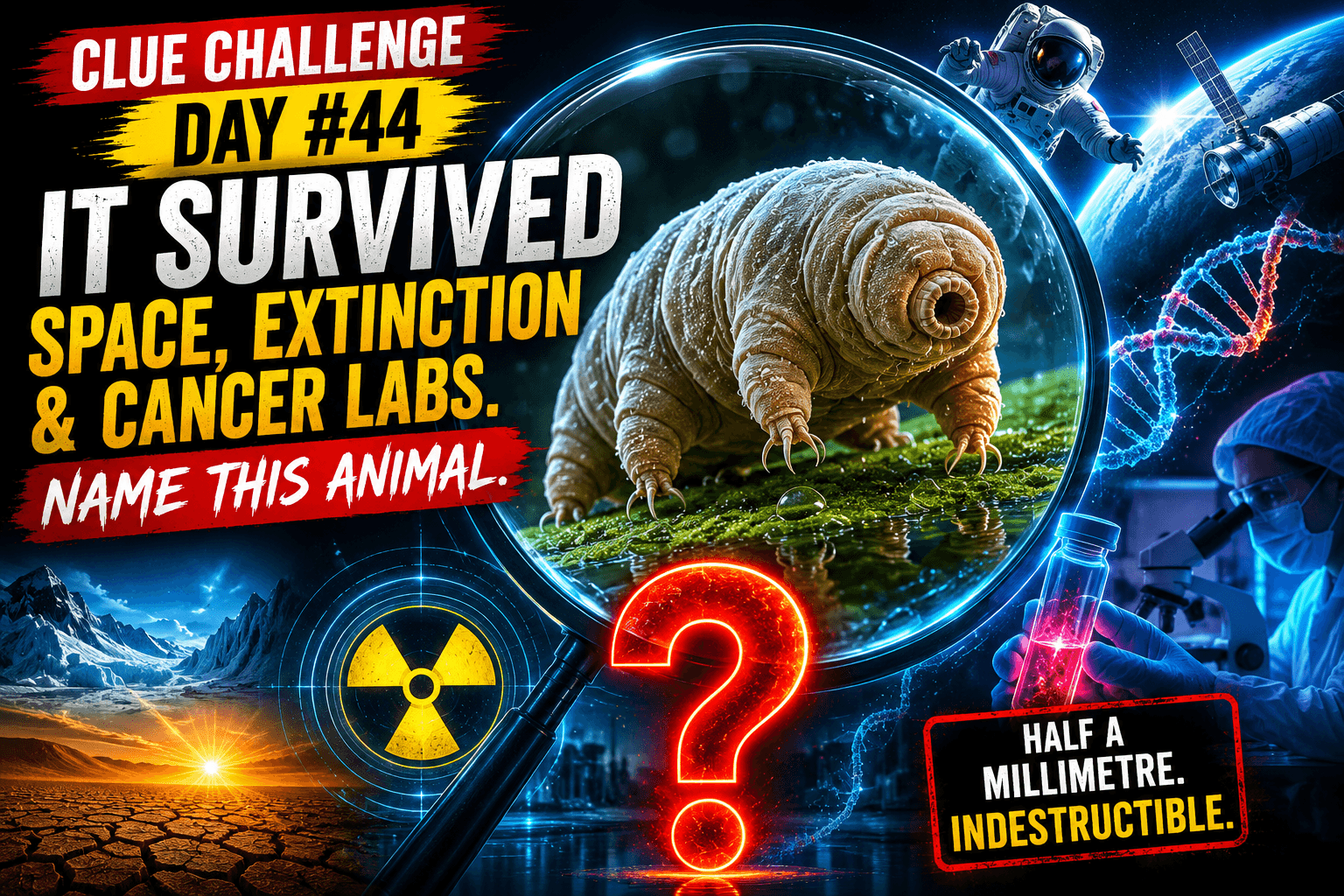
One creature. Five clues. 600 million years old. Smaller than a grain of sand. Tougher than almost anything that has ever lived.
It has survived all five of Earth’s mass extinctions. It can live in the vacuum of space, in boiling water, under six times the pressure of the ocean’s deepest trench, and in temperatures from near absolute zero to 150°C. Scientists just sent it back to the International Space Station — and it is now protecting cancer patients from radiation. Can you name it?
Can you identify it before the final clue?
Clue #1 — It May Be the Toughest Animal on Earth
Discovered in 1773, this microscopic eight-legged animal has existed for roughly 600 million years — hundreds of millions of years before the first dinosaurs appeared.
Scientists have found it almost everywhere imaginable:
- Himalayan peaks above 6,000 metres
- Antarctic ice
- Deep-ocean trenches
- The Sahara Desert
- Moss growing on city walls
There are more than 1,300 known species, and their survival abilities sound almost impossible.
When conditions become deadly, they enter a remarkable suspended state. They lose almost all of their body water, shrink into a tiny capsule-like form, and reduce their metabolism to nearly zero.
No eating.
No growth.
Almost no biological activity.
Then, sometimes years later, they wake up and continue as if nothing happened.
Clue #2 — India Sent Them to Space
In May 2025, a specially isolated strain of this creature travelled to the International Space Station aboard the Axiom-4 mission involving NASA, Axiom Space, ISRO, and researchers from the Indian Institute of Science.
The mission studied how the animal survives:
- Microgravity
- Space radiation
- Extreme environmental stress
Scientists hope the findings could help improve:
- Organ preservation
- Crop resilience
- Radiation protection
- Future long-duration space missions
Not bad for an animal smaller than the period at the end of this sentence.
Clue #3 — Cancer Researchers Are Borrowing Its Superpower
These creatures produce a protein called Dsup — Damage Suppressor — that wraps around DNA strands and physically prevents them from breaking under radiation. Researchers at MIT and the University of Iowa used mRNA nanoparticles to deliver Dsup to healthy mouse and human cells before radiation treatment — significantly reducing DNA damage in healthy tissue without affecting cancer-killing radiation. Published in Nature Biomedical Engineering on February 26, 2025.
Research published in Nature Communications in September 2025 showed how Dsup binds across chromatin of yeast cells, shielding DNA from the hydroxyl radicals that ionising radiation produces — confirming the protein’s mechanism in unprecedented molecular detail.
A separate team in March 2026 combined gene editing and stem cell technology to knock the Dsup gene directly into human blood stem cells — creating radiation-resistant cells that could protect cancer patients from the devastating side effects of radiotherapy.
Clue #4 — Scientists Just Discovered Another Survival Trick
In May 2026, researchers at the Indian Institute of Science uncovered a new mystery.
When this animal enters its dormant state, it appears capable of altering how heat moves through its body.
Instead of simply tolerating extreme temperatures, it actively reduces heat flow — effectively creating a biological thermal shield.
For engineers designing future heat-resistant materials, the implications could be enormous.
For an animal barely visible to the human eye, it’s another astonishing capability.
Clue #5 — Its Nickname Gives It Away
Most people don’t know its scientific name.
They know its nickname.
In fact, it has two famous nicknames.
One combines water with the largest land animal alive today.
The other combines water with a farm animal famous for rolling in mud.
Its scientific name, meanwhile, roughly translates to:
“Slow stepper.”
Put the clues together — and you’ve got your answer.
So — What Is This Creature?
- Around 600 million years old
- Smaller than half a millimetre
- Eight legs
- Survived all five mass extinctions
- Sent to the International Space Station in 2025
- Inspiring new cancer-protection research
- Confirmed in 2026 to possess a remarkable heat-survival mechanism
- Often called the toughest animal on Earth
And despite having only about 1,000 cells, it may end up teaching humanity how to survive some of the harshest conditions imaginable.
Bonus Challenge
Can you also name:
- Its two famous nicknames?
- The DNA-protecting protein attracting attention from cancer researchers?
- The Indian institution involved in the ISS experiment?
- The suspended survival state it enters when conditions become lethal?
Drop your answer below. Most animals struggle to survive a drought, a winter, or a disease. This one has been surviving the impossible for roughly 600 million years. 🔍
Stay Tuned for Next Clue Challenge 45
Missed yesterday’s challenge?
Clue Challenge Day #43: A Nation Is Disappearing Underwater in Real Time. Can You Name It?
Answer to Yesterday’s Challenge: DAY #43
(Click above to reveal)