
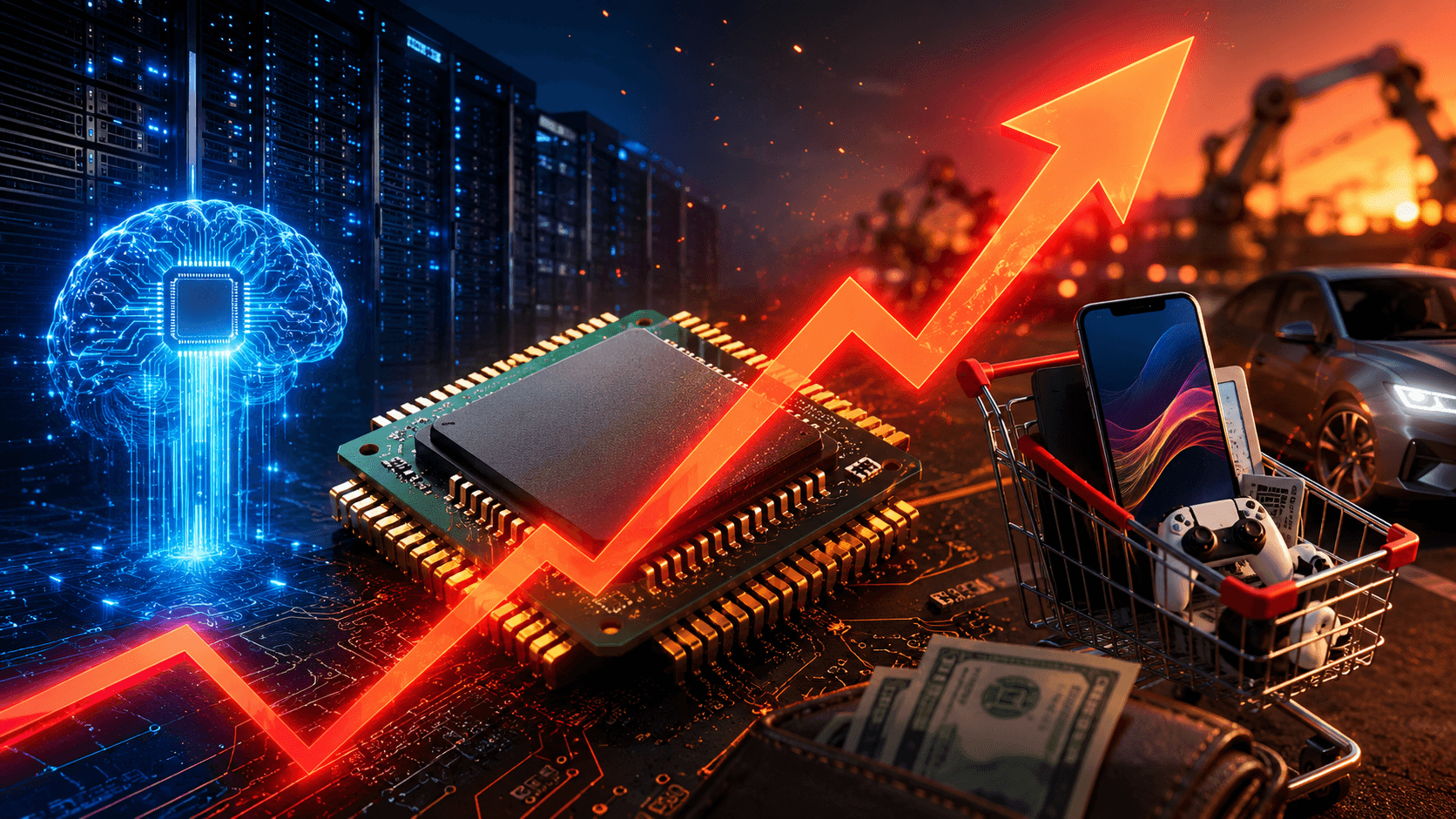
For years, artificial intelligence promised a future of lower costs, higher productivity, and smarter technology. But in 2026, AI is creating an unexpected side effect that economists and investors are watching closely: Chipflation.
According to a recent report from Morgan Stanley, soaring memory chip prices driven by the global AI boom are beginning to spread beyond data centers and into the wider economy. What started as a bottleneck in AI infrastructure is now affecting consumer electronics, cloud services, corporate spending, and even inflation discussions among policymakers.
The warning comes at a time when Big Tech companies are spending hundreds of billions of dollars building AI infrastructure, creating unprecedented demand for advanced memory chips.
What Is Chipflation?
Chipflation refers to inflationary pressure caused by rising semiconductor prices.
In the current cycle, the biggest issue is memory chips such as DRAM, NAND Flash, and High-Bandwidth Memory (HBM), which are essential for AI servers, smartphones, laptops, gaming consoles, automobiles, and cloud computing systems.
Morgan Stanley estimates that memory chip prices have increased nearly six-fold over the past year as manufacturers struggle to keep up with demand from AI companies. Chipmakers are increasingly prioritizing higher-margin AI data-center products instead of memory used in consumer electronics.
The result is a supply squeeze that is rippling through the global economy.
AI Is Consuming the World’s Memory Supply
The AI arms race has triggered one of the largest technology spending cycles in history.
Companies such as Microsoft, Google, and Meta are investing aggressively in AI infrastructure, requiring enormous quantities of advanced memory chips.
Morgan Stanley recently noted that the next phase of “agentic AI” will require even greater CPU and memory capacity, suggesting demand could remain elevated for years rather than months.
Research firm IDC projects that global semiconductor revenue could surpass $1.29 trillion in 2026, with memory revenue becoming one of the fastest-growing segments of the industry. Demand for AI-focused memory products is increasingly crowding out traditional buyers.
This means AI data centers are no longer competing only with each other—they are competing with smartphone makers, PC manufacturers, automakers, and medical device companies for the same memory supply.
Smartphones and PCs Are Feeling the Pain
The impact is already visible.
IDC forecasts that the global smartphone market could experience its largest decline on record in 2026. Smartphone shipments are expected to fall sharply as higher memory costs push up device prices. Low-cost Android manufacturers are expected to be hit the hardest.
Counterpoint Research projects smartphone shipments could fall by nearly 14% this year, with budget devices becoming increasingly difficult to produce profitably.
The PC market faces similar challenges.
IDC has warned that soaring RAM prices could reduce PC shipments by between 5% and 9% during 2026. Manufacturers may be forced to either increase prices or reduce specifications to protect margins.
For consumers, this could mean:
- More expensive smartphones
- Higher laptop prices
- Costlier gaming consoles
- Reduced hardware upgrades
- Fewer affordable entry-level devices
The era of ultra-cheap electronics may be ending sooner than many expected.
Why Businesses Are Worried
Chipflation is not just a consumer problem.
A coalition representing automakers, retailers, electronics firms, telecommunications companies, and medical device manufacturers recently warned U.S. authorities that memory shortages could create sustained price increases across multiple industries.
Automobiles increasingly rely on sophisticated electronics and memory systems.
Medical equipment, telecommunications infrastructure, and industrial machinery also depend heavily on semiconductor supply chains.
If memory prices remain elevated, businesses face difficult choices:
- Absorb higher costs
- Pass costs to customers
- Delay product launches
- Reduce investment spending
None of these options are particularly attractive during a period of slowing global growth.
The Microsoft Example
Even technology giants are feeling the impact.
Microsoft recently indicated that approximately $25 billion of its annual capital expenditure increase is linked to higher chip-related costs associated with AI infrastructure expansion.
When one of the world’s largest companies acknowledges rising semiconductor costs on that scale, it highlights how deeply chipflation has penetrated the technology ecosystem.
Cloud providers may eventually pass some of these costs to enterprise customers through higher AI service fees, cloud storage costs, and computing expenses.
Why This Time May Be Different
Historically, the semiconductor industry has experienced boom-and-bust cycles.
Prices rise, manufacturers build capacity, supply catches up, and prices fall.
However, Morgan Stanley believes the current situation could represent a more durable supply-demand reset. Major AI companies are signing long-term agreements and locking up future production capacity years in advance.
Building new semiconductor fabrication plants is also extremely expensive and time-consuming.
New capacity often takes several years to become operational.
That means supply may struggle to catch up even as manufacturers expand production.
The Bigger Economic Story
Chipflation is becoming one of the most important hidden consequences of the AI revolution.
The issue extends beyond technology stocks or semiconductor companies.
It touches consumer prices, business investment, cloud computing costs, industrial production, and global supply chains.
What began as a shortage inside AI data centers is now spreading throughout the broader economy.
The irony is striking: AI may eventually make many industries more efficient, but in the short term, the infrastructure required to power that future is making technology more expensive for everyone else.
As AI spending accelerates, chipflation could become one of the defining economic stories of the decade.