This is an independent summary of a lecture by Professor Jiang (Predictive History) on YouTube. All ideas, analysis and predictions belong to him. This blog is for educational purposes only. Watch the original video: [Predictive History – Professor Jiang]
My Take Before We Begin
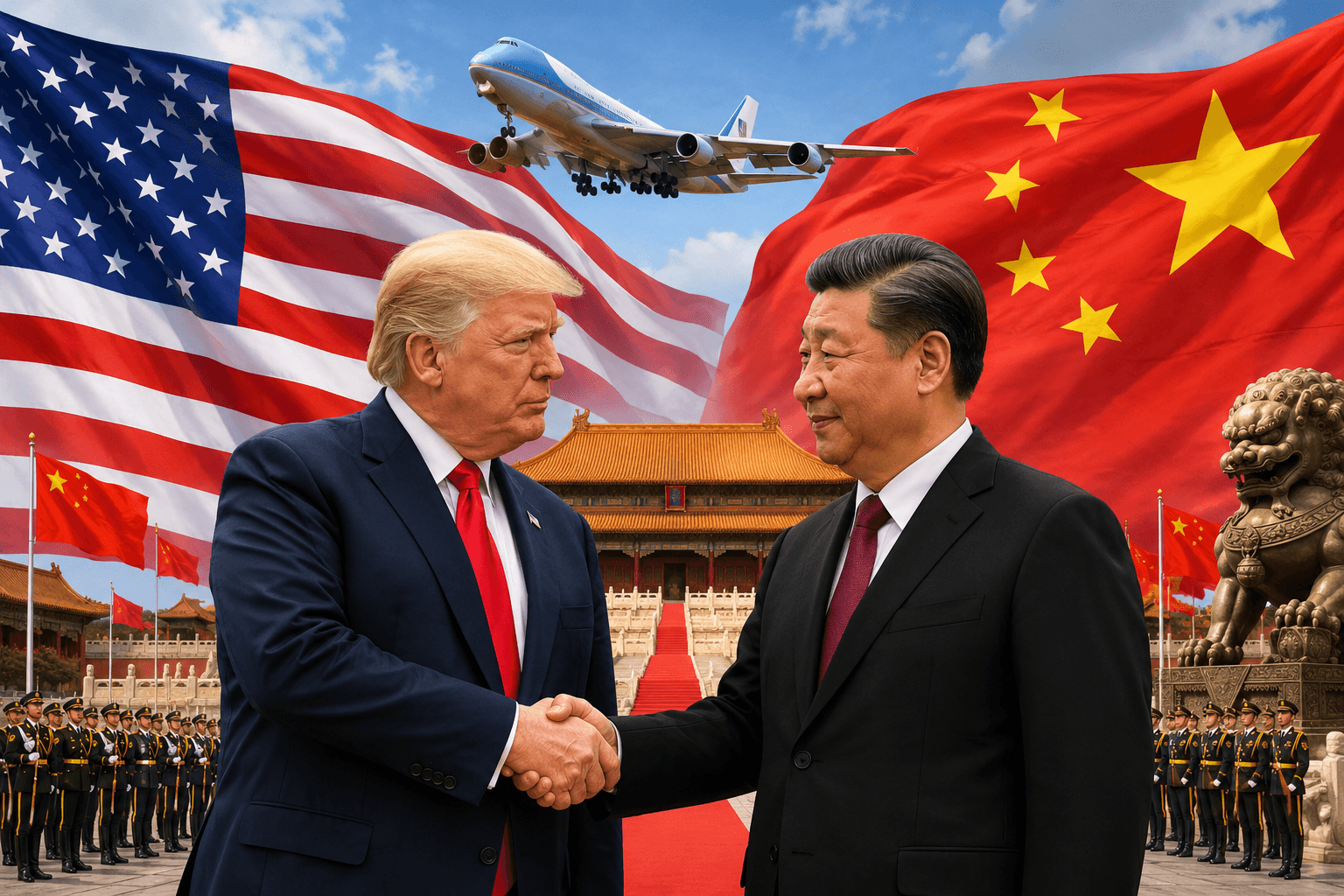
Most news coverage of Trump’s China visit focused on handshakes and photo opportunities. Professor Jiang cuts through all of that and explains what is actually happening beneath the surface. Whether you agree with his framework or not, the logic is difficult to dismiss.
The Room That Changed Everything
According to Professor Jiang, when Trump landed in Beijing something extraordinary happened.
In one room sat:
- Elon Musk (Tesla)
- Tim Cook (Apple)
- Larry Fink (BlackRock)
- Leaders of Goldman Sachs, Blackstone, Mastercard, Visa and Boeing
Combined company value: over $12 trillion.
As Professor Jiang puts it:
“You do not bring these people together in one room unless you have a mega deal to announce to the world.”
This was not diplomacy. This was a business negotiation at a scale the world has never seen.
To Understand Today, You Must Understand 1972
Professor Jiang argues that what is happening right now is almost identical to Nixon’s 1972 China visit — and for the exact same reason.
In 1971, Nixon removed the dollar from the gold standard. Suddenly the dollar was backed by nothing. The American financial system needed a new foundation urgently.
Nixon’s solution was brilliant and ruthless. He created two new systems to generate global demand for the dollar:
System 1 — The Petrodollar Middle Eastern nations would sell oil exclusively in US dollars. Anyone wanting energy now needed dollars first.
System 2 — China China would become the world’s manufacturing base. Everything it manufactured would be traded in dollars. China would accumulate dollars. Global dollar demand was saved.
According to Professor Jiang, this is the real reason Nixon opened China. Not ideology. Not geopolitics. Pure financial survival.
The Uncomfortable Truth About China
Here is where Professor Jiang makes his most provocative argument.
He describes China as a “hallucination of a hallucination.”
What does he mean?
The entire US dollar system is itself an illusion — a collectively agreed fiction that only works because everyone believes in it. China was created as an extension of that illusion. China only exists and prospers because it plugged itself into the dollar system.
This creates three fundamental weaknesses Professor Jiang identifies:
- No genuine creativity — a shadow of a shadow has nothing original to stand on
- Wealth always flows back to America — Chinese prefer dollars over yuan because they understand their own currency is built on dollars
- Extreme fragility — if the dollar system wobbles, China wobbles twice as hard
My observation: This explains something I always found puzzling — why despite decades of explosive growth, ordinary Chinese citizens do not feel wealthy. The growth benefited the system, not the people inside it.
Why The Trade War Started And Why It Is Ending
When China joined the WTO in 1999 it made two promises to America:
- Protect US intellectual property
- Open its financial sector to allow free yuan-dollar conversion
China kept neither promise.
Huawei copied Apple technology and built better phones. The financial sector stayed firmly closed because opening it would cause an immediate collapse — every Chinese citizen would convert yuan to dollars overnight.
This broken promise triggered Trump’s 2018 trade war. Eight years of economic conflict followed.
So why is it ending now?
Because according to Professor Jiang, China has finally run out of road. The Middle East war has cut off 50-60% of its energy supply. America controls the Western Hemisphere’s resources. China’s consumer confidence has collapsed. Its best students are leaving and not returning. Capital is fleeing the country disguised as export revenues — a $500 billion per year gap that is essentially legalised money laundering.
China needs this deal more than America does.
The Stable Coin Masterstroke — How America Offloads $39 Trillion of Debt
This is the part of Professor Jiang’s analysis that I found most jaw-dropping.
America has $39 trillion in debt. At 5% interest that means paying roughly $2 trillion per year just in interest — money it has to borrow again to pay back. The system is mathematically unsustainable.
The solution according to Professor Jiang is elegant and almost invisible:
Step 1: Create stable coins (like Tether and Circle) backed by US Treasuries
Step 2: Pass laws (the Genius Act and Clarity Act) forcing all stable coins to hold US Treasuries as backing
Step 3: Sell these stable coins to Chinese consumers through Apple, BlackRock and Visa — bypassing China’s closed capital account entirely
Step 4: Drop Treasury interest rates toward zero (financial repression) so inflation quietly destroys the debt over 50 years
The result: Chinese savers with a 40% savings rate — one of the highest in the world — unknowingly become the financiers of American national debt. All without China officially opening its capital account.
My observation: This is either genius or terrifying depending on which side of the Pacific you live on.
The Taiwan Bombshell
Professor Jiang predicts Trump may soon declare support for China-Taiwan reunification. This sounds like a massive American concession. According to the professor it is actually the opposite.
Here is the logic:
If Taiwan returns to China, the island now sits between South Korea and Japan on one side and Southeast Asia on the other. Japan and South Korea — who depend on Southeast Asian trade routes for their energy and resources — would be strategically strangled.
This means Japan and South Korea would have no choice but to confront China directly over Taiwan. America simply transfers an expensive geopolitical problem onto its allies while appearing to make a generous gesture toward Beijing.
As Professor Jiang bluntly puts it — it makes perfect strategic sense for Trump to hand Taiwan back to China.
My observation: If this prediction comes true it will be one of the most dramatic geopolitical reversals in modern history.
What Each Side Gets From The Grand Bargain
According to Professor Jiang the deal breaks down as follows:
China receives:
- Access to cheap energy from Venezuela and the Western Hemisphere
- Nvidia chips to power its AI development
- Access to the American consumer market
America receives:
- Access to Chinese financial markets and consumers
- Chinese consumers buying Treasury-backed stable coins — financing US debt
- China as an AI surveillance testing laboratory
- Chinese manufacturing investment inside America and Venezuela
The Surveillance Partnership Nobody Is Talking About
Professor Jiang makes a striking claim about AI that cuts against the dominant narrative of US-China tech rivalry.
He argues America and China are not competitors in AI. They are partners.
America has the technology. China has 1.4 billion people and essentially no privacy laws. According to Professor Jiang, America wants to use China as a testing ground for surveillance technology that could never be trialled on American citizens.
The AI war is theater. The surveillance state is the real project.
The Big Picture — Two Nations Trapped Together
Perhaps Professor Jiang’s most important insight is this:
The US and China cannot afford to let each other fail.
Both nations are the primary beneficiaries of the global economic system. If that system collapses — if people collectively wake up from what he calls the hallucination — everything falls apart simultaneously.
The trade war was China trying to escape the system. It failed. China is too deeply embedded in dollar dependency to leave.
So the grand bargain is not really about friendship or ideology. It is about two nations recognising they are chained to the same illusion and deciding it is better to maintain it together than destroy it separately.
Final Thoughts
Whether Professor Jiang is right or wrong about the details, his framework forces you to ask questions that mainstream media simply never raises.
Why did $12 trillion worth of executives fly to Beijing? Why did Jensen Huang board Air Force One mid-flight? Why is Trump — who built his brand on being tough on China — suddenly sitting down for what appears to be the most significant US-China deal in 50 years?
The answers the professor provides are uncomfortable. But they are logical.
Watch the original lecture and decide for yourself.
All analysis and predictions in this blog belong to Professor Jiang of Predictive History on YouTube. This is an independent educational summary. I do not own any of the ideas presented here. Watch the original video: [Predicitve History]
Disclaimer: This blog represents a summary of one analyst’s views and should not be taken as financial, political or legal advice.