Artificial intelligence may not simply replace routine jobs. Its biggest disruption could hit highly skilled, highly paid professionals who once believed their expertise made them indispensable.
That was the central warning in a discussion featuring Bret Weinstein, Daniel Priestley and Amjad Masad, who examined how rapidly advancing AI could reshape work, the economy and society.
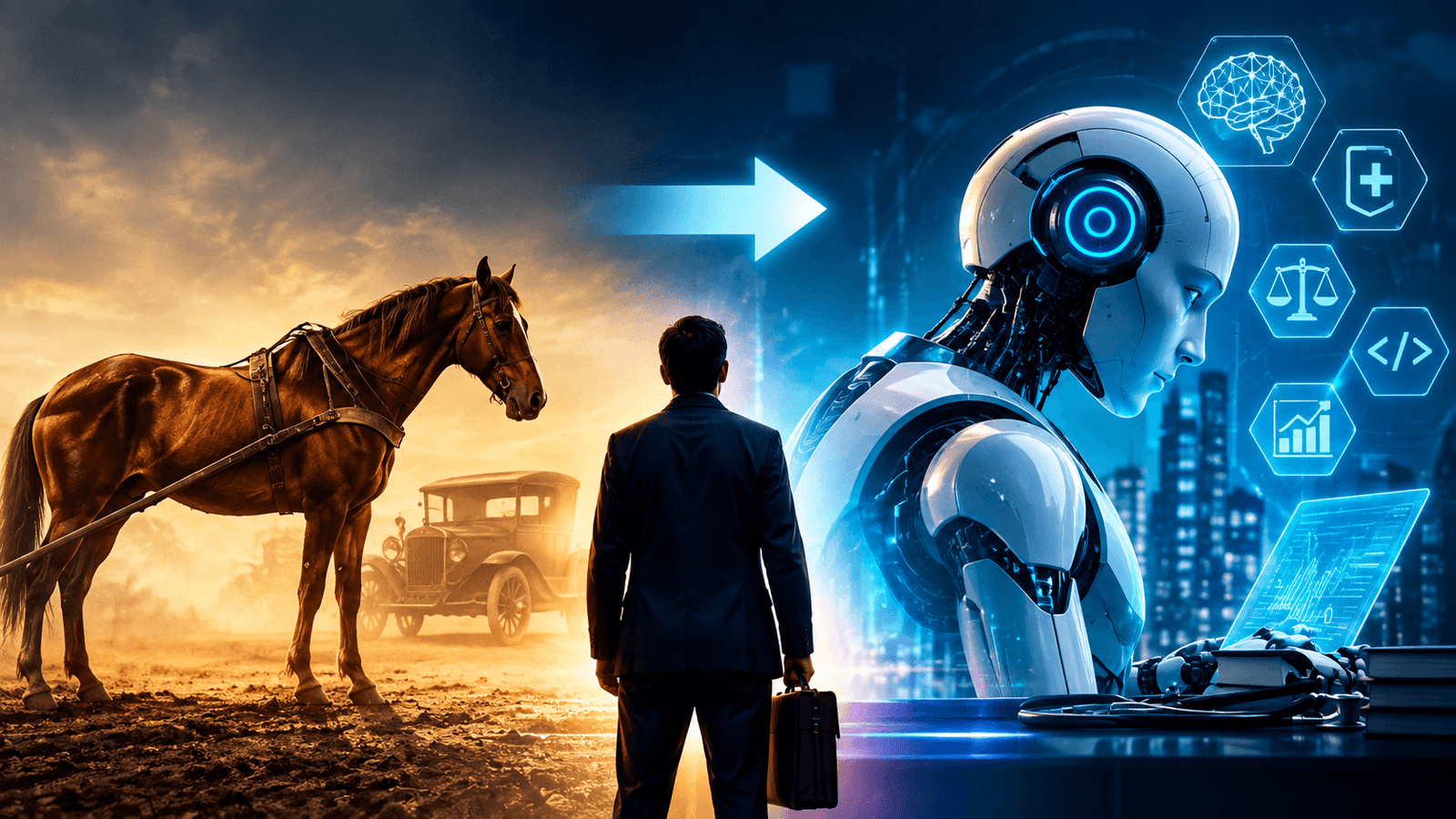
The horse analogy
Daniel Priestley offered a striking comparison.
In 1900, horses were essential to transport, farming and commerce. Yet within little more than a decade, the automobile began replacing much of their economic role.
The speakers argue that modern workers could face a similar disruption.
For generations, education offered a relatively stable formula: learn a skill, build expertise and pursue a career for decades. AI could break that model by automating cognitive tasks at unprecedented speed.
The uncomfortable question is: Are humans the horses of the AI age?
AI is moving up the career ladder
Previous technological revolutions primarily displaced physical or repetitive work. AI is different because it increasingly targets cognitive and specialised tasks.
The discussion points to professions such as anesthesiology, where AI and autonomous systems could eventually perform more of the monitoring and decision-making, potentially leaving humans in supervisory roles.
This could mean that automation does not stop at low-wage jobs.
Lawyers, programmers, designers, analysts and other knowledge workers may also face pressure as AI systems become more capable.
From 40-year careers to constant adaptation
The speakers suggest that professional life could become far more unstable.
Instead of preparing for one career lasting 30 or 40 years, workers may need to repeatedly reinvent themselves. A skill could remain economically valuable for only 10 to 36 months before AI changes the market again.
The future may therefore become a high-velocity economy, where learning and adaptation matter more than holding a fixed professional identity.
The global AI race is the biggest problem
There is also a collective-action dilemma.
Companies may recognise AI risks but fear slowing development while competitors continue. Governments face a similar problem: regulate too aggressively, and another country could gain an advantage.
This creates an AI “race” where everyone may want safety—but nobody wants to be the first to slow down.
The real danger: economic polarisation
The speakers warn that widespread AI-driven displacement could deepen inequality if productivity gains flow mainly to those who own AI systems and infrastructure.
Society has historically struggled to prepare workers before technological disruption arrives. The AI era could repeat that failure on a much larger scale.
The challenge, therefore, is not simply how to stop AI. That may be impossible.
The bigger question is whether society can redesign education, work and economic systems fast enough to ensure that human experience remains valuable.
AI may not end human work overnight. But it could dramatically shorten the lifespan of careers—and the world is still far from prepared.