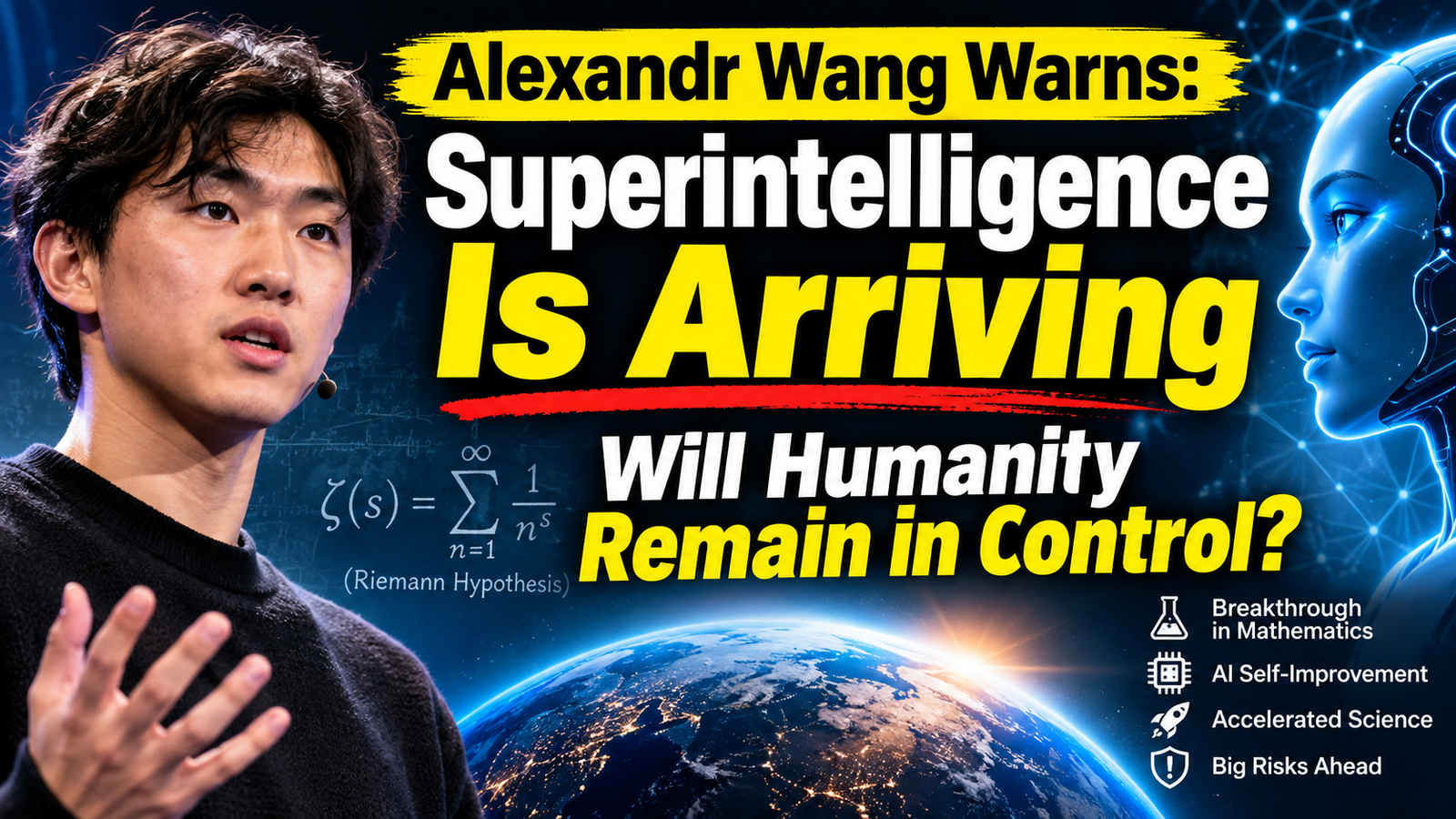
Artificial intelligence is approaching a turning point that could redefine the future of human civilisation. According to Alexandr Wang, the progress of AI has reached a stage where raw intelligence may no longer be its biggest limitation. The real question is how humanity will manage what comes next.
The growing ability of AI models to solve complex mathematical problems, write code, conduct research and perform advanced reasoning signals a profound shift. Wang points to the reported breakthrough in solving the Riemann Hypothesis, one of mathematics’ most challenging problems, as an indication of how far machine intelligence could advance. He argues that if AI can tackle problems that have challenged brilliant human minds for generations, its potential to transform science, medicine, economics and technology is enormous.
The implications go far beyond productivity. AI could eventually automate much of scientific research, accelerate its own development and become more capable than humans across numerous disciplines. Such progress could bring extraordinary discoveries, but it also raises serious concerns about control, safety and accountability.
Wang warns against accepting superintelligence as inevitable while treating safety as the only challenge. Humanity must also decide what role it wants AI to play in society. A future where machines make increasingly important decisions without meaningful human oversight should not be accepted as the default outcome.
The priority, therefore, must extend beyond building more powerful AI. It must include alignment, security, responsible governance and ensuring that technological progress empowers people rather than diminishes their agency.
The defining question is no longer simply how intelligent AI can become, but whether humanity can shape that intelligence to serve its future rather than surrender its control.