Chinese researchers have achieved a major milestone in optical communications by completing the world’s first bidirectional real-time transmission test over more than 1,000 kilometers of hollow-core optical fiber. The collaboration between China Telecom Research Institute, Yangtze Optical Fibre and Cable (YOFC), and ZTE successfully transmitted data across a 1,007.48-kilometer link, delivering 64 terabits per second in each direction for a combined capacity of 128 Tbps. Signals traversed the full distance in just 3.43 milliseconds one way.
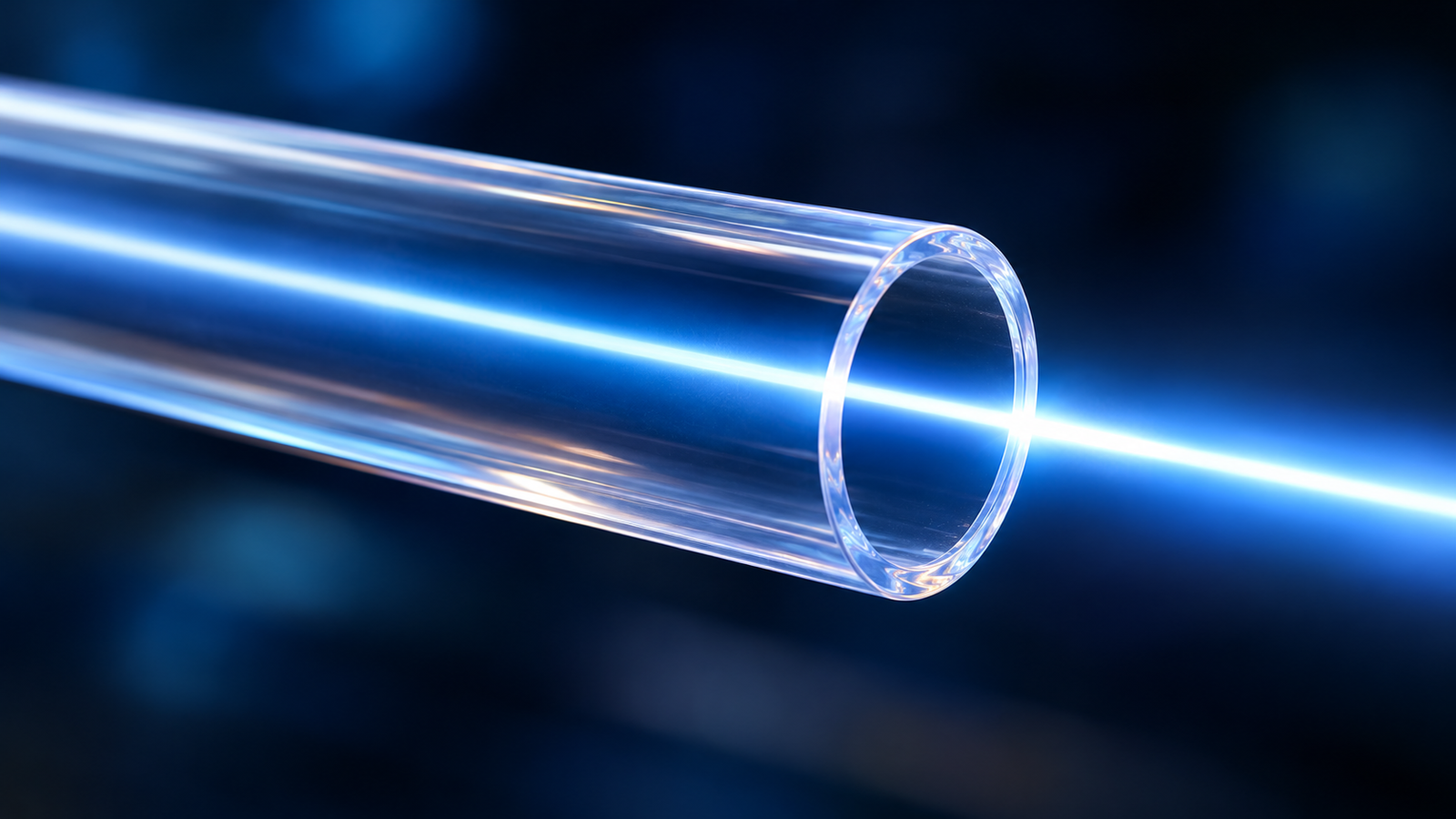
Hollow-core fiber differs fundamentally from conventional solid-core glass fibers. Instead of guiding light through a dense glass core, it channels light through an air-filled central cavity. Because light travels faster through air than through glass, the technology reduces latency by approximately 30 percent. The recent test also demonstrated roughly double the transmission capacity and a 60 percent longer reach compared with the best-performing solid-core fibers available today. Relative to earlier hollow-core experiments of a similar type, the distance achieved represents a fifty-fold improvement.
The trial used advanced modulation (PCS-16QAM) across the extended C+L wavelength bands, carrying 800 Gbps per wavelength while maintaining practical engineering margins for loss and signal quality. The system operated bidirectionally on a single fiber—an important practical step for real-world network deployment—while overcoming challenges such as gas-line absorption and reflections.
This breakthrough is already moving beyond the laboratory. Hollow-core fiber powers the world’s first cross-border commercial financial line between Shenzhen and Hong Kong and supports more than ten commercial and pilot projects across Asia and Europe. Experts highlight its particular value for AI data centers and large-scale computing networks. Ultra-low latency and massive bandwidth can accelerate the movement of training data between distant facilities, improve the efficiency of large-model training, and help reduce the overall cost of high-performance computing infrastructure.
As demand for computing power continues to surge, technologies that deliver both higher capacity and lower delay become essential building blocks for next-generation networks. The successful 1,007-kilometer bidirectional test provides concrete evidence that hollow-core fiber can support long-haul, high-capacity, low-latency links while remaining compatible with existing transmission equipment. Industry observers expect the technology to expand into broader backbone and data-center interconnect applications in the coming years, strengthening the foundation for advanced AI and cloud computing systems.