
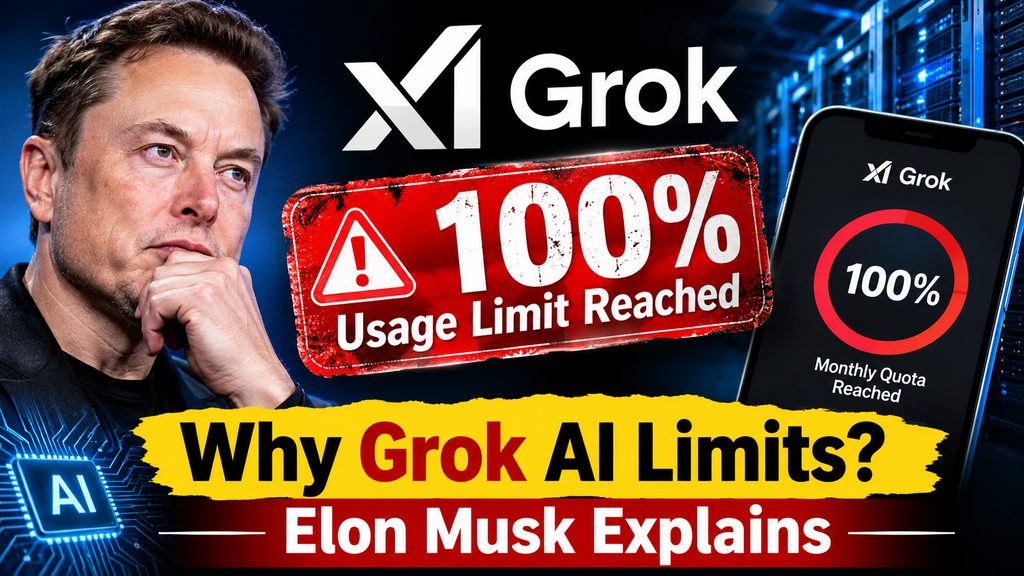
SpaceX revealed that Grok Bot’s expenses have surged beyond revenue, leading to strict usage caps for its 800,000 paid weekly users who more than doubled in a month. Musk noted the service’s explosive growth, now serving 0.01% of the world at full capacity, while frustrated users reported sudden meter spikes and some canceled high-tier plans like $300 monthly SuperGrok Heavy. Investor Jason Calacanis viewed the limits positively as proof of real value, comparing bots to $30-an-hour employees, and analysts suggested premium tiers for heavy users amid broader AI compute challenges.
On November 1, 2026, Elon Musk responded to complaints from Grok users whose usage quotas had reached 100% days before the monthly reset.
His explanation was direct: “The cost of serving Grok Bot was unsustainably high relative to revenue.”
Several accounts, including X/@ DogecoinNorway, had reported unusually rapid depletion of their usage allowances. The complaints raised questions about Grok’s usage limits, subscription value and the cost of operating advanced AI services.
Why is Grok expensive to operate?
Unlike traditional software, which can serve additional users at relatively low marginal cost, generative AI requires computing resources every time a model generates a response.
Each Grok interaction can consume:
- GPU computing power: AI accelerators process the model’s calculations.
- Electricity and cooling: Data centres require substantial energy to operate and manage heat.
- Data-centre capacity: Servers, networking infrastructure and hardware must support user demand.
- Additional computing resources: Longer conversations, complex prompts and certain advanced features can require more processing.
As usage increases, the cumulative cost of serving millions of interactions can rise significantly.
Musk’s statement indicates that, at the time of his response, the cost of providing Grok Bot had become too high relative to the revenue it generated.
Why do AI companies impose usage limits?
Usage quotas are one way to manage the financial and technical demands of operating AI models.
When computing costs grow faster than subscription revenue, companies have several options: increase prices, improve model efficiency, expand revenue sources or restrict usage.
Limits can help companies:
- Control the cost of serving each user.
- Manage demand during periods of heavy usage.
- Preserve computing capacity for other users and features.
- Reduce the risk of operating a service at a persistent loss.
However, quotas alone do not solve the underlying problem. Long-term sustainability depends on improving computing efficiency, managing infrastructure costs and generating sufficient revenue.
Is this a problem unique to xAI?
No. The economics of AI inference are a broader challenge for companies operating advanced language models.
Traditional software can often accommodate additional users without a proportional increase in operating costs. Generative AI is different: every response requires computation, although the cost varies considerably depending on the model, prompt length, hardware and serving efficiency.
AI companies therefore face a difficult balancing act. They must offer enough access to attract and retain users while ensuring that the cost of providing that access remains commercially viable.
The precise economics vary across companies, and Musk’s statement alone does not establish Grok’s overall profitability or the cost of each individual interaction.
What does this mean for Grok users?
For users, the immediate concern is whether their subscription provides enough usage capacity for their needs.
If quotas run out well before the reset date, users may find themselves unable to use the service as frequently as expected. This can be particularly frustrating for those who rely on Grok for research, coding or regular professional tasks.
Transparent communication about usage limits, reset schedules and subscription benefits can help manage expectations. Predictable quotas are also important for users deciding whether a paid plan offers sufficient value.
Critics may reasonably argue that xAI should anticipate demand and provide adequate infrastructure. However, rapidly changing usage patterns can complicate capacity planning, making adjustments necessary.
The economics behind Grok’s usage limits
Elon Musk’s explanation highlights a central challenge facing the generative AI industry: building a powerful AI model is only part of the business problem; serving it at scale must also be economically sustainable.
If the cost of providing AI services consistently exceeds the revenue they generate, companies must improve efficiency, adjust pricing or limit usage.
For Grok, the November 1 episode underscores the trade-off between generous access and the cost of running advanced AI systems. Whether future limits change will depend on how xAI balances user demand, computing efficiency and revenue.
Editorial note: The quoted statement and reported user complaints should be verified against the original November 1, 2026, posts before publication.