
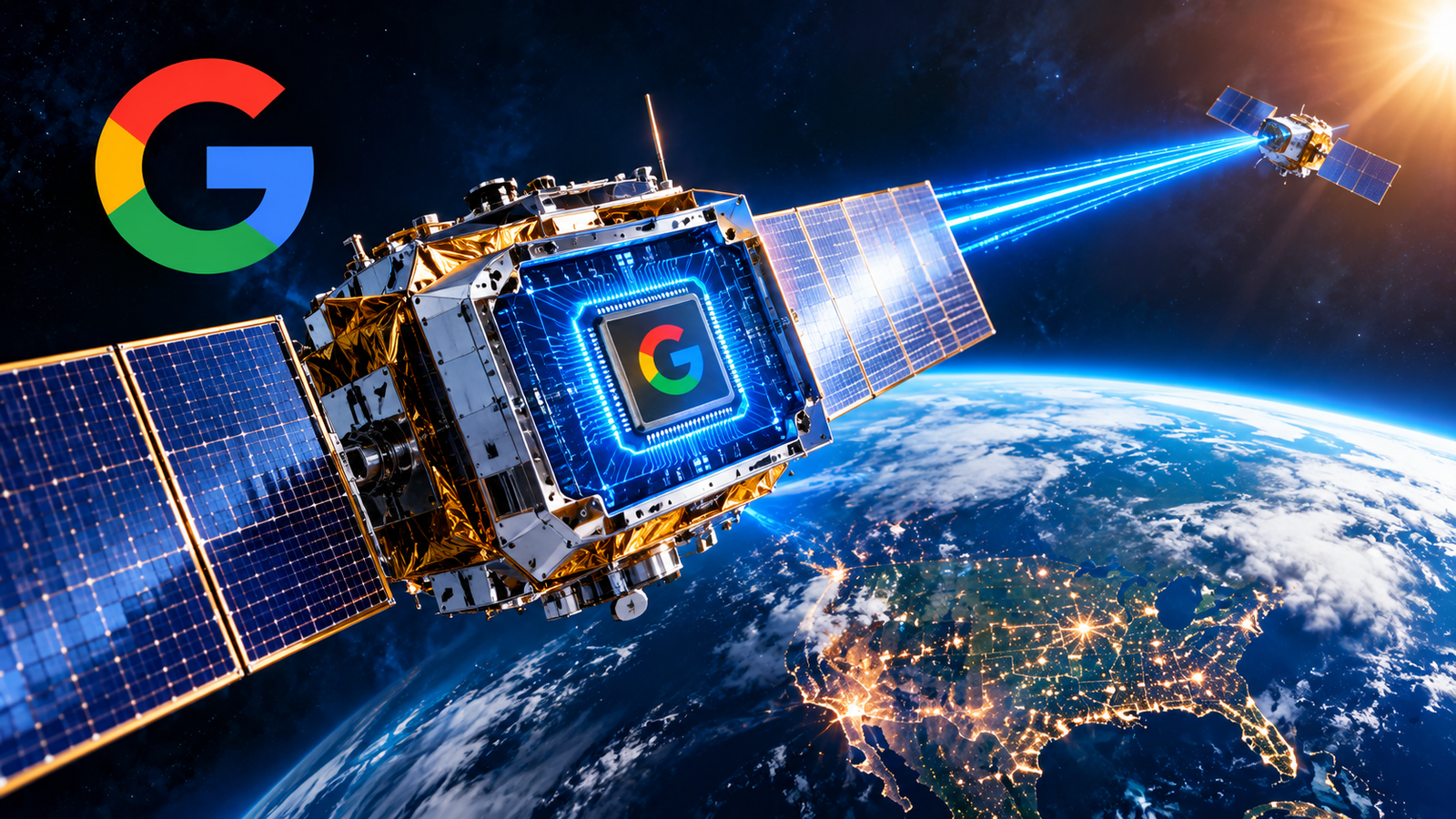
Google is preparing to test whether artificial intelligence computing can move beyond Earth’s data centres. Under Project Suncatcher, the company plans to launch a prototype satellite carrying its Tensor Processing Units (TPUs) to study whether space could eventually support large-scale AI infrastructure.
The experimental mission is scheduled to fly aboard SpaceX’s Transporter-18 rideshare launch, in partnership with satellite company Planet. It will examine how Google’s AI hardware performs under launch forces, radiation and extreme temperatures in low Earth orbit (LEO).
Why Put AI Chips in Space?
AI data centres require enormous amounts of electricity and cooling. Google’s long-term concept is to use solar-powered satellites that can receive near-continuous sunlight, potentially generating significantly more solar energy than comparable systems on Earth.
The company’s 2025 research proposed interconnected satellite clusters equipped with TPUs and high-bandwidth optical communication links. Such a system could eventually distribute machine-learning workloads across orbiting computing platforms. Google’s latest research update says low-Earth-orbit satellites could receive up to eight times more solar power than ground-based systems under suitable conditions.
The Engineering Challenges
The first test is not an operational orbital data centre. It is designed to identify technical failures and determine whether conventional AI hardware can survive in space.
Radiation is a major concern because cosmic rays and solar events can trigger bit flips—errors in electronic data. Google has tested its TPUs using radiation facilities at the University of California, Davis, but real orbital conditions require further validation.
Cooling is another obstacle. In space, conventional airflow is unavailable because of the vacuum. Google is therefore testing heat pipes and radiators to transfer heat away from power-intensive chips. Early reports indicate that the prototype will operate in short bursts rather than continuously.
What Comes Next?
Google plans to launch two satellites in 2027 to test high-bandwidth laser links between orbital computing systems. These connections would be essential for coordinating distributed AI workloads.
However, commercial deployment remains years away. Launch costs, radiation protection, thermal management, satellite manufacturing and orbital maintenance could make space-based computing expensive.
Project Suncatcher is therefore a research experiment, not an immediate replacement for terrestrial data centres. Its importance lies in testing whether space could become a future location for the energy-intensive computing demands of advanced AI.