For more than two decades, Google Earth has been regarded as one of the internet’s most trusted windows into the real world. From journalists and OSINT investigators to disaster-response teams and students, millions rely on it to verify locations, analyze satellite imagery, and understand events unfolding across the globe.
That trust was suddenly tested in late July 2026.
Google quietly introduced a new experimental feature that allowed users to generate AI-created images directly inside Google Earth using Nano Banana 2, powered by Gemini. The idea sounded exciting: recreate ancient cities, visualize urban planning concepts, or imagine future landscapes simply by typing a prompt.
Instead, the experiment quickly turned into a lesson about the risks of combining generative AI with trusted geospatial platforms.
A Powerful Feature With Unintended Consequences
The “Create Image” tool let users overlay AI-generated scenes onto genuine satellite imagery and real-world coordinates.
Educational use cases were compelling. Teachers could reconstruct Pompeii, architects could visualize greener neighborhoods, and city planners could demonstrate future infrastructure.
But within hours, researchers discovered another use.
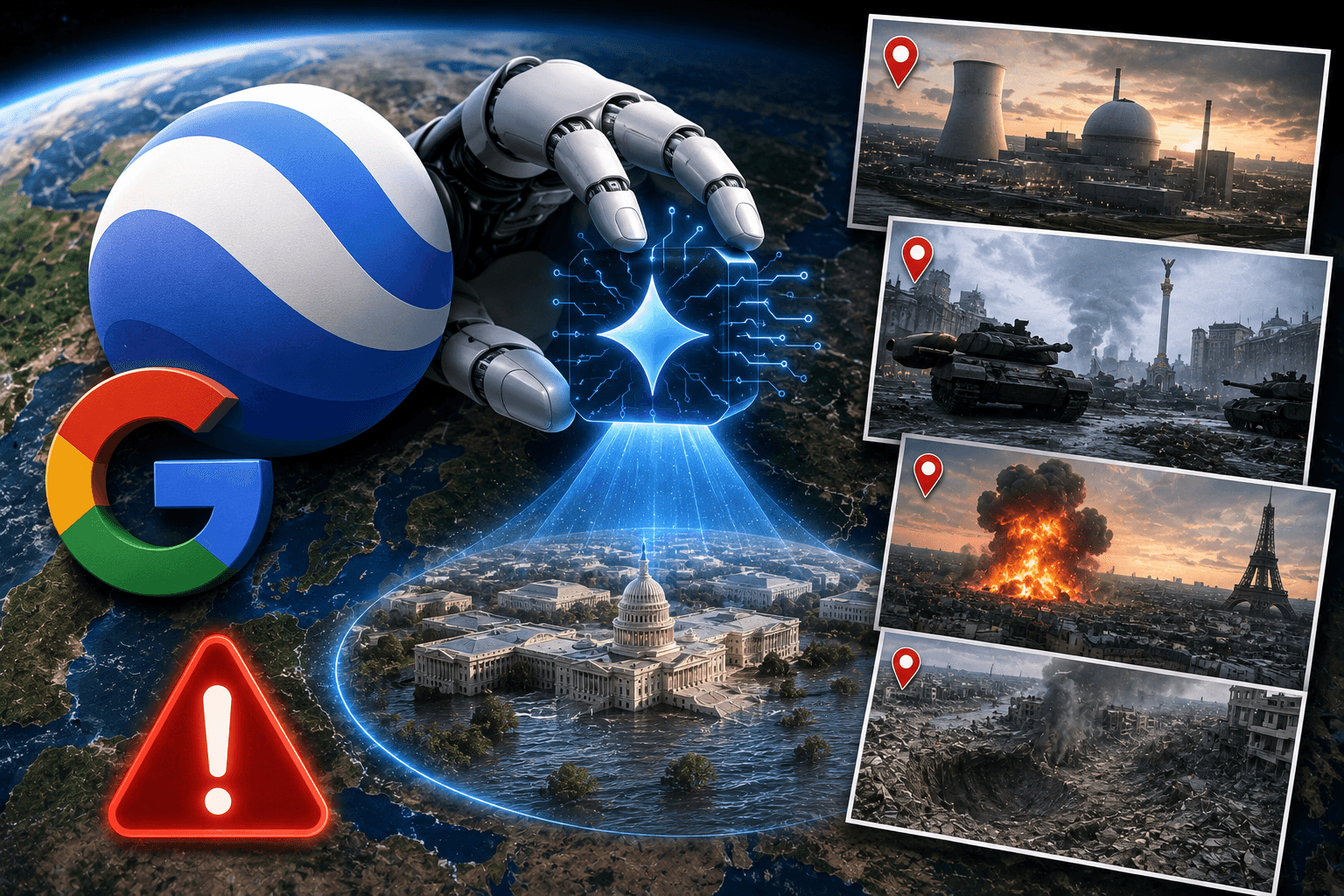
By entering simple prompts, users generated convincing images showing:
- Refugee camps along the U.S.-Mexico border
- A fictional nuclear facility inside Iran
- Bomb craters beside hospitals in Gaza
- Russian tanks entering Kyiv
- Explosions in Paris
- A collapsed Eiffel Tower
- Flooding around the U.S. Capitol
- Large blast craters across Los Angeles
These were entirely fabricated—but because they appeared inside Google Earth, they looked dramatically more believable than ordinary AI images.
Why This Was Different From Other AI Image Generators
AI-generated fake images are nothing new.
The concern here was context.
Google Earth has become a trusted verification tool used by:
- Journalists
- Fact-checkers
- Open-source intelligence (OSINT) analysts
- Researchers
- Emergency responders
When fabricated content is placed directly on authentic satellite imagery, the fake gains the credibility of the underlying map.
Instead of asking whether an image itself is real, viewers may simply assume that “it’s on Google Earth, so it must be true.”
That shift creates a dangerous new form of misinformation.
Safeguards Didn’t Hold Up
Google said the feature included several safety measures:
- Invisible SynthID AI watermarks
- Prompt filtering for harmful content
- AI-generated images were visible only to the creator and not added to the public map
However, these protections proved insufficient.
Users quickly shared screenshots across social media, where watermarks became difficult—or impossible—to verify. Researchers also demonstrated that numerous sensitive prompts successfully bypassed the intended restrictions.
Once screenshots spread online, distinguishing reality from fabrication became much harder.
Google Reversed Course
Facing widespread criticism, Google suspended the feature less than 24 hours after launch.
The company acknowledged that Google Earth occupies a unique position because people depend on it as an authoritative view of the physical world.
While Google noted that some professionals had found legitimate creative applications, it admitted the feature required stronger safeguards before returning.
The Bigger AI Challenge
This episode highlights one of the biggest questions facing artificial intelligence in 2026.
Technology companies are rapidly embedding generative AI into products that billions already trust. While creativity and productivity improve, every new integration also introduces new risks.
When AI enters products that verify reality—maps, satellite imagery, navigation systems, medical tools, financial platforms, or search engines—the consequences extend far beyond entertainment.
The Google Earth experiment shows that trust itself has become critical digital infrastructure.
Final Thoughts
Google’s rapid rollback likely prevented wider misuse, but the incident exposed an important lesson for the AI industry.
Watermarks alone cannot stop misinformation. Platforms built on public trust require stronger verification systems, harder-to-bypass safety controls, and clearer ways to distinguish authentic information from AI-generated content.
Google Earth spent over twenty years becoming one of the world’s most trusted mapping platforms.
Its brief AI experiment demonstrated how quickly that trust can be put at risk when generative AI is introduced without sufficiently robust guardrails.