Meta’s newest AI tool lasted only a few days before the company was forced into a dramatic U-turn.
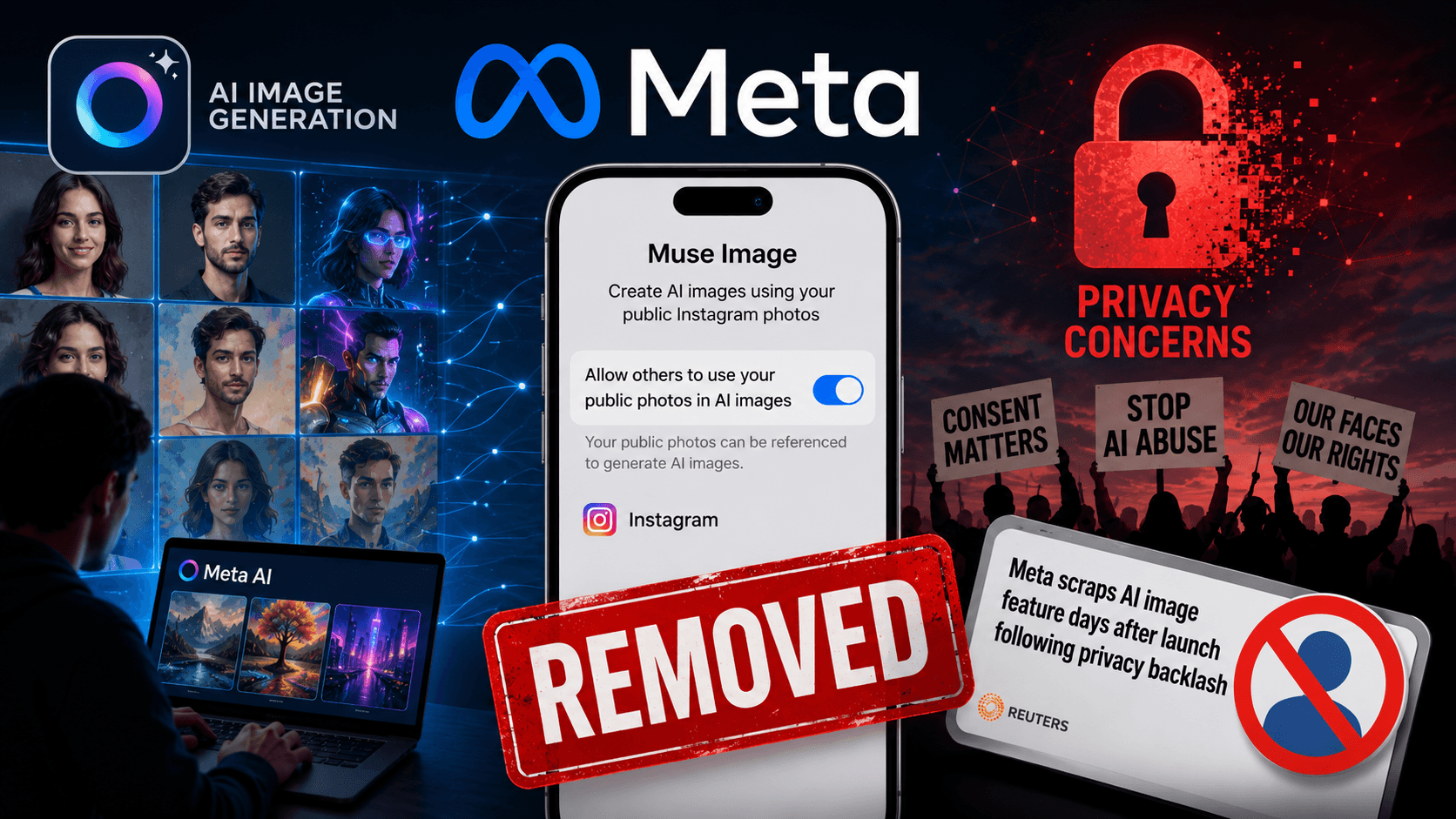
On July 10, 2026, Meta announced it was discontinuing one of the headline features of its newly launched Muse Image AI model, after facing intense criticism over privacy, consent, and the use of public Instagram photos.
The feature allowed users to generate AI images using public Instagram accounts as references. Although Meta said the goal was to provide a creative tool, critics argued that it effectively enabled anyone to create AI-generated images based on another person’s publicly shared photos—without explicit permission.
Within 72 hours of launch, the backlash had spread from privacy experts to Hollywood actors, labor unions, creators, and regulators, forcing Meta to abandon the feature.
What Was Muse Image?
Muse Image is the first image-generation model developed by Meta Superintelligence Labs, Meta’s new AI division focused on competing with OpenAI, Google, xAI, Anthropic, and other frontier AI developers.
Integrated into the Meta AI chatbot, Muse Image can:
- Generate images from text prompts
- Edit existing images
- Transform photos using sketches
- Create AI artwork for social media and messaging apps
The feature was designed to make AI-powered image creation easier for Instagram, Facebook, and WhatsApp users.
But one capability immediately became controversial.
The Feature That Sparked the Outrage
Meta initially introduced an option that allowed users to reference public Instagram accounts while generating AI images.
The setting was enabled by default for many eligible public profiles.
Critics argued that this represented an opt-out system rather than an opt-in one.
In other words, users’ public photos could potentially be referenced unless they actively disabled the feature.
Privacy advocates warned that such a design weakened meaningful consent and increased the risk of misuse, particularly as generative AI becomes capable of producing highly realistic images.
The controversy rapidly spread across social media.
Hollywood Joins the Protest
The backlash soon extended beyond technology circles.
Emmy Award-winning actor Hannah Einbinder, best known for the television series Hacks, publicly criticized Meta after discovering that the feature had been enabled automatically on her account. She urged Instagram users to disable the setting immediately.
Even more significant was the response from SAG-AFTRA, the union representing more than 160,000 actors, broadcasters, journalists, recording artists, and other media professionals.
The union issued a strongly worded statement arguing that anything short of a clear opt-in system for AI use of people’s images was unacceptable.
It warned that the dangers of non-consensual digital replicas are already well understood and described Meta’s implementation as a serious misjudgment of public expectations regarding AI safety.
Meta Reverses Course
Facing growing criticism, Meta announced that it would discontinue the feature.
In its official statement, the company said:
“Our intent was to provide a useful creative tool and to give people control over whether their public content could be referenced in this way.”
Meta acknowledged that it had received widespread feedback indicating the feature “missed the mark” and confirmed that it was no longer available.
Following the announcement, SAG-AFTRA welcomed the decision, calling it “the responsible thing to do” given the risks associated with AI-generated digital replicas.
Why This Matters Beyond Meta
The Muse Image controversy highlights one of the biggest challenges facing artificial intelligence today:
Consent.
As AI systems become capable of generating highly realistic images, voices, and videos, companies are increasingly being asked difficult questions:
- Should publicly available photos automatically become AI training material?
- Should users have to opt out—or explicitly opt in?
- Who owns an individual’s digital likeness?
- How can companies prevent AI-powered impersonation and deepfakes?
These questions are no longer theoretical.
They are becoming central issues in AI regulation worldwide.
The Bigger AI Trend
The timing is particularly significant.
The AI industry is moving rapidly toward multimodal systems capable of generating text, images, audio, and video from simple prompts.
Recent launches from Meta, Google, OpenAI, xAI, and Chinese AI companies such as DeepSeek and Zhipu AI have dramatically expanded these capabilities.
At the same time, governments are introducing stricter rules around transparency, copyright, and user consent.
The Muse Image episode illustrates that technical innovation alone is no longer enough.
Public trust has become just as important.
The Bottom Line
Meta’s decision to withdraw the feature only days after launch sends a clear message to the technology industry.
People are increasingly willing to embrace AI-powered creativity—but not at the expense of privacy and informed consent.
The controversy demonstrates that in the race to build the most powerful AI tools, companies must also earn user trust.
As generative AI becomes part of everyday life, the most successful products may not simply be the smartest—they will be the ones that give people meaningful control over how their own images, identities, and digital lives are used.