One world. Five clues. A mission already in deep space. A treasure chest worth quadrillions. And it could completely change how humanity thinks about mining, resources, and the future of space.
NASA launched a spacecraft toward it in October 2023. It is not a planet. Not a moon. Not even a dwarf planet. Yet some estimates suggest the metals locked inside it could be worth more than the entire global economy combined. Can you name it before the final clue?
Clue #1 — NASA Is Already On Its Way
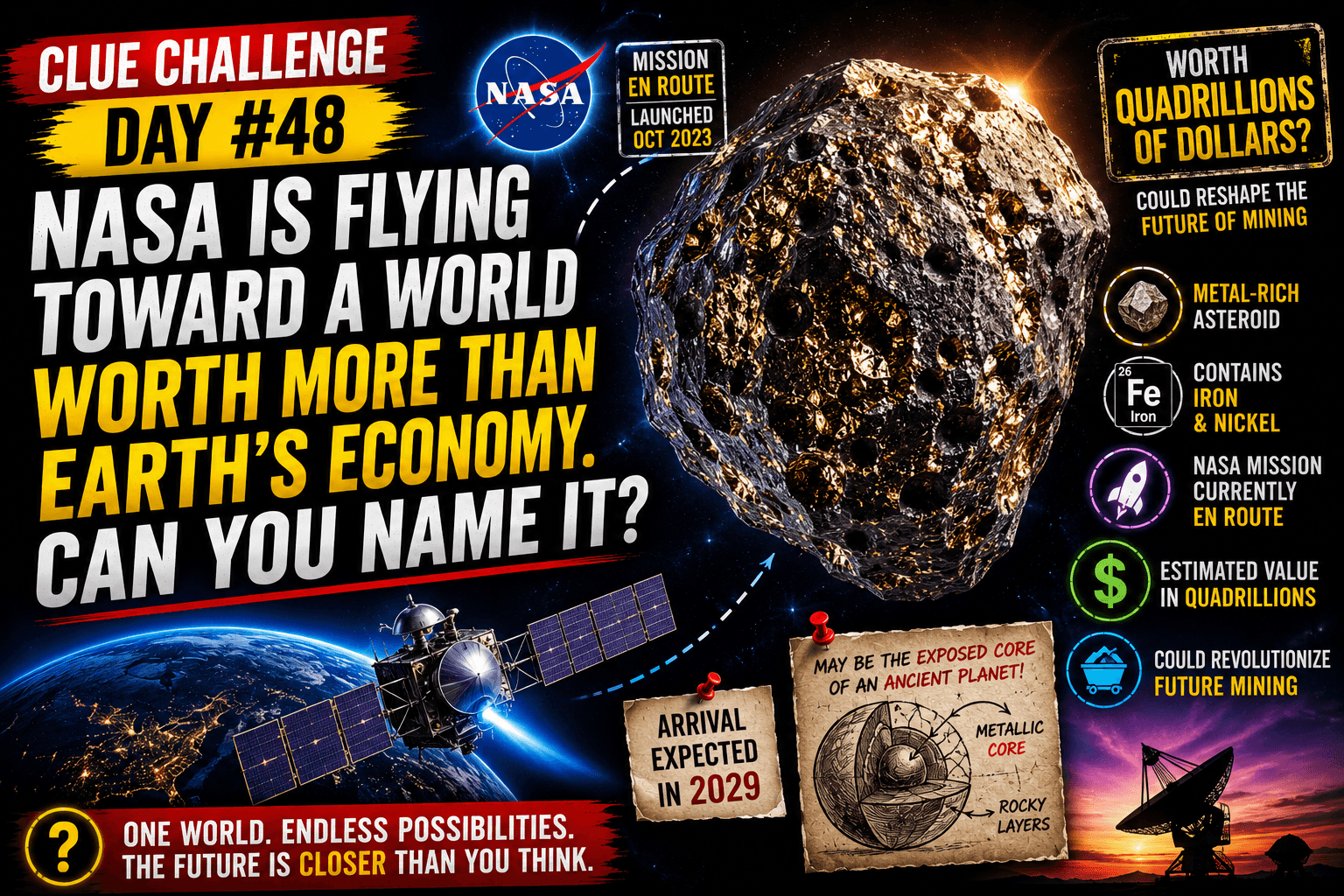
In October 2023, NASA launched a spacecraft on a six-year journey to investigate one of the most unusual objects ever discovered in our Solar System.
The mission is currently cruising through deep space and remains on track for arrival in 2029.
Scientists believe this object may be the exposed metallic core of an ancient protoplanet — a building block from the earliest days of the Solar System.
If true, it offers a rare chance to study something normally hidden deep inside planets like Earth.
Clue #2 — It Is Made Mostly of Metal
Unlike most asteroids, which are rocky or icy, this object appears extraordinarily rich in iron and nickel.
Those are the same metals that make up much of Earth’s core.
Radar observations and spectral analysis suggest it contains vast quantities of metallic material packed into a single body roughly 220 kilometers (140 miles) across.
Scientists often describe it as one of the most metal-rich objects ever observed.
Clue #3 — Headlines Keep Calling It the “Quadrillion-Dollar Asteroid”
The object frequently returns to the news because of its astonishing theoretical value.
Popular estimates place the value of its metals in the quadrillions of dollars.
Experts caution that these figures are hypothetical — flooding Earth’s markets with such resources would instantly destroy current metal prices.
Still, the numbers highlight just how extraordinary the asteroid is.
Few celestial objects have generated as much discussion about the future of space mining.
Clue #4 — It Could Rewrite How Planets Form
The mission is not primarily about getting rich.
NASA’s bigger goal is scientific.
Researchers want to understand whether this object is the exposed core of a failed planet that lost its outer layers billions of years ago after catastrophic collisions.
If that theory is correct, it would provide humanity’s first direct look at a planetary core without having to drill thousands of kilometers beneath Earth’s surface.
In other words, this mission could reveal how rocky worlds like Earth were built.
Clue #5 — Its Name Comes From Ancient Mythology
This object shares its name with a famous figure from Greek mythology associated with the soul.
The spacecraft carrying the same name will spend more than two years orbiting and mapping the object after arrival.
By the early 2030s, scientists hope to have produced the most detailed metallic world survey ever attempted.
What started as a mysterious asteroid may become one of the most important scientific destinations of the century.
So — What Is It?
A metal-rich world.
A possible exposed planetary core.
Packed with iron and nickel.
Currently being visited by a NASA spacecraft launched in 2023.
Frequently described as the “quadrillion-dollar asteroid.”
And one of the most important space exploration targets of the 2020s.
Bonus — Can You Also Name?
- The NASA mission launched toward it in October 2023
- The year the spacecraft is expected to arrive
- The two metals believed to dominate its composition
- The planetary structure scientists think it may represent
Drop your answer below. Unlike Wordle, this puzzle is orbiting the Sun between Mars and Jupiter — and NASA is already chasing it.
Missed yesterday’s challenge?
Clue Challenge Day #47: Fewer Than 800 Remain. Can You Name the World’s Rarest Great Ape?
Answer to Yesterday’s Challenge: DAY #47
(Click above to reveal)