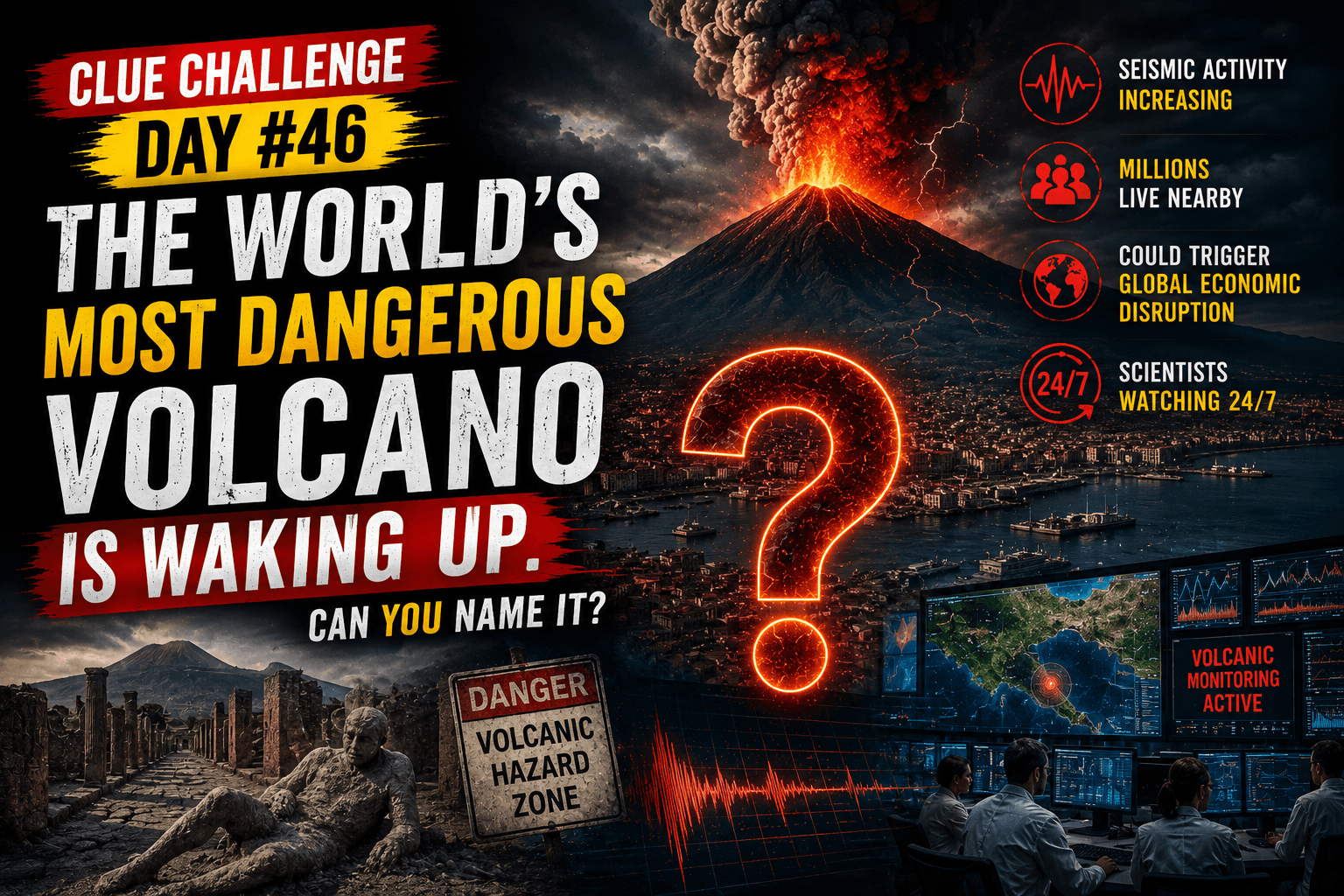
One volcano. Five clues. Nearly three million people nearby. A history of catastrophe. And fresh warning signs making headlines in 2026.
It destroyed an entire Roman city in a single day. It sits beside one of Europe’s most densely populated metropolitan areas. Scientists have recently recorded renewed seismic activity beneath it, prompting closer monitoring and emergency planning. If it erupts again, the impact could extend far beyond one country.
Can you identify it before the final clue?
Clue #1 — Millions of people live in its shadow
Few volcanoes on Earth are considered as dangerous as this one.
It remains the only active volcano on mainland Europe and is considered one of the world’s most dangerous due to the densely populated metropolitan area of Naples (including over 3 million residents) surrounding its base.
Unlike remote volcanoes, an eruption here would immediately become a humanitarian crisis.
That alone keeps emergency planners awake at night.
Clue #2 — Scientists have been tracking increased seismic activity
In recent months, Italian authorities and volcanologists have reported recurring earthquake swarms and ground deformation in the broader volcanic region.
Most tremors have been minor, but the activity has renewed public attention and triggered continuous monitoring.
Scientists stress there is no immediate sign of a major eruption, yet they are watching developments around the clock.
It had been dormant for centuries before exploding in 79 AD, burying surrounding settlements in deep ash and lethal pyroclastic flows. Pliny the Younger documented the event, leading to the term “Plinian” eruption.
When one of the world’s most famous volcanoes starts making news again, people pay attention.
Clue #3 — It once erased entire communities in hours
Nearly 2,000 years ago, this volcano produced one of the most infamous eruptions in human history.
A towering column of ash and gas rose into the atmosphere.
Pyroclastic flows swept across nearby settlements.
Entire communities were buried beneath volcanic debris, preserving buildings, streets, and even victims in astonishing detail.
Today, those ruins remain among the world’s most visited archaeological sites.
Clue #4 — An eruption today could disrupt far more than tourism
This volcano sits near major transportation networks, ports, industries, and critical infrastructure.
A significant eruption could:
- Force large-scale evacuations
- Shut down airports
- Disrupt Mediterranean shipping routes
- Damage agriculture across southern Europe
- Trigger economic losses measured in billions of dollars
The consequences would extend well beyond the immediate blast zone.
Clue #5 — Its name has become synonymous with disaster
Few volcanoes are famous enough to be recognised worldwide by a single name.
This one is.
It towers above a bay celebrated for its beauty, while carrying a reputation built on one of history’s deadliest natural disasters.
Its silhouette appears in textbooks, documentaries, and disaster preparedness plans alike.
For volcanologists, it remains one of the most closely watched mountains on Earth.
So — Which Volcano Is It?
A volcano that destroyed ancient cities.
A volcano overlooking millions of people.
A volcano making headlines again because of renewed seismic activity and continuous scientific monitoring.
A volcano whose next major eruption would become a global news event within minutes.
Can you name it?
Bonus Challenge
Can you also name:
- The famous Roman city buried during its most notorious eruption?
- The year that catastrophic eruption occurred?
- The Italian city located closest to the volcano?
- The volcanic hazard that caused most of the deaths during the ancient disaster?
Drop your answer below. Unlike Wordle, this puzzle is being monitored 24 hours a day by scientists who hope they never have to see history repeat itself.
Stay Tuned for Next Challenge Day 47
Missed yesterday’s challenge?
Clue Challenge Day #45: Microsoft Just Dropped a 1,000x More Reliable Quantum Chip. Can You Name It?
Answer to Yesterday’s Challenge: DAY #45
(Click above to reveal)