One chip. Five clues. Unveiled June 2, 2026. The boldest quantum claim in years — or the world’s most expensive gamble. All real. You decide.
It uses a material found in hospital X-ray shields. It was partly designed by an AI. It stores data using exotic ghost particles predicted by a physicist who vanished without trace in 1938. Microsoft says it just halved its timeline to a practical quantum computer. Independent physicists say the evidence is thin. Can you name this chip before the final clue?
Clue #1 — The world’s most ambitious quantum chip was unveiled this week — and the number is almost unbelievable
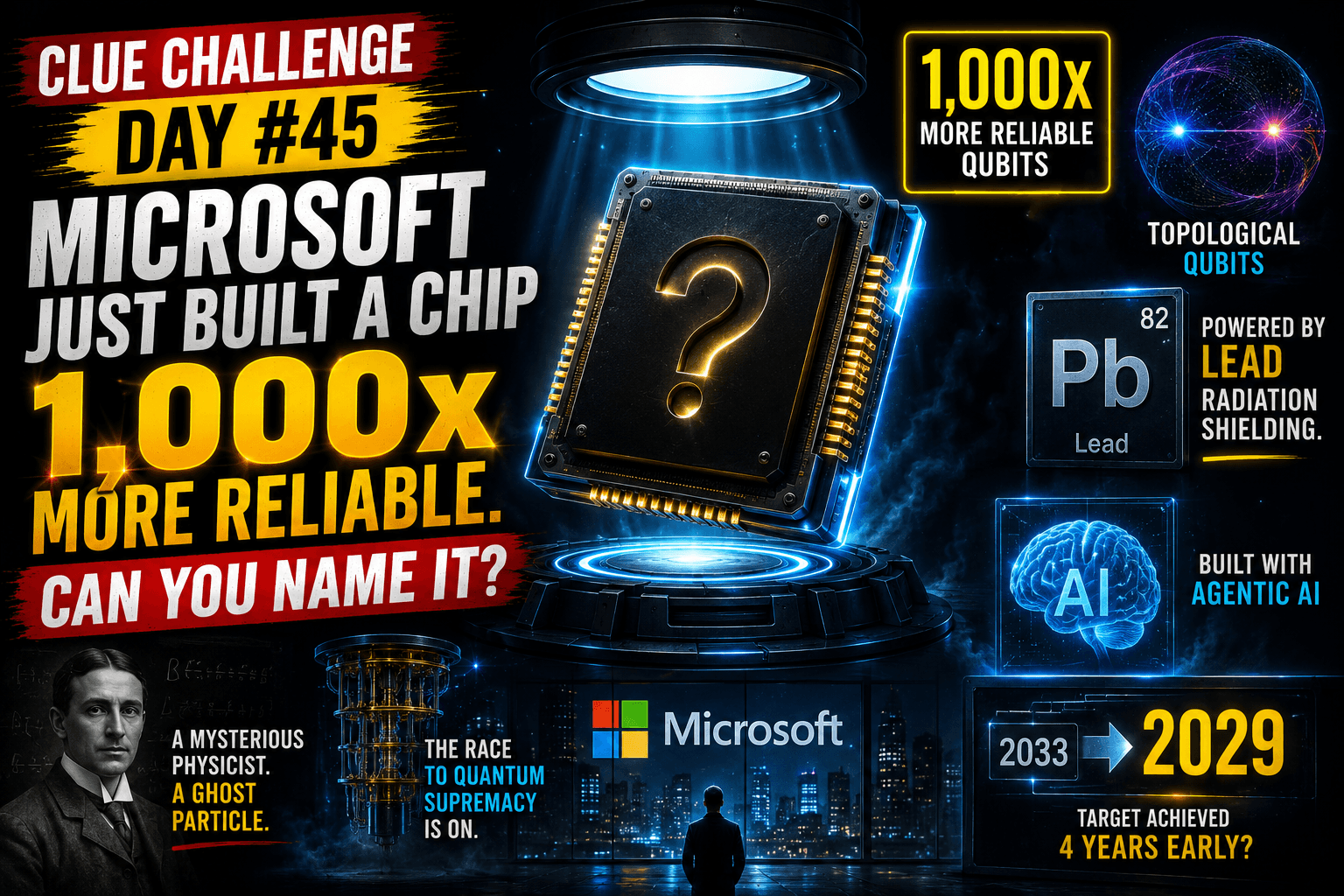
The chip arrived at Microsoft Build 2026 with numbers that are genuinely difficult to contextualise: qubits 1,000 times more reliable than those of the first-generation model, a mean qubit lifetime of 20 seconds against an industry norm measured in microseconds, and a revised roadmap targeting a commercially scalable quantum computer by 2029.
Microsoft’s own analogy: a phone battery that, instead of dying in a day, lasts nearly three years on a single charge.
Outside experts say the topological qubit approach it relies on does not work and never has — with Microsoft having had to retract or correct earlier claims twice already, in 2021 and 2025.
The biggest quantum claim of 2026. The most contested number in physics. Named after a ghost.
Clue #2 — It swapped aluminium for lead — and an AI figured out how to make lead stick to a chip
Where Google, IBM, and most others run superconducting wires made of aluminium, Microsoft went with lead — a heavier atom widely used in hospital radiation shields. The company leaned on AI tools built for materials science to make the switch work. The hard part was getting lead — which dissolves in water — to stay on a chip through manufacturing instead of washing away.
Microsoft’s Discovery AI turned 20 years of accumulated research data into a working breakthrough in only 16 months — compressing what would have taken a generation of human researchers into under two years.
An AI designing a quantum chip. A quantum chip that will eventually make that AI exponentially more powerful. The two greatest technological revolutions of the 21st century — building each other.
Clue #3 — It stores data using ghost particles predicted by a physicist who vanished without trace in 1938
Traditional qubits store data in a single particle — making them fragile, error-prone, and exquisitely sensitive to vibration, heat, and electromagnetic noise.
Unlike traditional qubits, topological qubits store information across two or more exotic quasiparticles simultaneously. Because information is encoded in the relationship between particles rather than a single particle’s state, local noise — the primary enemy of quantum computing — cannot easily disturb the data.
The quasiparticles at the heart of this chip are named after a brilliant Italian theoretical physicist. He predicted their existence in a landmark paper. Then, in March 1938, he boarded a passenger ferry between Palermo and Naples — and was never seen again. His ticket stub was found. His body never was. His particle may not physically exist either. And yet, one of the world’s largest technology companies has staked its entire quantum future on his name.
His surname — appended with the number 2 — is the answer you are looking for.
Clue #4 — Microsoft just halved its timeline — from 2033 to 2029. IBM set the same deadline last month.
Microsoft cut its timeline for achieving a scalable, practical quantum computer from 2033 to 2029 — halving its development roadmap in a single announcement at Build 2026.
That 2029 date lines Microsoft up directly with IBM, which last month committed $10 billion to quantum machines and spun off a separate company to build quantum chips — backed by President Trump’s administration.
Global quantum computing funding reached $12.6 billion in 2025 — a 6.3-fold increase from 2024. Industry revenue exceeded $1 billion for the first time and is projected to reach $4.4 billion by 2028.
Two tech giants. One deadline. $12.6 billion in play. The entire encryption infrastructure of the internet in the balance.
Clue #5 — The AI platform that built it is now available to every researcher on Earth
Behind the chip is Microsoft Discovery — the company’s agentic AI platform for scientific R&D — which also reached general availability this week, making it accessible to research teams worldwide.
Microsoft Discovery used autonomous AI agents to automate chip testing, accelerate fabrication workflows, and compress a research timeline that would have taken a human team decades into under two years.
The tool that built this chip. Now open to everyone. To build the next one faster still.
One chip. Named after a vanished physicist. Built partly by AI. Carrying the number 2. And carrying the weight of Microsoft’s entire quantum future on its lead-lined shoulders.
So — what is this chip?
Unveiled June 2, 2026 at Microsoft Build. Second-generation topological quantum processor. Lead-based superconductor. 1,000x more reliable qubits. Qubit lifetime up to one full minute. Partly designed by agentic AI. Targeting a scalable quantum computer by 2029. Named after a theoretical particle predicted by a physicist who disappeared from a ferry in 1938 — and whose particle, like its creator, has never definitively been proven to exist.
Its name is one word, one number, and one of the great unsolved mysteries of 20th century physics.
Bonus — can you name:
- The Italian physicist it is named after — and the year he disappeared
- The agentic AI platform Microsoft used to design it
- The predecessor chip released on February 19, 2025
- The competing tech giant racing Microsoft to the same 2029 quantum deadline
Drop your answer below. Unlike Wordle, this one could crack every password on Earth within a decade. Day #46 arrives tomorrow.
Missed yesterday’s challenge?
Clue Challenge Day #44: It Survived Space, Extinction & Cancer Labs. Name This Animal.
Answer to Yesterday’s Challenge: DAY #44
(Click above to reveal)