At Microsoft Build 2026, CEO Satya Nadella unveiled something much bigger than new software updates.
The company revealed a future where AI agents replace apps, powerful AI models run directly on your desk, and intelligent assistants become embedded in everyday devices.
If these plans succeed, the next decade of computing may look very different from today’s smartphone-and-app ecosystem.
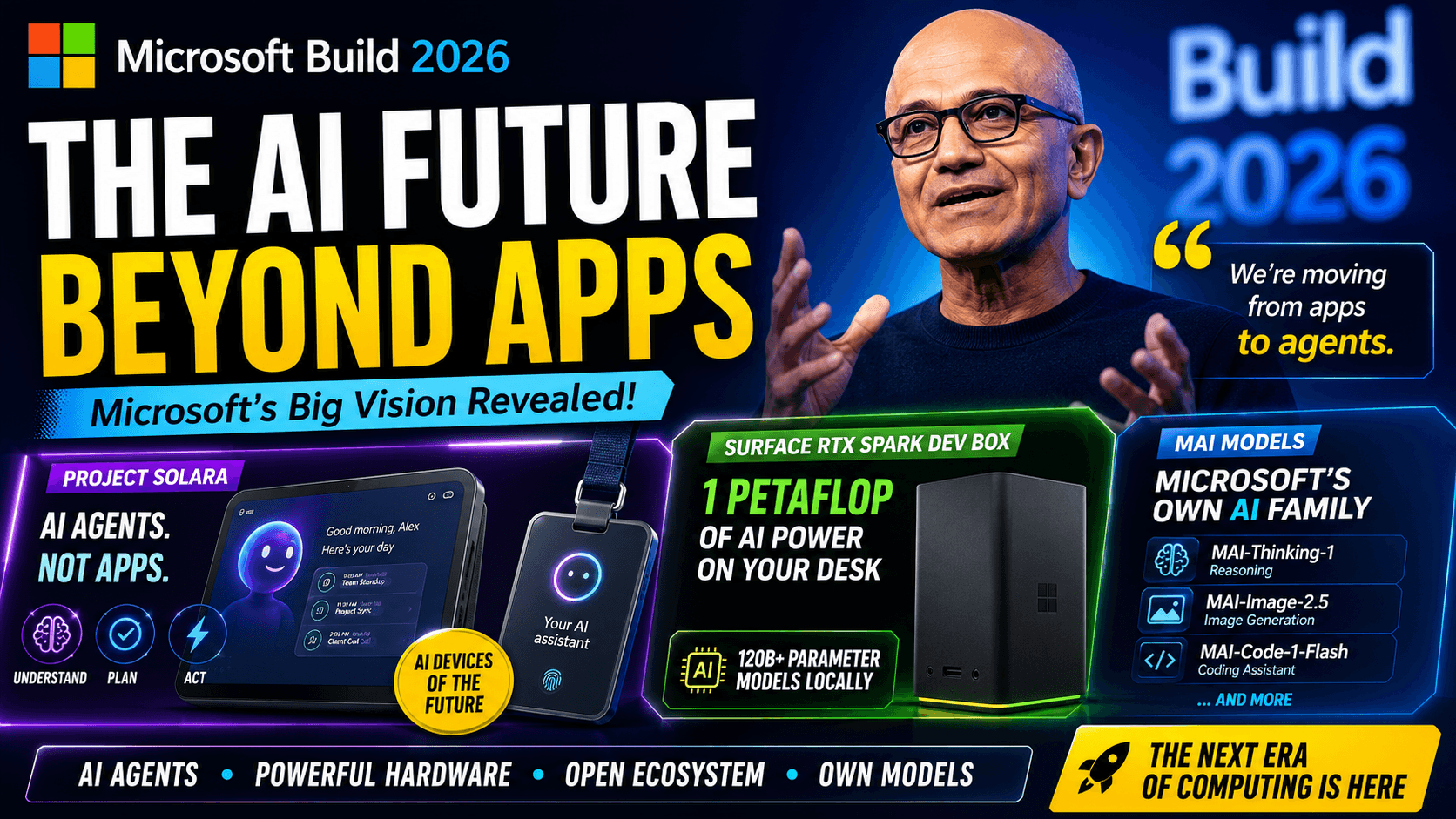
From a radical new platform called Project Solara to NVIDIA-powered AI developer hardware and Microsoft’s growing family of in-house AI models, Build 2026 offered a glimpse into what could become the next major computing platform.
The Big Shift: From Apps to AI Agents
For nearly two decades, digital life has revolved around apps.
Need transportation? Open an app.
Need food? Open an app.
Need work tools? Open another app.
Microsoft believes that model is reaching its limits.
Instead of manually navigating dozens of applications, the company envisions AI agents that understand intent and perform tasks automatically.
That vision sits at the center of Project Solara.
Project Solara: Microsoft’s Most Ambitious AI Bet
Project Solara is a new chip-to-cloud platform designed specifically for AI-native devices.
Rather than running traditional applications, Solara devices host lightweight AI agents that can understand context, communicate with cloud services, and take action on behalf of users.
Microsoft is effectively asking a bold question:
What if the future computer isn’t an app launcher at all?
Prototype #1: The Desk Companion
Microsoft showcased a smart-display style device featuring:
- Touchscreen
- Camera
- Microphones
- Speakers
- Facial recognition
The device can:
- Recognize who is using it
- Summarize schedules
- Coordinate meetings
- Deliver personalized updates
- Function as a Windows 365 terminal
Think of it as a much more capable AI companion rather than another smart display.
Prototype #2: The AI Badge
Microsoft also demonstrated a wearable badge-sized device equipped with:
- Touchscreen
- 5G connectivity
- Camera
- Microphones
- Fingerprint authentication
- Privacy controls
The concept targets:
- Healthcare workers
- Retail employees
- Warehouse operators
- Field technicians
The goal is simple: provide hands-free AI assistance anywhere.
Why Project Solara Matters
This isn’t just another gadget.
Project Solara represents Microsoft’s attempt to create an entirely new device category centered around AI.
The platform is built on:
- Android-based Microsoft Device Ecosystem Platform (MDEP)
- Microsoft Intune management
- Microsoft Entra ID security
- Qualcomm AI chips
- MediaTek hardware partnerships
Early pilot programs are reportedly planned with companies including CVS Health and Target.
If successful, Solara could become Microsoft’s answer to:
- Apple’s ecosystem
- Google’s AI assistant ambitions
- The limitations of today’s smartphone model
Surface RTX Spark Dev Box: Microsoft’s AI Supercomputer for Developers
While Solara focuses on future devices, Microsoft also unveiled powerful new hardware for today’s AI builders.
Meet the Surface RTX Spark Dev Box.
Designed alongside NVIDIA, this compact desktop targets developers building advanced AI applications locally.
Key Specifications
- NVIDIA RTX Spark Superchip
- Blackwell architecture
- Up to 1 petaflop of AI performance
- 6,144 CUDA cores
- 20-core Grace CPU
- Up to 128GB unified memory
Microsoft says the machine can run models exceeding 120 billion parameters locally.
That’s a capability previously associated with expensive cloud infrastructure.
Why Local AI Is Becoming a Big Deal
Most AI workloads today rely on cloud APIs.
But local AI offers major advantages:
Lower Costs
Developers avoid repeated API charges.
Better Privacy
Sensitive data remains on-device.
Reduced Latency
Responses arrive instantly without cloud round trips.
More Control
Companies can fine-tune and deploy models without external dependencies.
This is why many analysts view the RTX Spark Dev Box as Microsoft’s attempt to make Windows the preferred operating system for the AI era.
OpenClaw Arrives on Windows
Another notable announcement focused on AI agent orchestration.
Microsoft revealed secure support for OpenClaw, an increasingly popular open-source framework for coordinating multiple AI agents.
Using Microsoft Execution Containers (MXC), organizations can run agent systems with stronger security controls.
This enables enterprise deployments while reducing risks such as:
- Unauthorized file access
- Data leakage
- Uncontrolled automation
Microsoft demonstrated how these capabilities could power future Copilot experiences, including agents that help with:
- Email management
- Meeting preparation
- Expense reporting
- Workflow automation
Microsoft’s Growing Independence From OpenAI
Perhaps the most strategic announcement was Microsoft’s continued investment in its own AI models.
The company highlighted its expanding MAI family:
MAI-Thinking-1
Microsoft’s first reasoning-focused model.
Capabilities include:
- Multi-step reasoning
- Long-context understanding
- Advanced coding assistance
- Complex instruction following
Additional Models
Microsoft also introduced:
- MAI-Image-2.5
- MAI-Transcribe-1.5
- MAI-Voice-2
- MAI-Code-1-Flash
Together, these systems strengthen Microsoft’s ability to control more of its AI stack internally.
Microsoft’s Endgame: Owning the Entire AI Stack
A clear pattern emerged from Build 2026.
Microsoft is building AI capabilities across every layer:
Hardware
- Surface
- NVIDIA partnerships
- Qualcomm partnerships
- MediaTek partnerships
Platforms
- Windows
- Project Solara
Agents
- Copilot
- Scout
- OpenClaw integrations
Models
- MAI family
Cloud
- Azure
This full-stack strategy mirrors approaches previously used by companies such as Apple and Google, but now centered around AI agents rather than apps.
Why Build 2026 Could Be Remembered as a Turning Point
Many technology conferences showcase incremental upgrades.
Build 2026 felt different.
Microsoft wasn’t simply launching products.
It was presenting a vision of a world where:
- AI agents replace many traditional apps
- Intelligent assistants become ambient and always available
- Powerful AI runs locally instead of exclusively in the cloud
- New categories of devices emerge beyond phones and PCs
Whether Project Solara succeeds remains uncertain.
But one thing is clear:
Microsoft is no longer preparing for the AI era.
It is actively trying to define it.
Quick Takeaways
- Project Solara introduces AI-first devices designed around agents instead of apps.
- Surface RTX Spark Dev Box delivers up to 1 petaflop of AI performance for local model development.
- OpenClaw support brings secure enterprise-grade agent orchestration to Windows.
- Microsoft’s MAI family signals a growing push toward AI independence.
- Build 2026 suggests Microsoft believes the next computing revolution may be agent-first rather than app-first.