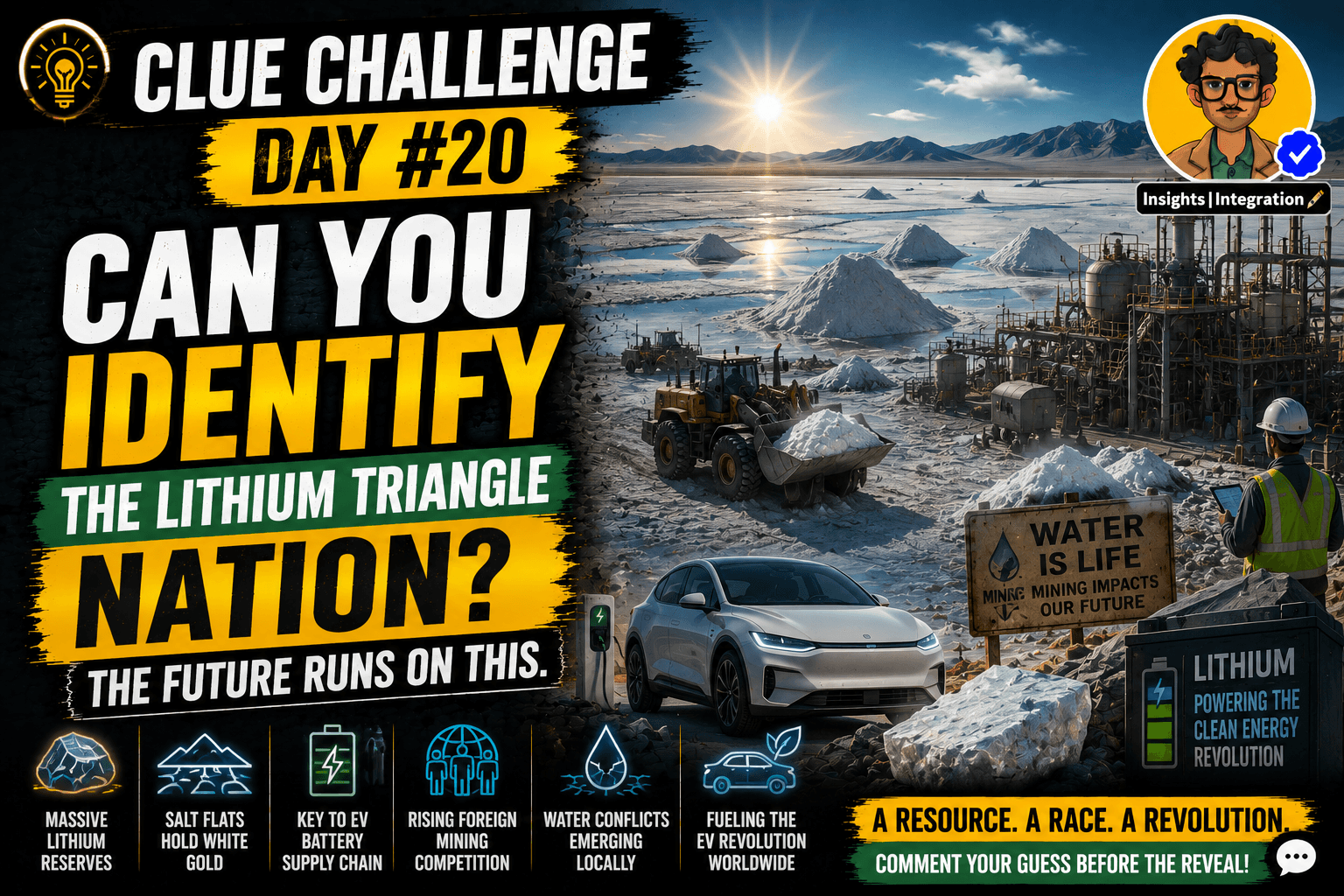
The global clean-energy revolution is accelerating a new geopolitical race centered around one critical mineral:
Lithium.
From electric vehicles and renewable energy storage to AI infrastructure and advanced battery technologies, lithium has become one of the world’s most strategic resources. Governments, mining giants, automakers, and global powers are now competing for influence over regions holding massive lithium reserves.
At the center of this race lies the famous Lithium Triangle — a mineral-rich South American region containing some of the largest lithium reserves on Earth.
The Lithium Triangle spans more than 414,000 square kilometers (160,000 square miles).
But this challenge is different.
This time, the goal is not to identify a single country.
Your challenge is to identify all three nations that together form the globally important Lithium Triangle.
Clues
1. Home to the World’s Most Important Lithium Region
These nations together form the globally famous Lithium Triangle, one of the richest lithium-bearing zones on the planet.
The region stretches across:
- Andes-linked salt flats
- High-altitude plateaus
- Harsh desert ecosystems
- Mineral-rich evaporation basins
Analysts often describe this region as:
“The Saudi Arabia of lithium.”
Together, these countries hold a major share of the world’s known lithium resources.
2. “White Gold” Is Reshaping Global Power
Lithium is increasingly called:
“White Gold.”
Why?
Because modern economies now depend heavily on lithium for:
- Electric vehicles (EVs)
- Grid-scale battery storage
- Renewable energy systems
- Smartphones and electronics
- AI hardware infrastructure
- Strategic defense technologies
The global EV boom during 2025–2026 sharply increased competition for influence across these lithium-rich South American nations.
3. Massive Salt Flats Dominate These Nations
One of the biggest identifying features of Lithium Triangle countries is the presence of enormous salt flats and lithium brine fields.
Globally important lithium zones connected to the region include:
- Salar de Atacama
- Salar de Uyuni
- Hombre Muerto
- Olaroz
- Cauchari
Of these, the core of Salar de Atacama has the highest concentration of lithium (0.15% by weight) among all world’s brine sources.
These locations contain lithium-rich underground brines extracted using evaporation technologies.
The surrounding geography includes:
- Andes Mountains
- Extreme-altitude deserts
- Dry climate zones
- Massive evaporation ponds
- Rugged mineral landscapes
Some of these regions are among the driest places on Earth.
4. Global Powers Are Competing for Influence Here
Lithium geopolitics increasingly resembles oil geopolitics of the 20th century.
Major players competing for influence across these nations include:
- China
- United States
- European firms
- Global EV manufacturers
The strategic competition revolves around:
- Battery supply chains
- Critical mineral access
- Refining capacity
- Long-term industrial dominance
- Energy-transition security
Chinese firms expanded investments aggressively across lithium projects in South America, while Western countries accelerated critical-mineral diplomacy during 2025–2026.
5. Indigenous Communities Are Central to the Debate
Several indigenous communities live near lithium-rich regions across these nations, including:
- Quechua
- Aymara
- Colla/Kolla
- Uru Chipaya
- Atacameño (Likan Antai)
Mining expansion triggered growing concerns regarding:
- Water depletion
- Land rights
- Ecological disruption
- Cultural preservation
- Local ownership of natural resources
Environmental activists increasingly warn that unchecked lithium extraction could permanently reshape fragile desert ecosystems.
6. Water Conflict Is Emerging as a Strategic Risk
One of the most controversial issues surrounding lithium extraction is groundwater consumption.
The extraction of lithium is water-intensive, using up to 2 million liters per ton of lithium, which dries up aquifers that feed surrounding streams.
Important river and basin systems linked to the broader region include:
- Los Patos River
- Trapiche River
- Pilcomayo River
- Desaguadero River system
Local communities increasingly fear that:
Future lithium conflicts may become water conflicts.
This issue became politically sensitive because many desert communities already face severe water scarcity.
7. Resource Nationalism Is Rising Across the Region
Political debates intensified across these Lithium Triangle nations regarding:
- State ownership of lithium
- Foreign mining influence
- Domestic refining capacity
- National industrial policy
- Local battery manufacturing
Some governments pushed for stronger state control over lithium projects to avoid becoming merely exporters of raw materials for richer economies.
The core debate increasingly centers around one question:
Who truly benefits from the global green-energy transition?
Final Question
Can you name the three South American nations that form the Lithium Triangle?
Missed yesterday’s challenge?
Check it here → Clue Challenge Day #19: Can You Identify the Insurgency-Hit Gas-Rich Coastal Region?
Answer to Yesterday’s Challenge: DAY #19
(Click above to reveal)
Stay Connected
Hit subscribe on the bell icon or join the WhatsApp channel to get daily clue challenges instantly.
Because the next clue (CLUE CHALLENGE DAY 21) might just be the one you can solve faster than anyone else.