
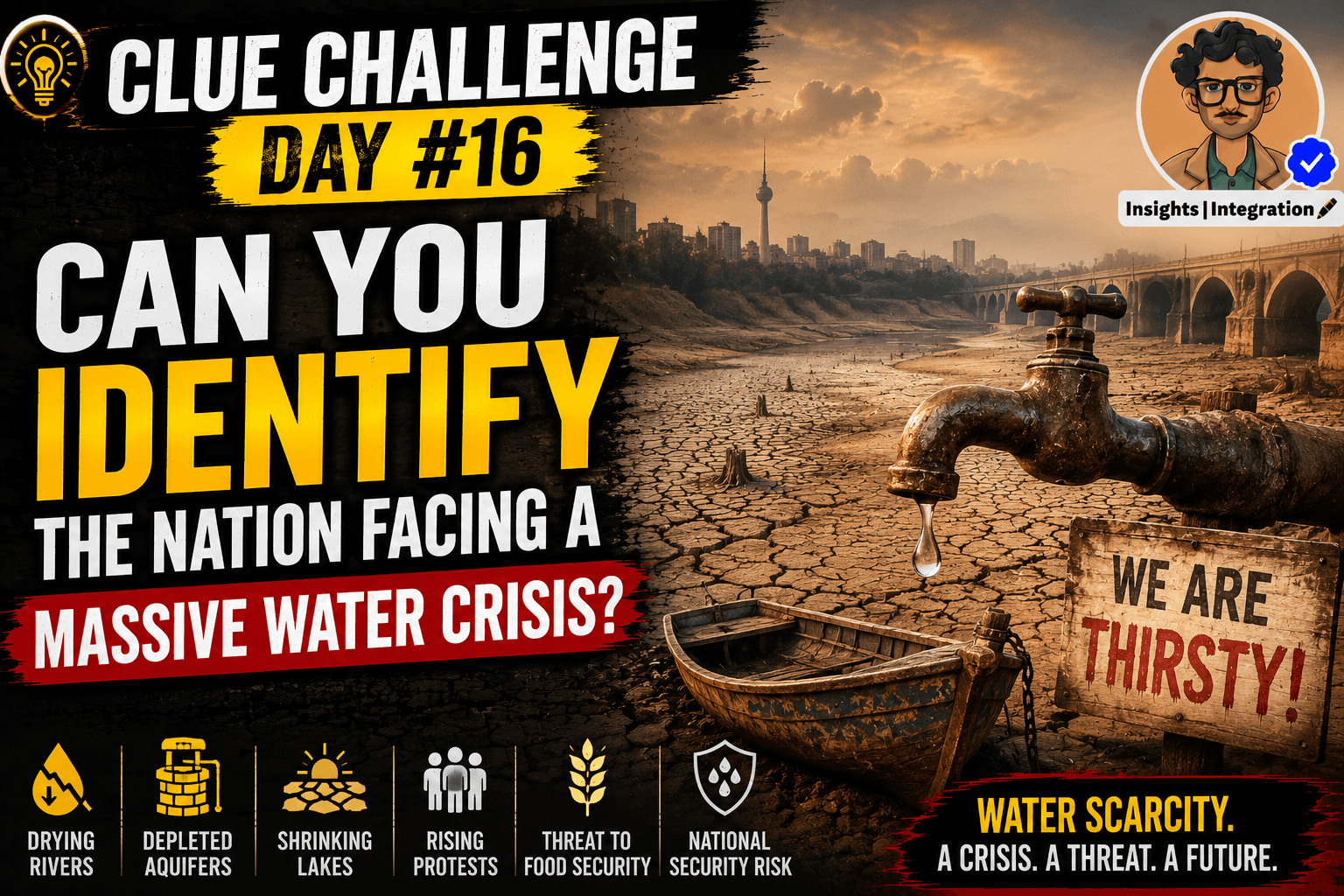
Water scarcity is no longer just an environmental issue — it is now shaping geopolitics, food security, migration, protests, and national stability.
This country is facing one of the world’s most severe long-term water crises. Rivers are drying, aquifers are collapsing, lakes are shrinking, and climate change is intensifying an already dangerous situation.
Can you identify the nation before the final reveal?
Missed yesterday’s challenge?
Check it here → Clue Challenge Day #15: Can You Identify The Commodity?
Answer to Yesterday’s Challenge: DAY #15
(Click above to reveal)
Clues
National Crisis
- Over 70% of major aquifers are overdrawn.
- Renewable water resources have declined sharply in the last two decades.
- Water scarcity is now viewed as a national security challenge.
- Droughts and extreme heatwaves are becoming more frequent.
Major drought impact in Capital City. November 14, 2025:
Large crowds gathered for salat al-istisqa (communal rain prayer).
Autumn 2025 rainfall: ~90% below long-term average.
Driest season in nearly 50 years.
Government:
- Conducted cloud seeding (Lake Urmia basin).
- Discussed possible water rationing.
- President hinted at potential evacuation of ~10 million residents from capital city.
Rivers Running Dry
- The historic Zayandeh-Rood River, once known as the “life-giving river,” has remained dry for long periods.
- The Karun River, one of the country’s most important rivers, faces declining flow and pollution concerns.
- Reduced flow from the Helmand River has intensified tensions with neighboring Afghanistan.
Shrinking Lakes
- Lake Urmia, once one of the world’s largest salt lakes, has dramatically shrunk due to drought, dam construction, and excessive water diversion.
- Environmental experts warn of ecological collapse and salt storms affecting nearby populations.
Groundwater Collapse
- Major aquifers around major city:
- Capital city
- Isfahan
- Mashhad
- Kerman
are being depleted rapidly.
- Excessive groundwater extraction has caused severe land subsidence in several regions.
Policy & Infrastructure Issues
- Decades of support for water-intensive crops worsened the crisis.
- Subsidized water and electricity encouraged excessive irrigation.
- Rapid urbanization increased pressure on already stressed systems.
- Thousands of unregulated wells accelerated groundwater depletion.
- Aging qanat (kariz) systems suffer from major leakage losses.
Capital City Pressure
- The capital depends heavily on mountain reservoirs and snowfall.
- Declining snowpack from the Alborz Mountains has reduced water availability.
- Authorities have even discussed shifting the capital closer to the Makran coast near the Gulf of Oman due to long-term water concerns.
Regional Tensions
- Water transfer projects between provinces triggered protests and accusations of inequality.
- Ethnic and regional tensions intensified in provinces like:
- Khuzestan
- Chaharmahal-va-Bakhtiari
- Yazd
- Some major cities face rotational water cutoffs.
Agriculture Under Threat
- The nation’s population exceeds 90 million.
- Food self-sufficiency goals are under strain.
- Water-intensive agriculture is becoming unsustainable.
- Dependence on food imports is rising.
Climate Pressure
- Rainfall in some regions has declined drastically.
- Rising temperatures are accelerating evaporation.
- Shrinking snowpack is reducing river flow.
- Cloud-seeding efforts produced limited success.
Social Stability Concerns
- Protest slogans included:
- “We are thirsty!”
- Farmers repeatedly protested near dried riverbeds.
- Rural migration toward cities is increasing.
- Water inequality is increasingly linked to governance criticism.
- Internet shutdowns limiting information flow.
Final Hint
This nation is home to:
- Ancient Persian civilization
- One of the world’s largest energy reserves
- Strategic Gulf access
- Growing regional water disputes
Next Day Challenge: Clue Challenge 17