The software industry just crossed another major milestone.
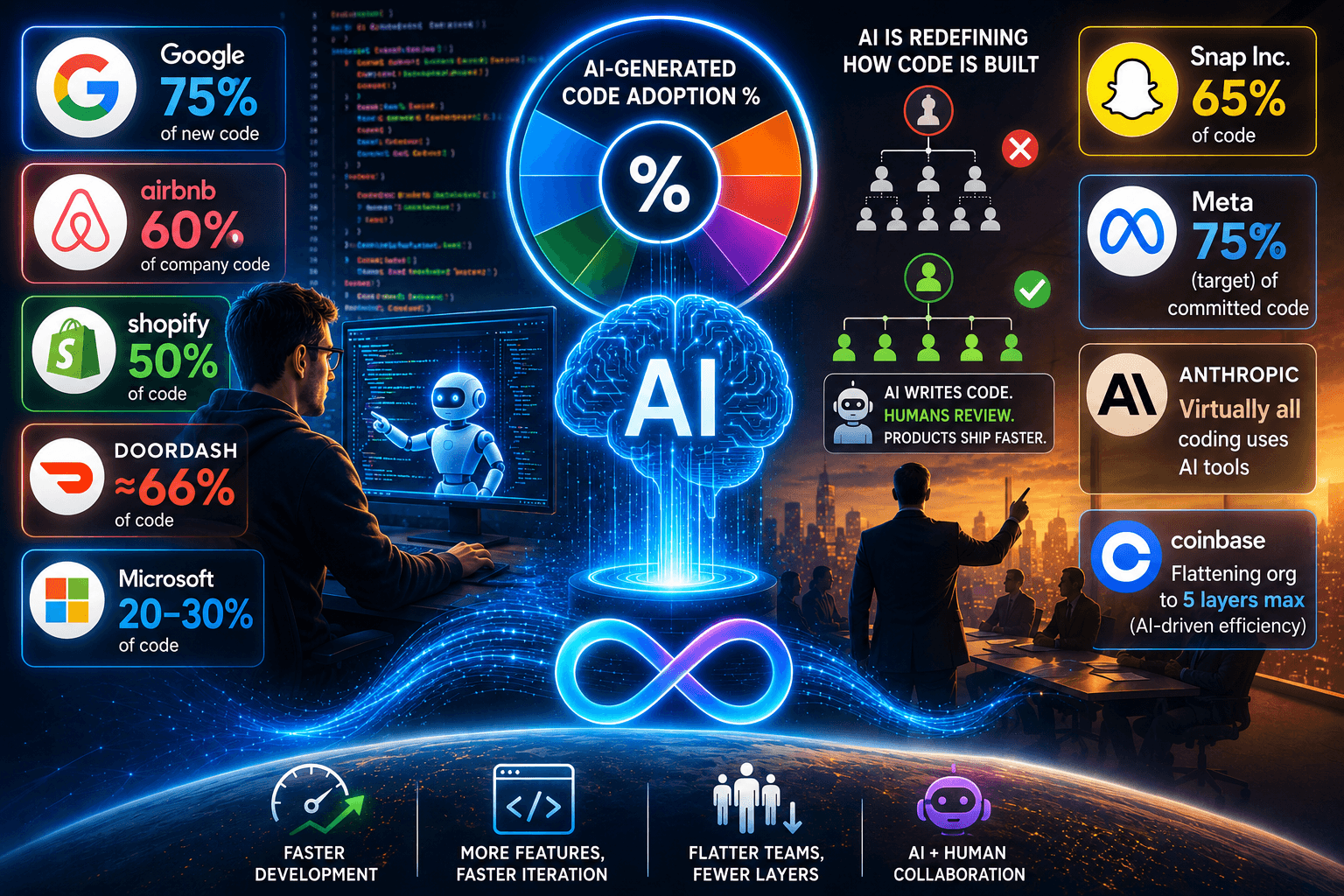
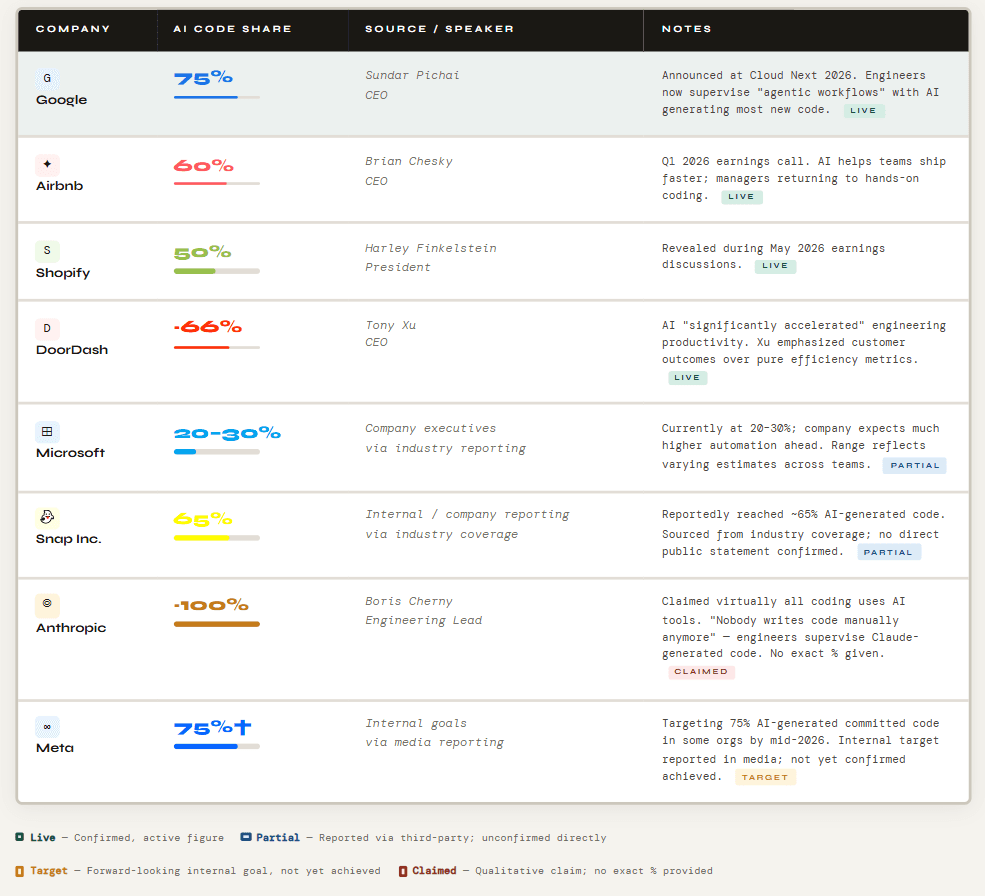
During Airbnb’s May 2026 earnings call, Brian Chesky revealed that nearly 60% of Airbnb’s code is now written by AI. But the bigger message was not just about productivity — it was about how artificial intelligence is reshaping the entire structure of tech companies.
According to Chesky, AI is helping Airbnb engineers ship products faster, iterate quickly, and reduce development friction. Even managers are now expected to become hands-on again.
“There is no room for pure people managers,” Chesky said, signaling a future where leadership roles may increasingly require technical involvement and AI fluency.
This is no longer an isolated experiment. Across Silicon Valley, companies are openly revealing how much of their software is now AI-generated.
Google Says AI Writes 75% of New Code
Google has gone even further.
At Cloud Next 2026, CEO Sundar Pichai announced that 75% of all new code at Google is now AI-generated and reviewed by engineers. That number stood at just 25% in 2024 and 50% in late 2025 — showing how quickly AI-assisted software development is accelerating.
Pichai described the new workflow as “agentic,” where engineers increasingly orchestrate autonomous AI systems instead of manually writing every line themselves.
Google also revealed that AI agents helped complete a major code migration project six times faster than traditional engineering methods.
The message is clear: software engineers are evolving from coders into AI supervisors, reviewers, and system architects.
Shopify, Snap, Meta, Microsoft: The Industry Shift Is Already Here
Other major tech firms are reporting similar numbers.
- Shopify said around 50% of its code is AI-generated.
- Snap Inc. reportedly reached about 65% AI-generated code.
- Meta is internally targeting 75% AI-generated committed code in some divisions by mid-2026.
- Microsoft executives indicated AI already generates roughly 20–30% of company code, with expectations for much higher adoption ahead.
Meanwhile, AI startup Anthropic reportedly told employees that almost all software development now involves AI coding tools like Claude Code.
Even companies outside traditional software infrastructure are aggressively adopting AI-assisted development.
Uber recently revealed that autonomous AI agents are already responsible for around 10% of code changes internally.
The Rise of the AI-Native Engineer
The biggest transformation may not be coding itself — but the definition of an engineer.
For decades, software development centered on writing syntax manually. That era is fading rapidly.
Today’s high-performing engineers are increasingly expected to:
- direct AI systems,
- review generated code,
- manage AI agents,
- validate outputs,
- design system architecture,
- and integrate human judgment into AI workflows.
In many companies, typing raw code line-by-line is becoming less valuable than understanding how to orchestrate intelligent systems effectively.
This shift explains why executives are emphasizing “hands-on managers” and flatter organizations.
Middle Management May Be the Next Disruption
Chesky’s comments about “pure people managers” reflect a broader trend across tech.
Coinbase recently announced it would flatten its organization to just five layers below the CEO and COO. CEO Brian Armstrong said managers must increasingly act as “player-coaches.”
Consulting firms like McKinsey & Company are also encouraging businesses to use AI agents to automate coordination, reporting, documentation, and workflow management.
The implication is massive:
AI may not only reduce repetitive coding work — it could also compress organizational hierarchies.
Companies may soon need:
- fewer coordinators,
- fewer middle-management layers,
- and smaller teams producing larger outputs.
What Happens Next?
The next phase of AI software development is likely to move beyond “AI copilots.”
Tech companies are rapidly transitioning toward:
- autonomous AI agents,
- self-improving workflows,
- multi-agent engineering systems,
- AI-driven testing,
- AI debugging,
- and AI-managed infrastructure.
Future developers may spend more time defining goals than actually writing implementation details.
The result could be:
- dramatically faster product cycles,
- lower software development costs,
- smaller engineering teams,
- and an explosion of new startups built by tiny AI-augmented teams.
But there are still major questions ahead:
- Can AI-generated code maintain long-term quality?
- Will security vulnerabilities increase?
- How will companies audit AI-created systems?
- What happens to entry-level programming jobs?
- And how should education adapt when AI writes most code already?
One thing is becoming difficult to ignore:
The software industry is entering an era where humans increasingly supervise machines that build software for other humans.
And according to some of the world’s largest tech companies, that future has already started.