Welcome back to your daily Clue Challenge Day 6—where curiosity meets real-world power.
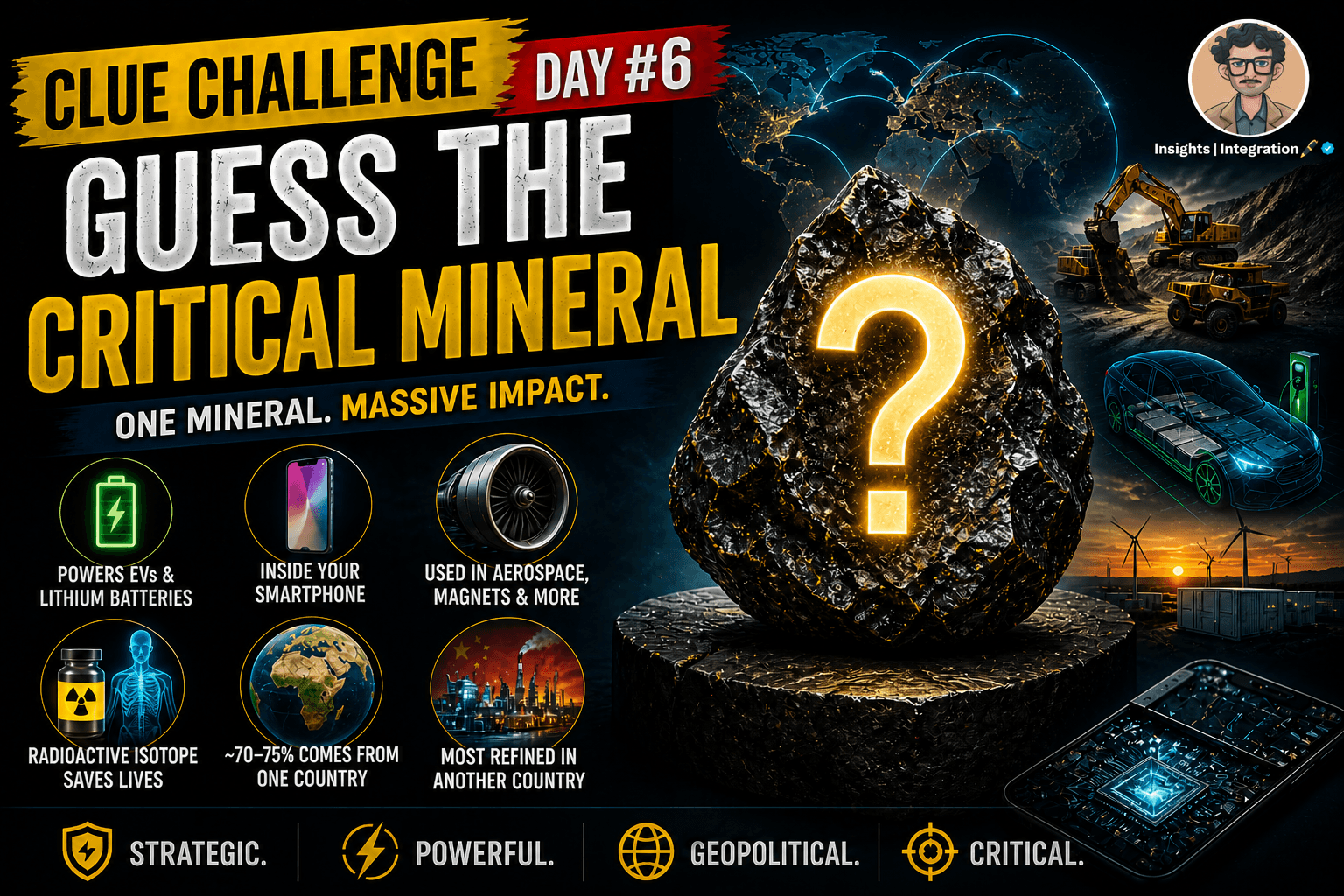
Today’s puzzle isn’t about a country or a company. It’s about a strategic mineral quietly shaping the future of technology, clean energy, and global geopolitics.
It sits inside your smartphone. It powers electric vehicles. It influences global supply chains and political decisions.
And yet—most people rarely think about it.
Can you identify it?
Missed yesterday’s clue challenge?
Check it here → Clue Challenge Day #5: Guess the Technology?
Answer to Yesterday’s Challenge: DAY #5
(Click to reveal)
The Clue
This mineral has rapidly become one of the most critical resources of the 21st century.
Consider the following:
- It is a hard, silver-grey metal, typically extracted as a byproduct of copper and nickel mining, with ores such as heterogenite (oxide), carrollite (sulfide), and skutterudite.
- It is a core component of lithium-ion batteries, enabling higher energy density and longer battery life.
- It powers everyday technologies—from smartphones and laptops to electric vehicles (EVs).
- It is used in jet engine superalloys, magnets, catalysts, and industrial tools, making it vital for both civilian and defense industries.
- A radioactive isotope of this mineral is used to produce high-energy gamma rays.
- It plays a key role in medical treatments and industrial tracing, allowing precise tracking and imaging.
- Around 70–75% of global supply comes from Democratic Republic of the Congo.
- An estimated 40,000 child laborers are reportedly involved in hazardous mining conditions in parts of the region.
- Despite African dominance in mining, most refining is controlled by China, which processes roughly 73–77% of global supply.
- The Katanga Copperbelt, particularly around Kolwezi, is the center of global production.
- The Democratic Republic of Congo has enlisted a private military force to secure its mines, financed by the United States and the UAE.
- By December, $100 million will deploy 3,000 armed “mining guards,” with plans to expand to 20,000 by 2028.
- Their mission: protect minerals production, ensure supply chain transparency, and eliminate militant interference currently destabilizing mining operations.
Recently a US-based advocacy group has sued Apple in Washington, DC, accusing the iPhone maker of relying on minerals linked to conflict and human rights abuses in the Democratic Republic of the Congo (DRC) and Rwanda — a claim Apple firmly denies.
Part of 24 India’s Critical and Strategic Minerals List under the Mines and Minerals (Development and Regulation) Act (Part D-First Schedule).
It is a key mineral on the official critical materials lists for the US, EU, and China due to its role in high-tech, defense, and electric vehicle (EV) battery sectors.
Key Global Mining Sites
- Kisanfu Mine – Among the world’s largest and highest-grade producers
- Tenke Fungurume Mine – One of the biggest globally
- Mutanda Mine – A major open-pit operation
- KOV / Kamoto Complex – A historic and strategic mining hub
- Metalkol RTR – Reprocessing project extracting value from tailings
- COMMUS Mine – Notable for community conflict disputes
Final Clue: Connect the Dots
Before you scroll, consider this:
- ❓ Which hidden material sits inside your phone today?
- ❓ Which resource has nations quietly competing to secure supply?
- ❓ Which mineral carries the promise of clean energy and the weight of controversy?
Think carefully. You’ve read it somewhere. But have you noticed it?
Answer Reveals Tomorrow
We’ll unveil the answer in Clue Challenge Day #7, along with a brand-new puzzle that will test a completely different dimension of your knowledge.