The world is experiencing an unusually disruptive November as major outages and cyberattacks hit Apple, Microsoft, US airlines, major banks, supermarkets and critical infrastructure.
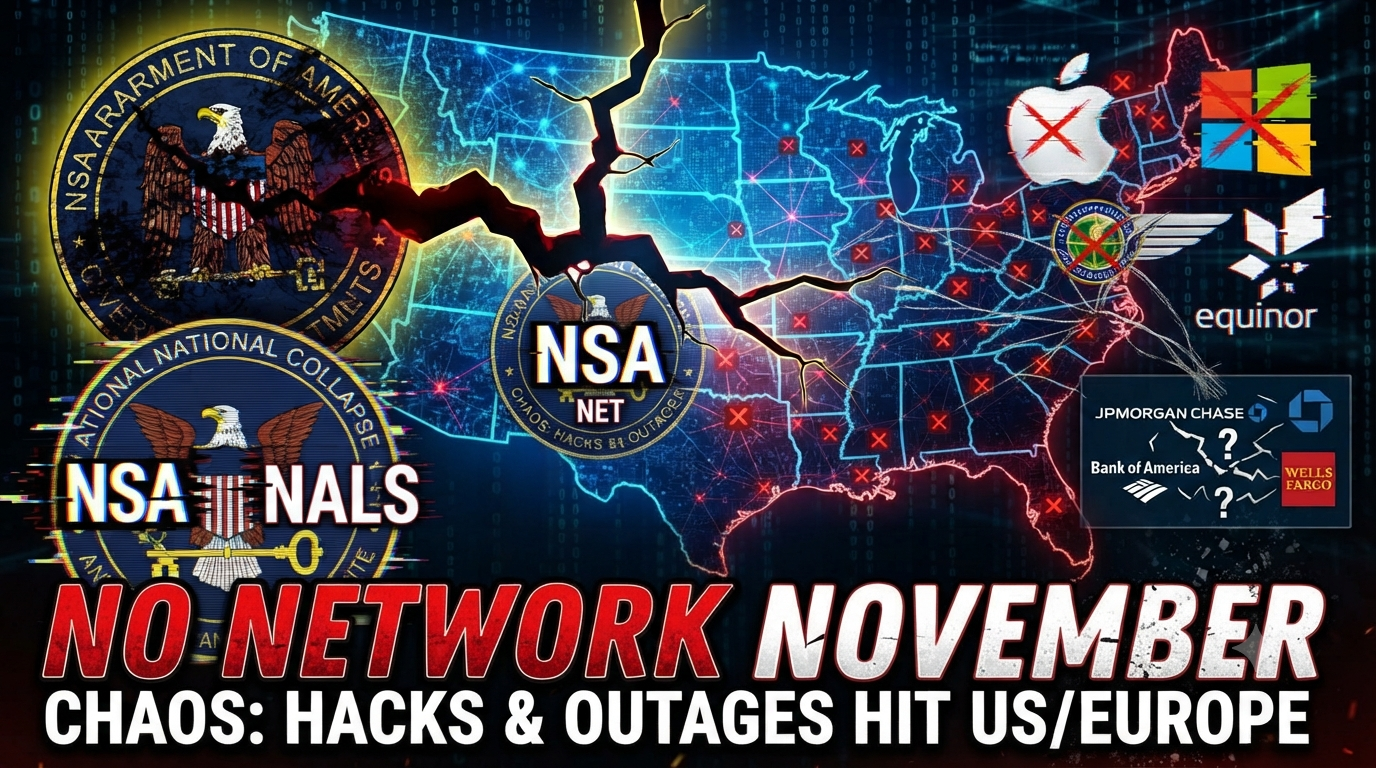
What started as another November has increasingly begun to look like a global technology nightmare. Social media users are calling it “No Network November”, a twist on the popular “No Nut November” trend, after a series of major internet outages, service disruptions and cyberattacks affected some of the world’s biggest companies.
Since November 2, disruptions have reportedly impacted supermarkets across Europe, Apple’s services, Microsoft 365, US flights, major American banks and critical infrastructure organisations.
Adding to the concerns, Google recently warned that “the era of autonomous attacks has arrived,” highlighting growing cybersecurity risks as artificial intelligence makes cyber threats potentially faster and more sophisticated.
However, not every incident appears to have been caused by hackers. According to the reported breakdown, only three of these incidents were linked to cyberattacks, while technical outages accounted for most of the disruptions.
No Network November: A Timeline of Major Global Outages and Cyberattacks
Here is a breakdown of the incidents reported so far:
- November 2: Suspected hackers manipulate supermarket freezer systems, pushing temperatures to 50°C across seven European countries.
- November 10: Apple’s iCloud Mail, Calendar and Contacts experience outages.
- November 12: A worldwide Microsoft 365 outage disrupts Outlook and Teams.
- November 13: The FAA grounds US flights for more than four hours.
- November 16: Online banking disruptions affect Chase, Bank of America and Wells Fargo.
- November 16: United Airlines delays departing flights following a technical outage.
- November 16: Crypto-stealing code is planted on 178 websites, including CNN, Zoom, BBC and IKEA.
- November 17: Apple experiences another disruption, affecting iCloud, the App Store and Apple Pay.
- November 17: The NSA reportedly confirms that some of its internal systems were affected.
- November 17: Norwegian energy giant Equinor is hit by a cyberattack.
That’s a remarkable concentration of disruptions in just over two weeks.
But there is an important distinction that deserves attention.
Are These Global Outages Actually Cyberattacks?
Despite the alarming number of incidents, it is important to understand that not every service disruption is the result of hacking.
Based on the reported incidents, only three were linked to hackers, while the majority were attributed to outages and technical disruptions.
This distinction matters because cyberattacks and infrastructure failures require different responses.
A cyberattack involves malicious activity intended to compromise systems, steal information, disrupt operations or gain unauthorised access.
A technical outage, on the other hand, can result from software bugs, configuration errors, server failures, network problems or infrastructure issues.
Both can cause significant disruption, but their underlying causes are very different.
The bigger problem: Our dependence on digital infrastructure
Think about how much of modern life depends on systems we rarely think about.
You need to book a flight? Digital infrastructure.
You need to transfer money? Digital infrastructure.
You need to communicate with colleagues? Digital infrastructure.
You need to purchase groceries, access cloud storage or make an online payment? Again, digital infrastructure.
The problem is not simply that individual companies are experiencing outages.
The bigger concern is that our world has become deeply interconnected, creating dependencies that can turn a relatively small technical problem into a much larger disruption.
When a major cloud service experiences problems, businesses relying on that service can also go down.
When banking systems become unavailable, customers may struggle to access their money.
When airline technology fails, thousands of passengers can face delays.
One failure can create a chain reaction across multiple industries.
This is the hidden vulnerability of the digital economy.
Google’s warning makes the situation even more serious
Adding another layer to these concerns, Google warned this week:
“The era of autonomous attacks has arrived.”
That statement deserves attention.
Cyberattacks are evolving. Artificial intelligence is increasingly capable of helping attackers automate reconnaissance, identify vulnerabilities and scale malicious operations.
This could make certain attacks faster, more sophisticated and harder to contain.
However, we should not confuse the warning with evidence that AI caused the incidents listed above. There is no basis to assume that all these disruptions are connected or part of one coordinated campaign.
Still, the broader message is clear: cybersecurity threats are evolving, and traditional defence mechanisms must evolve with them.
No Network November Is a Warning for the Digital World
The phrase “No Network November” may have started as an internet joke, but the incidents behind it highlight a serious issue.
From banking and aviation to energy infrastructure and cloud computing, modern society depends on digital systems that must remain reliable and secure.
The bigger concern is not simply how many companies experience outages in one month. It is how interconnected the global economy has become and how quickly disruptions can affect millions of people.
Whether caused by cyberattacks, software failures or infrastructure problems, these incidents reinforce one important lesson: digital connectivity is powerful, but it also creates vulnerabilities that organisations cannot afford to ignore.
November may be remembered for its memes, but it could also serve as a reminder of how dependent the world has become on networks that are never guaranteed to stay online.