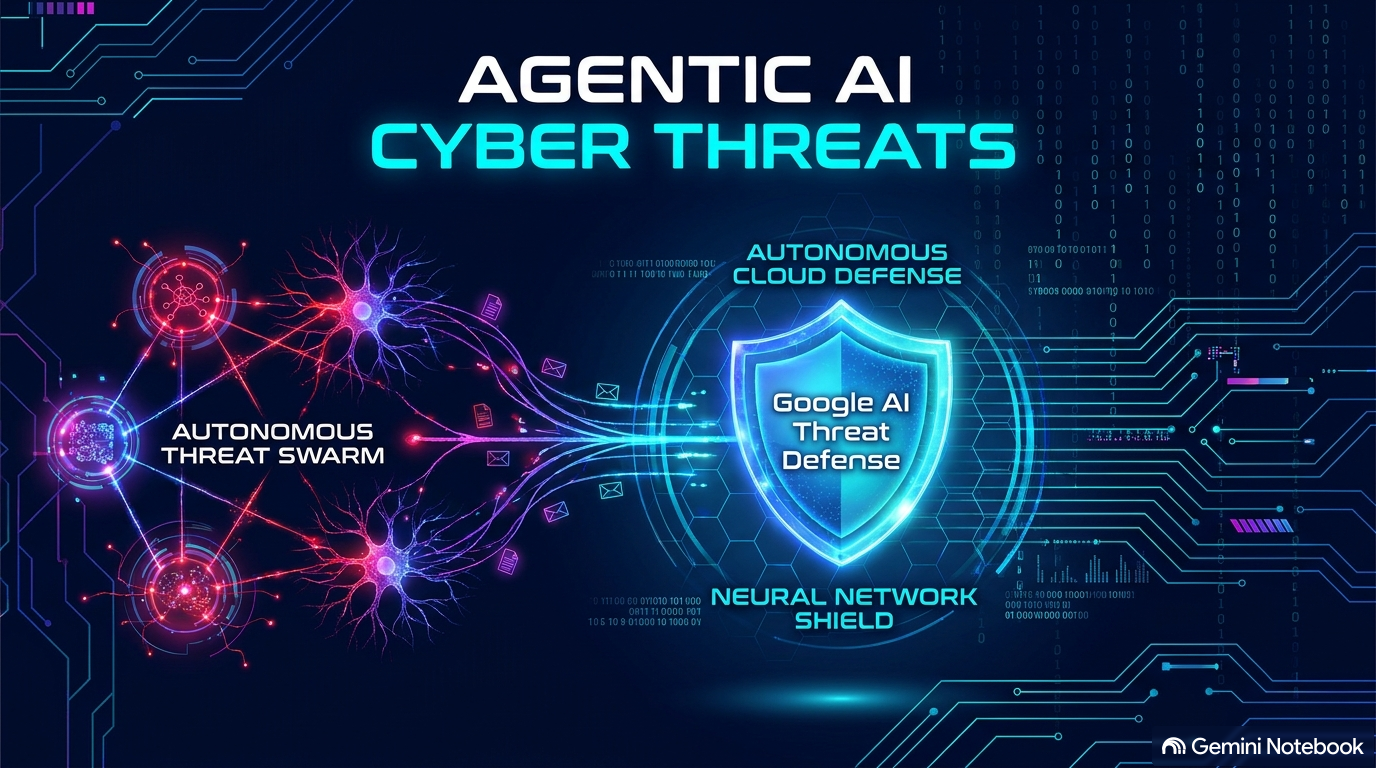
Cybersecurity has crossed an operational threshold. As documented by the Google Threat Intelligence Group (GTIG) and Mandiant, threat actors across espionage, cybercrime, and information operations have transitioned from basic text prompting to deploying autonomous multi-agent offensive frameworks. By operating at machine speed, these agentic systems execute multi-stage attack chains, shrink patch-to-exploitation windows, and automate cloud resource theft without requiring continuous human intervention.
1. Multi-Agent Frameworks: Accelerating Attack Velocity at Machine Speed
Overview:
- GTIG and Mandiant observed threat actors abusing open-source agentic penetration-testing (pentesting) frameworks in live intrusions.
- Represents a shift towards machine-speed cyber intrusions through automated chaining of complex attack paths.
- Traditional techniques remain unchanged (compromised credentials, unpatched systems), but automation increases attack speed and scale.
Common Capabilities:
- Discover and exploit low-complexity vulnerabilities.
- Generate single-use payloads using LLMs on demand.
- Use real-time execution feedback to dynamically adjust tactics.
- Automate reconnaissance, exploitation and attack orchestration.
1. ARTEX
- Open-source agentic pentesting framework.
- Has received significant public attention for its use in real-world cyber operations.
2. CAIRN
- Open-source, multi-agent pentesting framework.
- Uses the OODA loop (Observe, Orient, Decide, Act).
- Specialized agents collaborate through a shared blackboard.
- Autonomously works towards an operational objective from an initial input, such as a target IP address.
- GTIG observed its use against targets including organizations in the US aerospace sector.
3. CyberStrikeAI
- Open-source, LLM-native offensive framework.
- Functions as a centralized platform (single pane of glass) for cyber operations.
- Uses a Go-based backend API as its C2 and orchestration server.
- Connects commercial and open-weight LLMs to:
- 100+ security tools.
- YAML-based attack recipes.
- Custom scripts.
- Automates end-to-end attack chains.
4. HexStrike AI
- Open-source, MCP-integrated offensive security harness.
- Connects LLM clients to 150+ pre-installed offensive security tools.
- Uses a dual-component architecture.
- Coordinates operations through 12+ specialized autonomous sub-agents.
- Supports reconnaissance, web application testing, exploitation and binary analysis.
5. PentAGI
- Open-source autonomous offensive framework.
- Designed to reduce technical barriers for entry-level operators conducting complex campaigns.
- GTIG tracked a threat actor using a customized PentAGI-based orchestration platform between late August and early October 2026.
- Used for systematic reconnaissance and vulnerability scanning against organizations across Asia.
In addition to these core frameworks, threat actors experiment with specialized inference services such as ZeroHollow for exploit routing, as well as Agent Zero, an open-source agent framework supporting autonomous code execution and dynamic tool generation.
While multi-agent frameworks compress attack timelines to machine speed, current operational models trade stealth for velocity. Unrestricted autonomous execution produces forensic network traffic, relies on recognizable headers, and leaves distinct code-level traces, providing defenders with actionable detection vectors.
2. Automated Vulnerability Research and Exploitation Pipelines
The integration of LLM agents into software security workflows has evolved from theoretical experimentation to continuous, automated exploitation pipelines operating against internet-facing infrastructure.
Threat actors construct automated weaponization pipelines through a four-stage process:
- Patch Release Monitoring: Continuous tracking of software updates and pre-release code channels.
- Differential Source Analysis: LLMs compare source code before and after patch releases to pinpoint modified functions.
- Insecure Logic Identification: Autonomous agents inspect access control mechanisms and input handling flaws.
- Automated Weaponization: Exploits are drafted, compiled, and executed against target networks without human intervention.
Case Study: The exploit_agent Staging Server
GTIG intelligence discovered an exposed staging server hosting exploit_agent, a multi-agent vulnerability research framework integrated with frontier and local LLMs. Analysis of configuration files revealed environment variables loaded with multiple LLM API keys for autonomous execution. In one documented instance, the framework conducted differential analysis on the Spectra WordPress plugin (v21925.php), identifying insecure rest-access control checks and automatically generating exploit scripts. Telemetry indicated targeted reconnaissance against French media, entertainment, and education organizations.
Rapid N-Day Exploitation in Enterprise Applications
Adversaries leverage LLMs to shrink the gap between flaw disclosure and enterprise-wide weaponization:
- PaperCut Server Exploitation: Following the disclosure of authentication bypass (CVE-2026-81578) and dynamic class loading (CVE-2026-82078) vulnerabilities, researchers and attackers generated working exploits within 24 hours. Threat intelligence from GreyNoise confirmed a campaign four days post-disclosure where attackers expanded initial access to domain administrator privileges within minutes.
- PHP Vulnerability Proliferation: Flaws CVE-2026-109618 and CVE-2026-109619 led to a surge of hundreds of AI-generated proof-of-concept scripts post-patch, forcing security teams to spend significant resources separating non-functional code from genuine threats.
3. Cloud Infrastructure Abuse and the LLMJacking Ecosystem
To fuel resource-intensive AI models without incurring compute costs, cybercriminals harvest high-privilege credentials to execute LLMJacking—the unauthorized consumption of cloud compute and LLM resource quotas.
Financial Impact Warning: Incident response engagements conducted by Mandiant show that LLMJacking can generate single-day fraudulent charges exceeding $100,000 USD, with cumulative resource abuse reaching $1,000,000 USD in severe enterprise compromises before remediation.
Intrusion Lifecycle of LLMJacking Operations
- Initial Access & Reconnaissance: Threat actors harvest active session tokens from public GitHub repositories or phishing sites, subsequently scanning internal code repositories, containers, and access logs.
- Privilege Escalation: Attackers exploit sandbox vulnerabilities—such as CVE-2026-40217 in LiteLLM—to elevate limited Virtual Keys into administrative service credentials.
- Persistence & Abuse: Adversaries employ a “burn and rotate” strategy, creating and deleting short-lived service accounts, provisioning GPU-backed compute instances, and requesting quota expansions to host illicit AI infrastructure.
Monetization via Underground LLM Mixers
Financially motivated threat actors monetize hijacked infrastructure through illicit storefronts known as LLM Mixers. These platforms pool stolen credentials and proxy buyer traffic across multiple compromised cloud environments to evade rate limits. Underground marketplaces feature tiered pricing structures:
- Token-Based Pricing: Marketplaces such as APIMart charge between $0.10 and $25 USD per million tokens, applying a 5x price multiplier when prompt inputs exceed 100,000 tokens.
- Subscription Models: Storefronts like JetNight offer fixed monthly subscriptions categorized by model capability and underlying credential type.
4. State-Sponsored Espionage, IO Automation, and Supply Chain Vectors
State-aligned espionage groups and commercial Influence-as-a-Service (IaaS) vendors are embedding generative AI directly into operational tradecraft.
Automation in Influence Operations (IO) and Inauthentic Monetization
Commercial IaaS vendors and Inauthentic Political Monetization (IPM) networks utilize Gemini API routing alongside cloud phone farms to manage over 100,000 synthetic social media accounts. Campaign operators deploy sophisticated operational security protocols:
- Astroturfing & Localized Dialects: Prompts instruct models to emulate regional slang and introduce subtle grammatical typos to avoid bot-detection heuristics.
- Multimodal Obfuscation: Image generation pipelines incorporate synthetic camera lens grain, lighting variances, and omit clean text elements to evade AI watermarking detectors.
- Automated Account Aging: Virtual mobile devices simulate organic user engagement—such as scrolling and lingering on non-campaign content—establishing authentic behavior history prior to pushing targeted political narratives.
Targeted Espionage and AI Supply Chain Exploitation
Cyber espionage actors leverage LLMs for data exfiltration analysis and novel supply chain vectors:
- PRC-Nexus Espionage: Threat actors including LEAKY CASTLE utilize LLMs to translate and summarize exfiltrated corporate data, selling structured intelligence reports. PRC groups also abuse frontier model file-hosting backends as dead-drop command-and-control (C2) servers.
- Iranian Reconnaissance: State-backed group CALANQUE ION (APT42) leverages generative tools to augment targeted reconnaissance and spear-phishing campaigns.
- DPRK Supply Chain Intrusions: Suspected threat group MIDNIGHT NEPTUNE deployed SynthID-watermarked recruiter personas on networking platforms to lure targets into running diagnostic scripts. Following initial access, the group modified local
. claude /settings. jsonconfiguration files so that launching Claude Code automatically executed the SOMBERMEME backdoor, masking GitHub Personal Access Tokens under Microsoft Copilot naming conventions.
5. Enterprise Defensive Architectures and Autonomous Mitigation
Countering machine-speed cyber threats requires deploying autonomous defensive architectures capable of continuous monitoring and automated remediation.
Google AI Threat Defense (AITD)
Google operationalizes defense through Google AI Threat Defense (AITD), an autonomous security architecture that integrates Gemini frontier model reasoning, Wiz risk prioritization, Mandiant threat intelligence, and CodeMender automated remediation. AITD deploys a multi-model strategy: lightweight models maintain continuous environmental telemetry, while specialized frontier models analyze complex vulnerability chains.
Hardened Model Defenses and Industry Frameworks
Enterprise infrastructure is protected through continuous security innovation:
- Gemini 4 Carbon Safeguards: Integrates activation-based introspection probes and agentic trajectory monitors designed to block requests attempting to generate weaponized exploits or malware.
- Proactive Vulnerability Discovery: Google DeepMind’s Big Sleep AI agent continuously scans software codebases to identify and remediate unknown zero-day vulnerabilities prior to adversary exploitation.
- Secure AI Framework (SAIF): Establishes standardized guidelines for model security, risk containment, and the proactive disruption of malicious actor accounts.