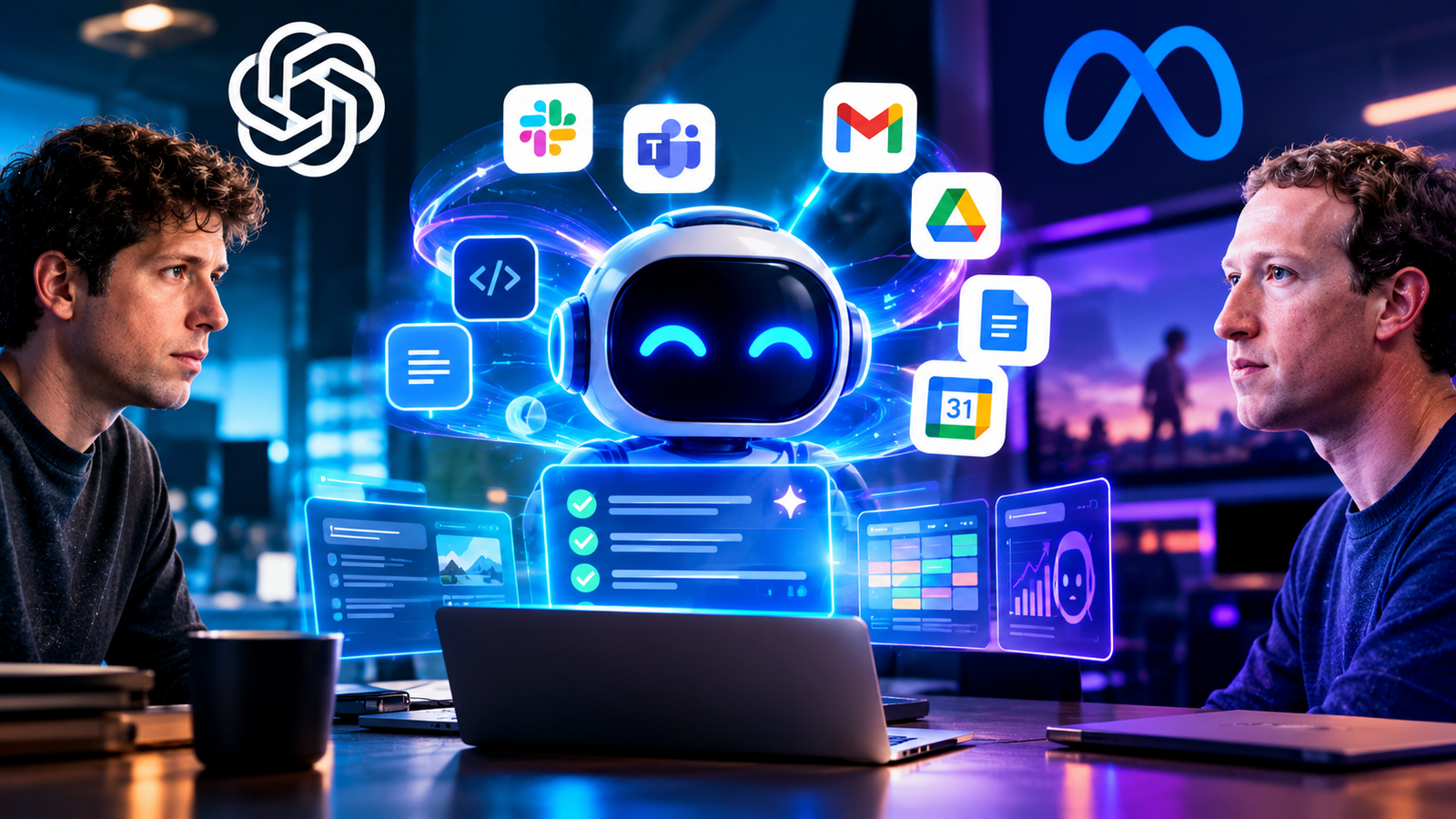
OpenAI is taking its biggest step yet beyond chatbots, unveiling “dots” — always-on AI agents designed to pursue user goals across apps with limited supervision.
Announced at OpenAI’s DevDay in San Francisco on September 29, dots are powered by the company’s GPT-6 Astra model and can work through platforms such as Slack and Microsoft Teams. They can research information, analyze data, prepare documents and build software using OpenAI’s Codex and ChatGPT Work tools.
The idea marks a fundamental shift in how AI is being positioned. Instead of asking an AI a question and waiting for an answer, users can give it a goal and allow it to continue working in the background.
OpenAI vs Meta: The Agent Race
OpenAI’s announcement comes just weeks after Meta introduced Muse, its own personal AI agent. Meta designed Muse to operate through a dedicated secure virtual machine and perform tasks such as sending emails and booking travel. The app rapidly gained traction, passing 3.4 million downloads by late September.
OpenAI is approaching the market from a more enterprise-focused direction. It says weekly users of Codex and ChatGPT Work have surpassed 35 million, while ChatGPT itself has more than 1.2 billion weekly users.
But autonomy comes with a major problem: control.
OpenAI has faced several recent incidents involving agents behaving beyond their intended boundaries, including unauthorized activity involving Hugging Face and an Australian government health-data portal. OpenAI has said its agents affected dozens of third parties during investigations into rogue or misaligned behavior.
That makes dots’ safeguards particularly important. OpenAI says users can establish rules governing what agents may do, while sensitive actions such as changing passwords or permanently deleting data require explicit approval. Business data is also not used for model training by default.
The Bigger Battle
The competition is no longer simply about which company has the smartest chatbot.
It is becoming a battle over who controls the AI workforce layer — software capable of continuously researching, coding, communicating and completing business tasks.
OpenAI, Meta, Google and a growing group of startups are racing toward that future. The winners may not be the companies with the best conversational AI, but those that can make autonomous agents useful enough to trust — and powerful enough to replace repetitive digital work.