
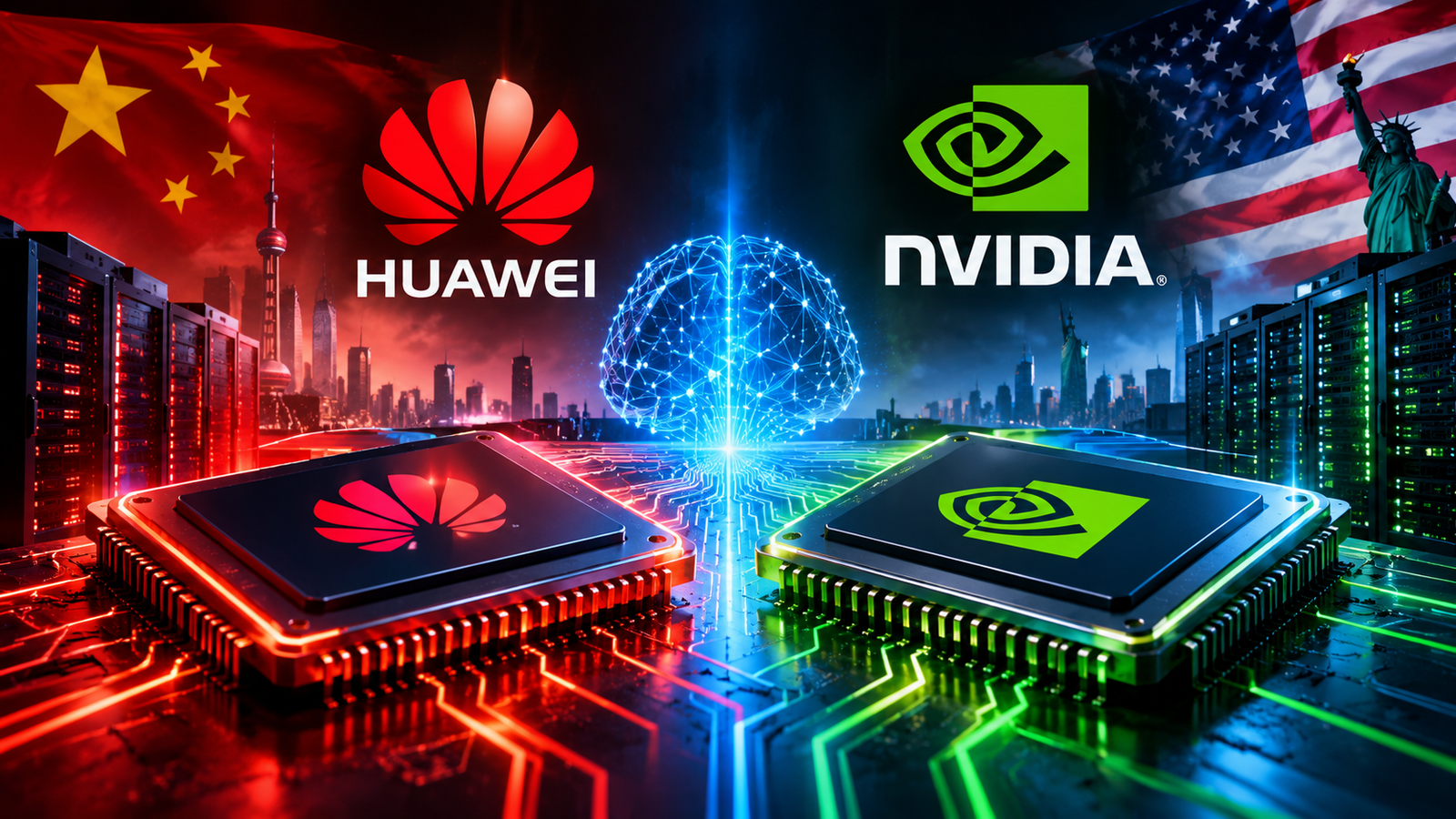
China’s Huawei is accelerating its AI chip ambitions. The company plans to launch two new processors in 2027 as it attempts to build a domestic alternative to Nvidia’s powerful AI computing ecosystem.
Huawei rotating chairman David Wang said the 960DT is scheduled for the first quarter of 2027, followed by the Ascend 960PR in the third quarter. The announcement comes as U.S. export restrictions continue to complicate China’s access to some advanced AI processors and semiconductor technology.
Huawei AI Chips Move Beyond the Processor
Huawei’s strategy is not simply about making faster chips. It is increasingly about connecting large numbers of them into a single computing system.
The company says its UnifiedBus technology is designed to allow AI processors to exchange data efficiently across large systems. Huawei has developed 11 semiconductors using the technology and says its future “superclusters” could connect as many as 1 million AI processors.
The company has already deployed more than 1,000 supernodes to over 370 customers, according to Wang. A supernode combines multiple AI processors so they can work on the same computing task.
That architecture matters because frontier AI models increasingly require computing power far beyond what a single accelerator can provide.
The Nvidia Problem
Huawei is attempting to close a gap with Nvidia, whose GPUs and CUDA software ecosystem remain deeply entrenched in global AI development.
U.S. export controls have pushed Chinese technology companies towards domestic alternatives. Washington has nevertheless allowed limited, case-by-case exports of Nvidia’s H200 and similar processors to approved Chinese customers under conditions introduced in January 2026.
The restrictions have also created a difficult supply environment inside China. Reuters reported in September that Huawei raised the indicative price of its Ascend 950DT accelerator above 250,000 yuan ($37,255), partly because of soaring high-bandwidth memory costs.
Huawei’s Bigger AI Bet
Huawei’s roadmap extends beyond the 960 series. The company has previously outlined an Ascend 970 generation and increasingly large AI clusters, including systems designed around hundreds of thousands of processors. Huawei has said its 960-generation systems could eventually scale to more than 1 million NPUs.
The significance of Huawei’s AI chip strategy is therefore broader than a single Nvidia rival.
China is trying to build an entire AI computing stack—from processors and high-speed interconnects to servers and software—capable of scaling without relying entirely on U.S. technology.
The race is no longer simply about who makes the fastest AI chip.
It is about who can build the largest, most efficient AI computing system around it.