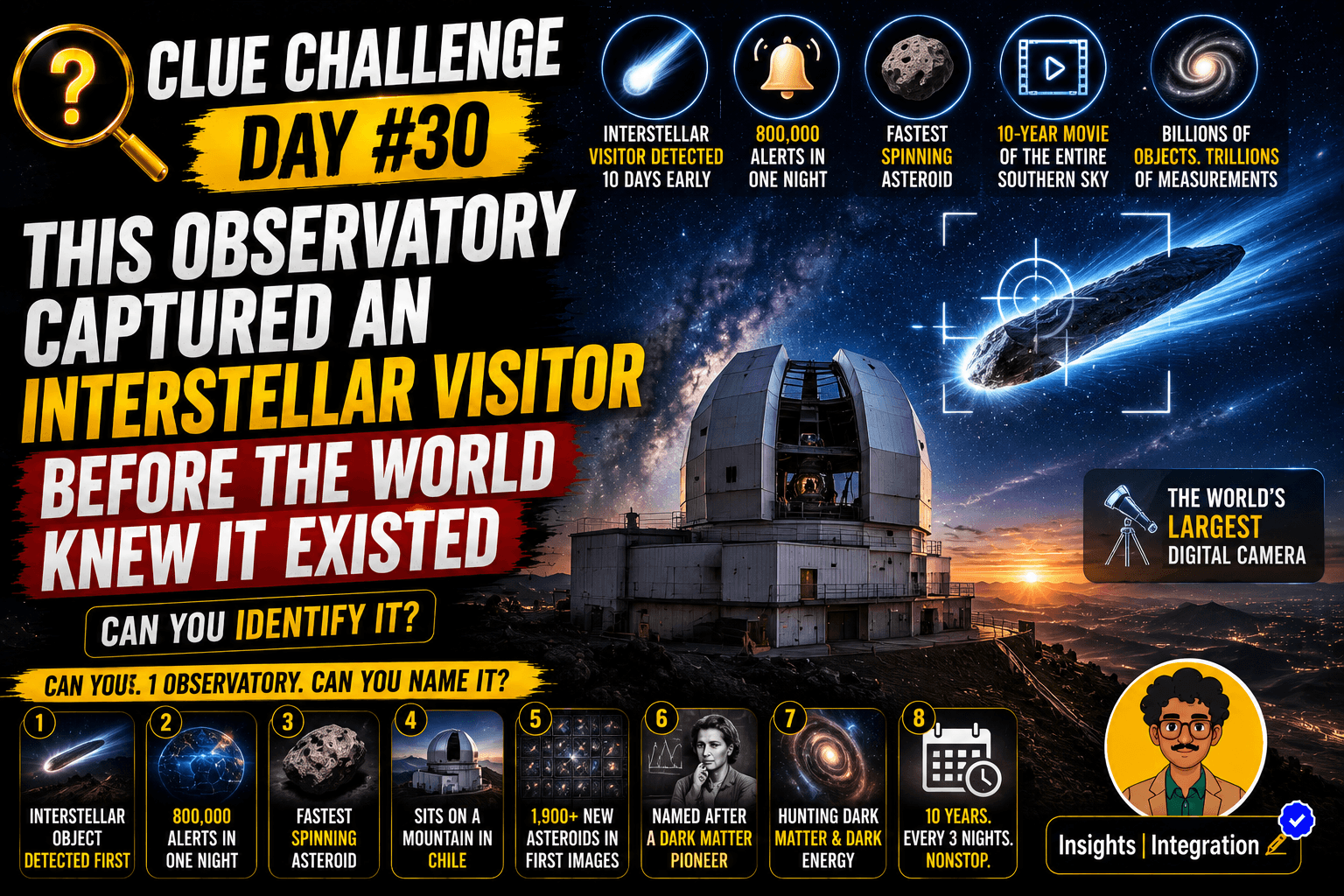
A daily puzzle for curious minds. One observatory. Eight clues pulled from one of the biggest science breakthroughs of 2025–2026.
A machine sitting high in the mountains of South America is quietly rewriting astronomy.
It carries the most powerful digital camera ever built for observing the night sky.
It can scan the entire southern sky every few nights.
It can detect exploding stars, dangerous asteroids, hidden galaxies, and mysterious objects arriving from outside our Solar System — sometimes before humanity even realizes they exist.
And scientists believe it may completely transform how humans observe the universe.
Can you identify it before the final clue?
Your Clues
Clue #1 — It Secretly Photographed an Object From Another Star System
In July 2025, astronomers announced the discovery of only the third confirmed interstellar object ever detected passing through our Solar System.
The object was named:
3I/ATLAS
But later researchers discovered something astonishing:
This observatory had already captured the object nearly 10 days earlier during routine sky scans — before anyone on Earth even knew it existed.
A visitor from another star system was hiding quietly inside archived images.
The machine had already seen it.
Clue #2 — It Fired 800,000 Cosmic Alerts in a Single Night
On February 24, 2026, observatories and research systems around the world suddenly received an avalanche of alerts.
Over:
- Asteroids
- Supernova explosions
- Variable stars
- Cosmic events
- Unusual changes in deep space
All automatically detected and distributed globally within minutes.
The number?
800,000 alerts in one night.
Scientists expect the system could eventually generate millions of alerts every night, making it one of the largest real-time astronomy systems ever built.
Clue #3 — It Found One of the Fastest-Spinning Giant Asteroids Ever Recorded
Using only a short observation period, astronomers identified an enormous asteroid rotating at astonishing speed.
The object — nearly twice the height of the Empire State Building — completes a full rotation in:
Just 1.88 minutes.
That made it the fastest-spinning known asteroid larger than 500 meters ever discovered.
And this came from only a tiny fraction of the observatory’s future data.
Clue #4 — It Is Creating a 10-Year Time-Lapse Movie of the Universe
The observatory sits high atop:
Cerro Pachón in Chile
One of the best astronomical locations on Earth because of:
- Dry air
- Stable atmosphere
- Extremely dark skies
- High elevation
From there, it will continuously scan the southern sky for an entire decade.
Its mission will generate:
- Around 500 petabytes of data
- Billions of celestial objects
- Trillions of measurements
Every few nights, the entire visible southern sky will be photographed again.
Scientists describe it as:
“A living movie of the universe.”
Clue #5 — Its First Images Shocked the Scientific Community
When its first official images were released in June 2025, astronomers worldwide were stunned.
The images revealed:
- Vast galaxy clusters
- Nebulae in extreme detail
- Previously unseen cosmic structures
- Nearly 2,000 newly discovered asteroids
The release instantly became one of the biggest astronomy stories of the year.
Many scientists called it:
A new era for observational astronomy.
Clue #6 — It Is Named After a Woman Who Helped Prove Dark Matter Exists
This observatory carries the name of a legendary astronomer whose research changed physics forever.
Her observations showed galaxies were rotating too fast for visible matter alone to explain.
That evidence helped establish the existence of:
Dark Matter
An invisible substance believed to make up most of the universe’s mass.
The observatory named in her honor became the first major US national observatory named after a woman.
Clue #7 — It Is Searching for Things Humanity Has Never Seen Before
The observatory’s mission goes far beyond photographing stars.
Its core scientific goals include studying:
- Dark matter
- Dark energy
- Interstellar objects
- Dangerous near-Earth asteroids
- Cosmic explosions
- Unknown transient phenomena
Scientists believe it may discover entirely new categories of astronomical objects never previously observed.
It is not just mapping the known universe.
It is searching for the unknown.
Clue #8 — Scientists Expect It to Detect Dozens More Interstellar Visitors
Researchers estimate this observatory could discover:
Between 5 and 50 interstellar objects
during its 10-year mission.
That means objects from distant star systems passing through our cosmic neighborhood may soon become routine discoveries rather than historic anomalies.
Thousands of citizen scientists worldwide are already helping analyze its data through public astronomy programs.
The age of real-time planetary-scale astronomy has officially begun.
Final Question
So — can you identify this revolutionary observatory that:
- Captured an interstellar object before its official discovery
- Carries the world’s largest astronomy camera
- Sends hundreds of thousands of alerts nightly
- Is building a 10-year movie of the universe
- Sits atop a Chilean mountain
- Is named after the astronomer who helped prove dark matter exists
Bonus Points If You Can Also Name:
- The Chilean mountain where it is located
- The interstellar object discovered in 2025
- The decade-long sky survey it is conducting
- The invisible cosmic phenomenon its namesake helped uncover
Drop your answer below before Day #31 arrives tomorrow.
Missed yesterday’s challenge?
Check it here → Clue Challenge Day #29: Sam Altman, Elon Musk & Ray Kurzweil Are All Warning About the Same Thing — Can You Name It?

Answer to Yesterday’s Challenge: DAY #29
(Click above to reveal)
Stay Connected
Hit subscribe on the bell icon or join the WhatsApp channel to get daily clue challenges instantly.
Because the next clue might just be the one you can solve faster than anyone else.