
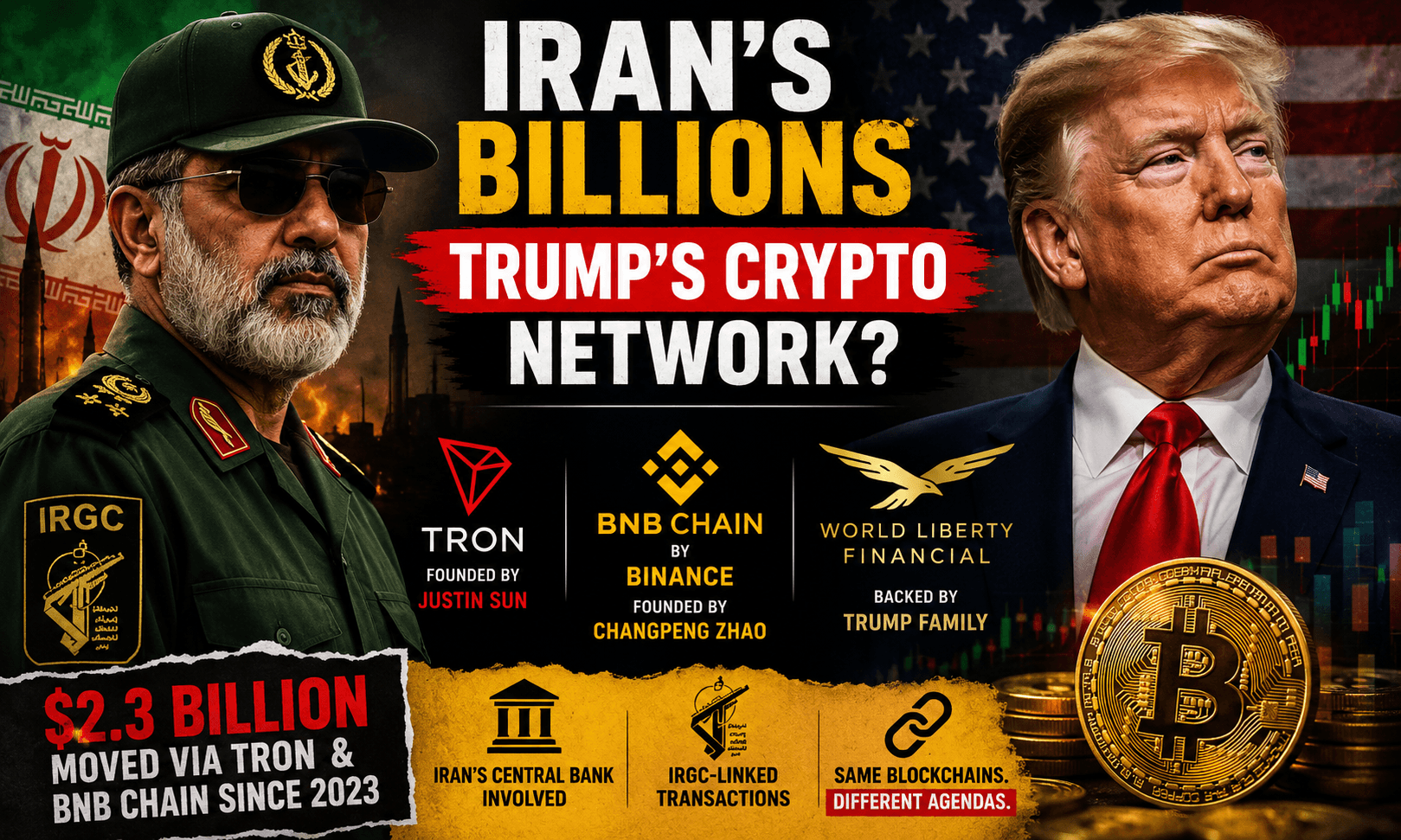
A Reuters investigation revealed that Iran’s largest crypto exchange, Nobitex, processed at least $2.3 billion through the Tron blockchain and another $317 million through BNB Chain since 2023.
The significance goes beyond crypto.
Both blockchain networks are closely tied to major supporters of World Liberty Financial — the Trump family’s flagship crypto venture.
What is Nobitex ?
Nobitex Iran’s largest crypto exchange; used by sanctioned Iranian central bank & IRGC. Processed $2.3B on Tron & BNB Chain since 2023.
The Key Numbers
According to blockchain data analyzed by Reuters using Arkham Intelligence:
- Nobitex processed at least $2.3 billion via Tron
- At least $317 million via BNB Chain
- Since the Iran conflict escalated in February 2026:
- $22.6 million moved through BNB Chain
- $550,000 moved through Tron
Reuters previously reported that Nobitex became a major financial channel inside Iran’s sanctions-resistant economy.
Its users allegedly included:
- Iran’s Central Bank
- the Islamic Revolutionary Guard Corps (IRGC)
- sanctioned financial entities
The U.S. sanctioned Iran’s central bank in 2019 for allegedly supporting the IRGC and Hezbollah.
Why Tron and BNB Chain Matter
Tron was founded by crypto billionaire Justin Sun.
BNB Chain was developed by Binance, founded by Changpeng Zhao (CZ).
Both Sun and Binance later became high-profile backers of World Liberty Financial, the crypto company co-founded by Donald Trump and his family.
Important distinction:
There is no evidence Trump or World Liberty Financial knew Nobitex was using these networks.
But the overlap creates a major political contradiction:
Blockchain infrastructure tied to Trump-aligned crypto figures was simultaneously being used by financial actors connected to sanctioned Iranian networks.
The Stablecoin Layer
The investigation also highlights the growing role of stablecoins in sanctions-resistant finance.
Iran’s central bank reportedly purchased more than $500 million worth of Tether (USDT) through Tron between November 2024 and June 2025, according to Elliptic and crypto analysts cited by Reuters.
Stablecoins matter because they:
- move faster than bank transfers
- operate globally
- bypass parts of the traditional banking system
- are harder to freeze in real time
Today, Tron processes one of the largest volumes of Tether transactions globally because of its:
- low transaction fees
- high transfer speed
- widespread adoption in emerging markets
The Trump Crypto Expansion
Since returning to office in 2025, Trump has aggressively embraced crypto.
The Trump family expanded into:
- stablecoins
- meme coins
- decentralized finance projects
- World Liberty Financial
Reuters previously reported that Trump-linked crypto ventures generated hundreds of millions of dollars in 2025 alone.
At the same time:
- U.S. regulators slowed enforcement actions against crypto firms
- the SEC settled fraud-related litigation against Justin Sun
- Trump later pardoned Binance founder CZ after his anti-money-laundering conviction
Legally, these events are separate.
Politically, the optics are explosive.
Why This Story Matters
This story exposes a larger structural reality:
Public blockchains are neutral infrastructure.
Unlike banks, they do not verify ideology, nationality, or geopolitics before processing transactions.
The same blockchain can simultaneously be used by:
- retail investors
- governments
- corporations
- sanctioned entities
- criminal networks
That creates a major challenge for modern sanctions policy.
For decades, U.S. financial power relied heavily on controlling access to dollar-based banking systems.
Crypto weakens that leverage by creating borderless financial rails outside traditional banking architecture.
The Bigger Shift
The Reuters investigation is not just about Trump or Iran.
It reflects a global transition where:
- geopolitics
- decentralized finance
- sanctions enforcement
- and digital infrastructure
are increasingly interconnected.
The core question is no longer whether crypto affects global politics.
It already does.
The real question is whether governments can regulate decentralized financial systems without fundamentally changing what made them decentralized in the first place.