
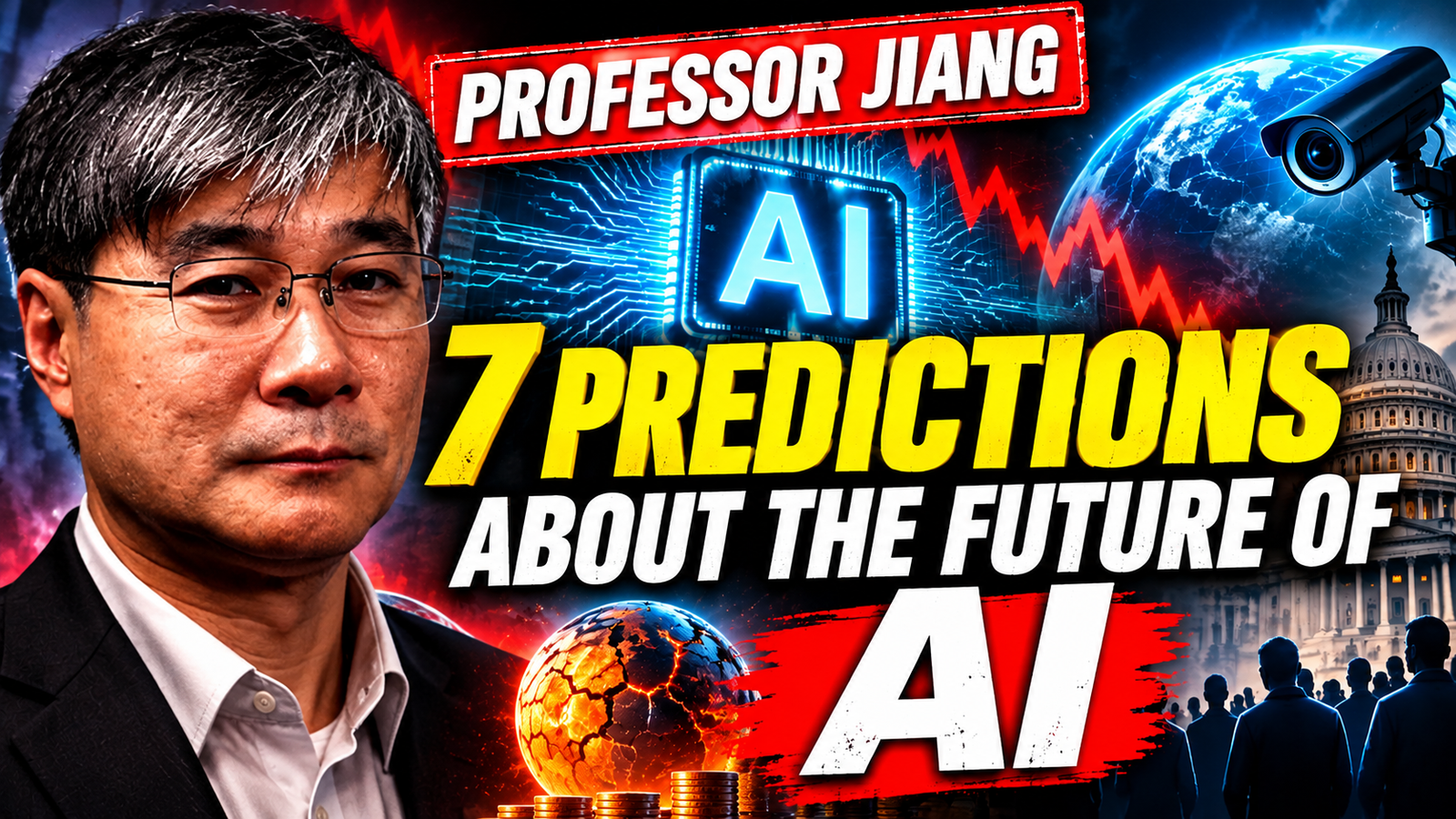
What happens if the artificial intelligence boom turns out to be one of the biggest investment bubbles in modern economic history? What if the billions being poured into AI infrastructure cannot generate the profits investors expect? And what happens when governments become financially tied to an industry that is too important to fail?
These are some of the questions raised by Professor Jiang, host of Predictive History, in his conversation with Robinson Erhardt.
Jiang presents a controversial outlook on the future of artificial intelligence, global finance and political power. His central argument is that the current AI investment boom is unsustainable, that its eventual collapse could force governments to intervene, and that this intervention could accelerate the development of an AI-powered surveillance system.
However, Jiang also makes an important distinction: he does not believe that the proposed AI control system will ultimately succeed.
He argues that global supply-chain weaknesses, human resistance and the arrogance of political and technological elites will eventually undermine the project.
So, what exactly does Professor Jiang predict? More importantly, why does he believe these developments are likely?
Let’s examine his major predictions and the reasoning behind each one.
1. Professor Jiang Predicts That the AI Bubble Will Eventually Burst
One of Jiang’s strongest predictions is that the enormous investment flowing into artificial intelligence will eventually become unsustainable.
His argument is not simply that AI technology is useless or that demand will disappear. Instead, he questions whether the financial expectations supporting the industry’s rapid expansion can realistically be fulfilled.
According to Jiang, AI companies and their investors are operating on the assumption that today’s enormous infrastructure investments will generate vastly greater financial returns in the future.
He uses a hypothetical example to explain the problem:
Imagine an AI company requiring approximately $1 trillion in computing infrastructure investment, while expecting that infrastructure to eventually generate $10 trillion in returns.
That expectation encourages investors, technology companies, semiconductor manufacturers and data-centre operators to commit enormous amounts of capital.
But what happens if the expected $10 trillion payday never materialises?
Jiang believes the entire investment structure becomes vulnerable.
Why does Professor Jiang think the AI bubble will burst?
He identifies several interconnected reasons:
1. Extremely high infrastructure costs: Building AI data centres requires enormous capital investment, advanced semiconductor chips, electricity, cooling systems and supporting infrastructure.
2. Uncertain profitability: AI companies still need sustainable business models capable of justifying their infrastructure spending and market valuations.
3. Increasing competition: Jiang argues that competing AI models, particularly open-source alternatives, make it harder for individual companies to maintain market dominance and charge premium prices.
4. Dependence on continued investment: The industry relies on investors continuing to believe that future AI revenues will justify today’s spending.
His concern is that once investors begin questioning those future returns, financing could become harder to obtain.
The result, in his view, could be a chain reaction across the AI investment ecosystem.
2. The AI Bubble Could Collapse Through a Liquidity Crisis
Jiang goes beyond predicting an ordinary technology-market correction. He argues that the AI investment boom is also dependent on the availability of excess global liquidity.
In other words, the industry needs a continuous flow of investment capital to sustain its expansion.
He specifically discusses the financial position of countries such as Saudi Arabia and Japan.
His argument is that international investors have substantial capital available for investment, and AI infrastructure has become one of the major destinations for that money.
However, geopolitical instability and energy-market disruptions could change those investment priorities.
Jiang uses the Iran conflict discussed in the interview as an example of a potential external shock.
His reasoning is straightforward:
- Saudi Arabia depends heavily on oil revenues.
- Japan depends heavily on imported energy to support its industrial economy.
- Major disruptions to global energy markets can place financial pressure on both countries.
- If these countries have less capital available for overseas investments, their ability or willingness to finance large AI projects could decline.
According to Jiang, reduced investment liquidity could expose the weaknesses in the AI financing structure.
His prediction: The AI bubble will eventually burst because the financial resources required to sustain its expansion will not remain available indefinitely.
This is a prediction about the vulnerability of the financing system, not simply the technological limitations of artificial intelligence.
3. AI Companies Could Receive Government Bailouts After the Crash
Perhaps one of Jiang’s most controversial economic predictions is what he believes will happen after the AI bubble bursts.
He argues that major AI companies may ultimately depend on government intervention to survive a financial collapse.
To explain this, he compares the potential situation to the financial crisis of 2008.
His reasoning is that AI infrastructure investment has become sufficiently interconnected with broader economic activity that a major collapse could create serious consequences beyond the technology sector.
If data-centre construction, semiconductor demand and related investment contribute significantly to economic growth, a sudden withdrawal of capital could create political pressure for government intervention.
Jiang suggests that governments could respond by:
- Providing financial support to struggling AI companies.
- Taking ownership stakes in important AI businesses.
- Nationalising or taking control of strategic data-centre infrastructure.
- Shifting some of the financial burden from private investors to taxpayers.
He describes the potential outcome as a system in which private companies retain much of the financial upside while taxpayers absorb a substantial portion of the losses.
This is the familiar economic debate about privatising profits while socialising losses.
Why does Jiang believe governments would intervene?
His argument is based on the strategic importance of AI infrastructure.
If governments consider AI essential to national security, economic competitiveness and technological leadership, allowing the entire industry to collapse could become politically unacceptable.
In that scenario, Jiang believes government intervention could become the mechanism through which the industry survives.
It is important to note that this is Jiang’s projected scenario, not an established government policy or a confirmed future bailout.
4. Professor Jiang Predicts the Expansion of an AI-Powered Surveillance State
This is arguably the most significant political prediction in the interview.
Jiang believes that government intervention in the AI industry could eventually accelerate the development of what he calls an AI control grid.
He describes a future in which artificial intelligence, digital identification and digital financial systems become increasingly integrated into everyday life.
According to his theory, the objective would be to collect and analyse information about individuals on a scale that has never previously been possible.
He specifically mentions the potential combination of:
- Digital identity systems.
- Digital currencies.
- Personal health information.
- Education records.
- Employment histories.
- Consumer purchasing behaviour.
- Social relationships and behavioural patterns.
Jiang argues that combining these information sources could allow institutions to develop increasingly detailed profiles of individuals.
The result, in his view, would be a society in which AI systems could monitor, analyse and potentially influence human behaviour.
Why does Jiang believe digital ID and AI are connected?
His reasoning is that digital identity could make it easier to connect information belonging to the same individual across different services and institutions.
For example, information about someone’s employment, purchases, education and health could theoretically contribute to a more comprehensive digital profile.
Jiang believes such a system could make behavioural prediction and surveillance substantially more powerful.
He also argues that advertisers could benefit from access to increasingly detailed information about consumers.
His concern is that technology initially introduced for convenience, efficiency and personalisation could eventually become part of a much broader system of behavioural monitoring.
His prediction: AI, digital identity and digital financial infrastructure could gradually converge into a powerful surveillance system.
This is a warning about the potential consequences of technological integration, rather than proof that a coordinated global surveillance programme is already being implemented.
5. AI Could Eventually Predict Human Behaviour Before People Make Decisions
Another important part of Jiang’s argument concerns the ability of artificial intelligence to predict individual behaviour.
He believes that people are far more predictable than they generally realise.
During the conversation, he identifies two major categories of information that could help predict someone’s future actions:
- Their previous behaviour.
- The behaviour of their friends and social circle.
His explanation is rooted in the influence of social relationships.
People are social creatures. Their decisions are frequently shaped by family, friends, professional environments and the communities in which they live.
Jiang argues that if an AI system has enough information about someone’s personal history and social environment, it could make increasingly accurate predictions about that person’s future decisions.
For example, purchasing patterns, lifestyle choices, political preferences and other behaviours could potentially be analysed through large-scale data processing.
Why does Jiang think social connections matter?
His argument is that people often adapt their behaviour to remain accepted by their social groups.
He discusses how social relationships can influence lifestyle choices, including health-related behaviour.
From his perspective, understanding someone’s social network provides additional information about the pressures and influences shaping their decisions.
He takes this argument further by suggesting that sufficiently comprehensive behavioural information could allow systems to predict how individuals might behave over decades.
That is a particularly ambitious claim.
Predictive algorithms can identify patterns and estimate probabilities, but knowing someone’s past behaviour and social connections does not establish that their decisions over the next 50 years can be predicted accurately.
Nevertheless, Jiang raises an important question: What happens when companies and governments have enough personal information to anticipate our behaviour before we consciously make certain decisions?
6. AI Could Become a Tool for Population Management Rather Than Just Productivity
Jiang’s broader theory is that the ambitions surrounding AI extend beyond making businesses more efficient.
He argues that certain technological and political elites want to create a more organised, predictable and controlled society.
To explain this, he draws a comparison with the modern education system and what he calls the meritocracy.
According to Jiang, the meritocratic system was an earlier attempt to shape society by identifying talented individuals, educating them at elite institutions and allowing them to influence the wider population.
He believes this approach failed to produce the desired level of social conformity and control.
His theory is that AI could become the next experiment.
Imagine an individual growing up with an AI assistant that constantly provides recommendations about health, education, work, relationships and personal behaviour.
Such an AI system could encourage people to exercise, eat healthier food, follow rules, become more productive and avoid behaviours considered undesirable.
Jiang argues that if AI becomes a permanent part of everyday life, it could influence human behaviour far more directly than traditional institutions.
Why does Jiang think AI could be used this way?
His reasoning is based on the ability of AI systems to operate continuously across different areas of life.
Unlike a traditional school, workplace or government department, a personal AI assistant could potentially remain involved in someone’s decisions throughout the day.
Jiang believes this creates the possibility of a society in which behavioural guidance becomes continuous rather than occasional.
His concern is that a technology marketed as a helpful personal assistant could eventually become an instrument for influencing how people think and behave.
This remains a speculative interpretation of the intentions behind AI development, not an established fact about the motivations of AI companies.
7. Jiang Believes AI Companies May Benefit From Making AI Seem More Powerful Than It Really Is
One of the more unusual arguments in the interview is Jiang’s belief that the public perception of AI could be as important as its actual technical capabilities.
He questions the tendency to describe AI as an independent intelligence capable of acting beyond human control.
He argues that AI companies benefit when people believe their technology is exceptionally powerful, potentially even approaching something resembling an independent or omniscient entity.
Why?
Because public belief in the technology’s power can encourage greater adoption, investment and dependence.
Jiang suggests that the more people trust AI systems to make decisions, provide guidance and solve problems, the more influence those systems could acquire over everyday life.
He connects this idea to the commercial incentives of AI companies.
If people become dependent on AI assistants, those companies could potentially gain access to enormous amounts of personal information and behavioural data.
Is Jiang claiming that AI is actually supernatural?
His argument moves into much more controversial territory here.
He discusses Freemasonry, Kabbalah, the occult and the idea that certain elites view technology as a way to transform or redeem humanity.
He also references comments attributed to an anonymous former OpenAI executive in a New Yorker investigation, describing AI infrastructure as building portals through which aliens were supposedly being summoned.
Jiang interprets the terminology and comments through an occult framework.
However, the interviewer challenges this interpretation, arguing that the reference to aliens could be metaphorical language about advanced non-human intelligence rather than evidence of supernatural activity.
The distinction matters.
The interview does not establish that AI executives are summoning demons or pursuing supernatural objectives. These are Jiang’s controversial interpretations, and the evidence presented in the conversation does not independently verify them.
The more grounded question is whether companies can use public perceptions of AI’s power to increase consumer dependence and commercial influence.
8. Professor Jiang Predicts That the AI Control Grid Will Ultimately Fail
Here is where Jiang’s argument takes an interesting turn.
Although he predicts that governments and technology companies could attempt to establish an AI-powered surveillance system, he does not believe they will ultimately succeed.
He identifies three major reasons.
Reason 1: Global supply chains will limit AI expansion
Jiang argues that AI is dependent on physical infrastructure.
Software may be developed digitally, but the computing systems that run it require semiconductor chips, electricity, specialised materials and complex manufacturing networks.
He highlights the international supply chains involved in semiconductor production and the importance of materials such as silicon, gallium, germanium, lithium and copper.
His concern is that geopolitical tensions or disruptions to international trade could restrict access to these materials.
If critical supply chains break down, building additional data centres and expanding computing capacity could become significantly more difficult.
His prediction: The physical limitations of global manufacturing and resource availability will eventually constrain the expansion of AI infrastructure.
Reason 2: Human beings will resist attempts at technological control
Jiang’s second argument is based on historical patterns of resistance.
He believes that whenever powerful institutions attempt to impose excessive control over populations, people eventually find ways to resist.
He argues that human creativity, innovation and adaptability cannot be eliminated through technological advancement.
To illustrate this, he refers to asymmetric warfare in the Middle East, where relatively inexpensive technologies and unconventional strategies can challenge much more sophisticated military systems.
He applies the same logic to AI.
Even if governments and technology companies develop sophisticated surveillance systems, individuals and communities could find ways to bypass, challenge or undermine them.
His prediction: Resistance to technological control will prevent the complete establishment of an AI control grid.
Reason 3: Elite arrogance will contribute to the system’s downfall
His third argument is psychological and political.
Jiang believes that powerful elites frequently overestimate their intelligence, competence and ability to control complex systems.
He refers to the Greek concept of hubris: excessive pride and arrogance that ultimately contribute to the downfall of powerful individuals and institutions.
According to Jiang, the people designing large-scale technological systems may underestimate the complexity of society and the unpredictable nature of human behaviour.
He argues that no matter how wealthy or influential technological elites become, they cannot completely eliminate uncertainty, resistance or unintended consequences.
His prediction: The arrogance of those attempting to control society will ultimately become one of the biggest obstacles to their ambitions.
9. Jiang Does Not Believe the AI Control Grid Will Be Established in Our Lifetime
This is one of the most important qualifications in his argument.
Jiang does not predict that an AI surveillance system will necessarily take complete control of society in the immediate future.
Instead, he suggests that attempts to develop such a system could continue, but that the resistance against it will prevent its full implementation within our lifetime.
He leaves open the possibility that similar ambitions could emerge in a more distant future.
His broader conclusion is that technological sophistication should not be confused with unlimited political power.
Even highly advanced systems depend on physical resources, economic stability, international cooperation and public acceptance.
And those dependencies create vulnerabilities.
For Jiang, the ultimate story is not the superiority of artificial intelligence but the resilience of humanity.
He argues that human freedom, imagination and ingenuity will remain powerful forces against attempts to impose excessive technological control.
What Are Professor Jiang’s Main Predictions? A Summary
The following table summarises the major forecasts and arguments presented during the interview.
| Prediction | Why Jiang believes it will happen |
|---|---|
| The AI bubble will burst | Infrastructure spending and expected future profits are unsustainable. |
| AI investment will face a liquidity crisis | The industry depends on continued investment and global capital flows. |
| Governments could bail out AI companies | AI infrastructure may become too economically important to allow a major collapse. |
| Digital surveillance will expand | AI, digital ID and financial infrastructure could enable extensive personal data collection. |
| AI will become a behavioural prediction tool | Personal history and social connections can reveal patterns in human behaviour. |
| AI could influence population behaviour | Continuous AI assistance could shape everyday decisions and social norms. |
| The AI control grid will ultimately fail | Supply-chain constraints, human resistance and elite arrogance will undermine it. |
| Complete AI control will not happen in our lifetime | Jiang believes resistance will be too strong for such a system to succeed in the foreseeable future. |
How Credible Are Professor Jiang’s Predictions?
It is important to separate Jiang’s economic and technological arguments from his more speculative claims.
His prediction about an AI investment correction raises legitimate economic questions. Massive infrastructure spending, uncertain returns, competition and dependence on financing are all important factors when evaluating the sustainability of the AI industry.
His concerns about data collection, digital identity and behavioural surveillance also raise significant questions about privacy, institutional power and individual freedom.
However, some of his claims go considerably further than the evidence presented in the interview.
For example, the suggestion that AI companies are pursuing an occult or supernatural agenda is not established by the conversation. Similarly, the claim that a person’s behaviour can be accurately predicted over the next 50 years from their personal history and social circle is much stronger than what the argument demonstrates.
His predictions should therefore be evaluated individually rather than accepted or rejected as one complete theory.
The interview itself also contains an important disagreement: Robinson Erhardt repeatedly challenges Jiang to distinguish between evidence, interpretation and speculation.
That disagreement makes the discussion particularly interesting because it highlights the difference between identifying genuine technological and economic risks and attributing hidden motives to the people developing the technology.
Final Thoughts: Is AI Leading Towards Economic Collapse or Greater Human Control?
Professor Jiang’s predictions present a connected scenario.
First, the AI industry expands through enormous investments in computing infrastructure. Then, according to his argument, the expected financial returns fail to justify the scale of investment, potentially triggering a major market correction.
Governments could intervene to protect strategically important infrastructure. That intervention could increase the integration of AI into public institutions, digital identity systems and surveillance capabilities.
But Jiang does not believe this process will result in permanent technological control over humanity.
He expects economic constraints, geopolitical instability, public resistance and the limitations of powerful elites to prevent the ultimate success of an AI control grid.
Whether these predictions prove correct remains to be seen.
But the questions behind them are worth examining: Can the AI industry generate enough real economic value to justify its enormous infrastructure costs? Who should control the digital systems increasingly embedded in everyday life? And how much personal freedom should society exchange for technological convenience and efficiency?
These are questions that extend far beyond artificial intelligence.
They concern the future relationship between technology, money, government and human freedom.
And that is ultimately what makes Professor Jiang’s predictions worth examining.
Frequently Asked Questions About Professor Jiang’s Predictions
What does Professor Jiang predict about artificial intelligence?
Professor Jiang predicts that the AI investment bubble will eventually burst, potentially forcing governments to rescue strategically important AI companies. He also warns that AI, digital identity and financial technology could contribute to an increasingly powerful surveillance system.
Why does Professor Jiang think the AI bubble will burst?
He believes AI companies are spending enormous amounts on data centres and computing infrastructure based on expectations of future profits that may never materialise. He also highlights dependence on global investment liquidity, international supply chains and continued investor confidence.
Does Professor Jiang predict an economic crisis caused by AI?
He argues that an AI investment collapse could create broader economic consequences because of the industry’s growing connection to infrastructure investment and economic activity. He suggests that governments could be forced to intervene.
Does Professor Jiang believe AI will create a surveillance state?
Yes. Jiang believes that AI combined with digital identity and digital financial infrastructure could enable extensive personal data collection, behavioural monitoring and government surveillance.
Does Professor Jiang believe AI will eventually control humanity?
Not completely. Although he warns about attempts to establish an AI-powered control system, he predicts that it will ultimately fail because of supply-chain limitations, human resistance and the arrogance of powerful elites.
Why does Professor Jiang think AI companies want to collect personal data?
He argues that detailed personal information could help companies predict consumer behaviour and create more effective advertising and commercial strategies. He also believes such information could give institutions greater influence over individuals.
Does Professor Jiang believe AI companies are involved in occult practices?
Jiang argues that certain ideas associated with Freemasonry, Kabbalah and the occult influence the thinking of some technological elites. However, the interview does not independently establish that AI executives are pursuing supernatural objectives.
Will AI surveillance become a reality in our lifetime, according to Jiang?
Jiang believes attempts to establish an AI control grid may continue, but he does not expect it to succeed within our lifetime. He considers human resistance and technological limitations major obstacles.
Note: This article summarises the arguments and predictions made by Professor Jiang during the interview. Predictions, interpretations and allegations are attributed to him and should not be treated as independently verified facts.
Credit: Robinson Erhardt and Predictive History